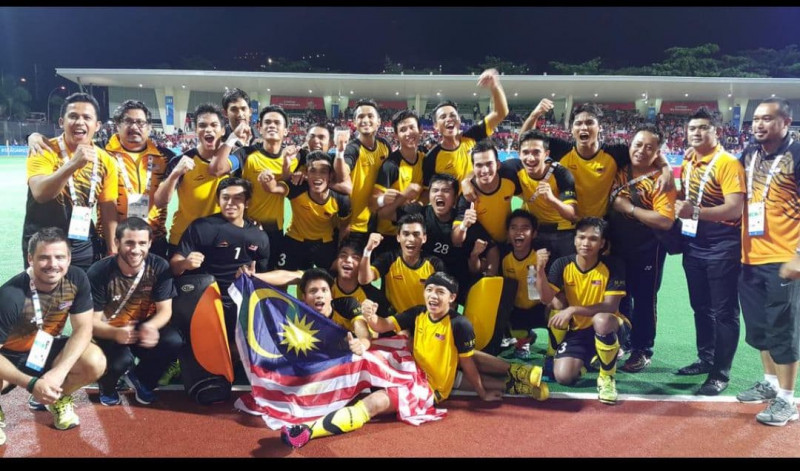


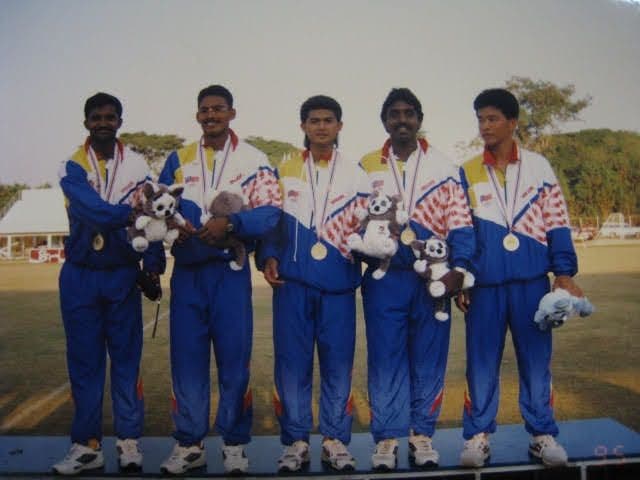
I AM exceptionally fortunate to say that I may well be the only hockey player ─ though I could be wrong ─ who has had the privilege of winning five gold medals in five Southeast Asian (SEA) Games, namely in 1993 (Singapore), 1995 (Chiang Mai), 1997 (Jakarta), 1999 (Brunei) and 2001 (Malaysia).
The SEA Games may not be as noteworthy as say, the Olympics, but I will always cherish the sweet memories it left me as much as its more prominent counterparts.
In these five editions, Malaysia was represented by either the A or B team, but more on this later.
Although the competition at the SEA Games may not be stiff ─ as Malaysia's hockey prowess far exceeds most Southeast Asian countries ─ not once did we underestimate what we were up against.
The only time Malaysia failed to win the gold at the SEA Games was in 1973 when the host nation, Singapore, defeated us by 1-0. The Malaysian team was represented by the B squad as the A-side was playing the World Cup in Amsterdam.
I made my SEA Games debut at the Singapore edition in 1993, where we were represented by the full senior squad under Australian coach, Terry Walsh. At the time, we were also preparing for the 1994 Sydney World Cup qualifier in Poznan.
Despite minimal competition, it was hard work just the same; there was no time for relaxation. Even on match days, we worked on our strength and fitness at the gymnasium in the mornings under the watchful eyes of our coach. As a result, our physicality improved, much to the benefit of the Poznan assignment.
As much as the workout had tired us out by the time we ended up on the pitch, we took it all in stride ─ since Walsh wanted us to play under such challenging conditions ─ and somehow managed to secure the gold in the end.
Although the B team ─ coached by Stephen van Huizen ─ was sent to Chiang Mai for the 1995 SEA Games, I was one of four players from the A team who were selected to beef up the squad.
Interestingly enough, since the tournament was played on grass, the other teams felt this was perhaps the best time to stun Malaysia. Unbeknownst to them, we did our homework prior to the tournament by training on the grass pitch at Universiti Pertanian Malaysia (now Universiti Putra Malaysia) in Serdang.
Furthermore, we had no problems as we used to play on grass in our schooling days. I, for one, enjoyed playing on it and had no problems in Chiang Mai.
Suffice to say, we won another gold medal in Thailand.
The 1997 edition in Jakarta had Malaysia send the A team with German Volker Knapp as coach. As the tournament was part of our preparation for the 1998 World Cup in Utrecht, Holland, we worked hard on our strength and fitness at the gymnasium ─ just like we did at the 1993 Games in Singapore.
Once again, we returned home with a gold medal.
In 1999, Malaysia sent the B team for the Brunei edition of the Games with Yahya Atan as coach and yours truly as captain for the first time.
While the rest of the team returned to Kuala Lumpur after playing for the senior side in a Four Nations tournament, I had to take a flight from London, along with goalkeeper Nasihin Nubli, forward M. Kaliswaran and S. Kuhan and to join the B team in Bandar Seri Begawan after playing for the senior side in a Four Nations tournament while the rest of the team returned to Kuala Lumpur.
Although we clinched the gold in Brunei, we had to face an ultra-defensive Singapore side that made for a difficult match even though we were the ones in control.
Despite several well-created opportunities to score, we were unable to follow through and had to resort to penalty corners to get the job done.
Fortunately, S. Kuhan managed to score from one of the penalty corners that I earned. In that instance, I informed him to make sure of a conversion and he did just that to secure our win.
Whenever the B team is sent to the Games, Kuhan and I would always be part of the selection; I earn the penalty corners and Kuhan flicks it home.
For the Brunei edition, goalkeeper Nasihin Nubli, forward M. Kaliswaran, S. Kuhan and myself had to take a flight from London to Bandar Seri Begawan to join the B team after playing for the senior side in a Four Nations tournament while the rest of the senior team returned to Kuala Lumpur.
Since we played host to the Games in 2001 and obviously, had to win the gold in front of our fans, Malaysia was represented by the A team under German coach Paul Lissek.
It was the first SEA Games of the 21st century when yet again, I captained the side that won Malaysia another gold medal.
The Kuala Lumpur edition proved to be the sweetest of my SEA Games’ memories as Malaysia would emerge overall champions of the Games with 111 gold medals, ahead of Thailand’s second-place finish of 103 medals.
To this day, Malaysia continues to be a hockey powerhouse in Southeast Asia.
At times, hockey will not be contested in the SEA Games when nations, such as the Philippines and Vietnam, play host to the tournaments as there isn’t much interest for the game in those respective countries.
In the near future, it would be great to see the rest of the Southeast Asian nations, especially Singapore, Thailand and Indonesia, improve their game.
Perhaps, the Asian Hockey Federation (AHF) could plan development programmes to help these ASEAN countries achieve a greater level of performance.
These countries need to play as many competitive matches as possible to improve. As it stands now, they only get to compete once every two years at the SEA Games, provided that hockey is actually contested during those instances.
Perhaps, a biennial tournament should be introduced amongst the Asean nations so that they have a chance to get better by playing more competitive matches.
Malaysia can be represented by the National Juniors.
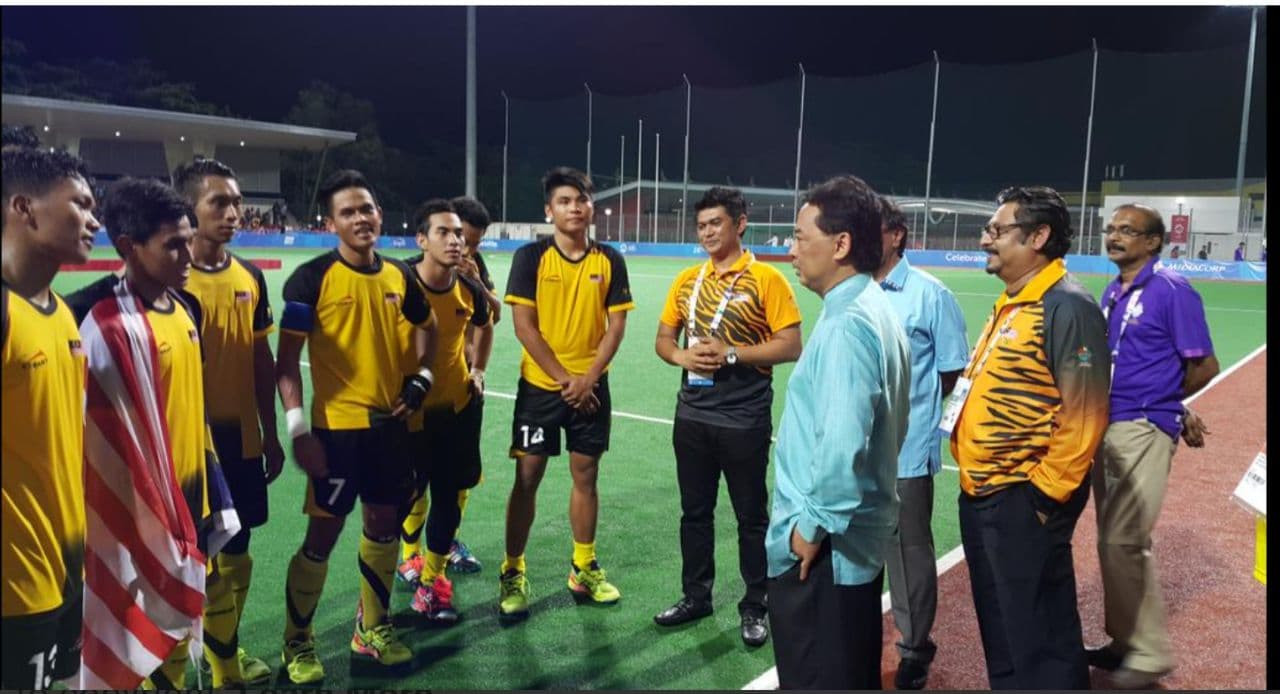
Coincidentally, when I was the manager, we did send our National Juniors with Arul Selvaraj as the coach to the 2015 SEA Games in Singapore and despite their youth, Malaysia still won the gold because of this huge gap in standards.
For the record, there was once this tournament called the Asean Cup, which was held in Bangkok in 2009, where the Under-18 side that represented Malaysia, which was also the Project 2013 side, emerged as champions after defeating Singapore; this happened while I was project manager and K.Dharmaraj was the team’s coach.
Anyway, some of the Asean countries are now pushing hard for indoor hockey to be included in the SEA Games because compared to field hockey, they feel they have a better chance of winning the gold.
All said and done, it would be nice to see another Asean country competing in the Olympics or the World Cup.
Until next week, stay safe, everyone. ─ The Vibes, 5 February, 2021



_Sukan_SEA_ke-32_Kemboja_mengadakan_lawatan_berjumpa_atlet_dan_jurulatih_cambodia_sea_games_-_SYEDA_IMRAN_-_2.jpg)