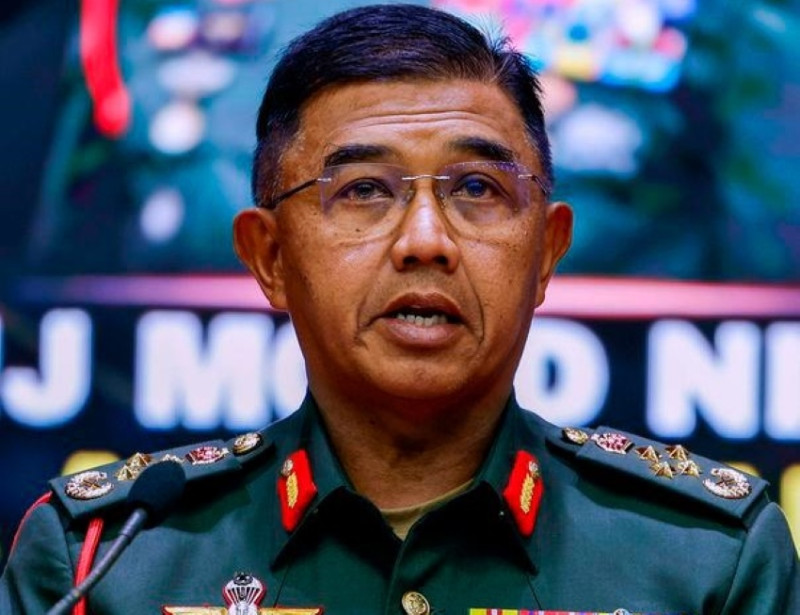
THE Commander of the Malaysian Armed Forces (ATM), General Tan Sri Mohd Nizam Jaffar, has issued a stern warning against corruption and undue influence within the military’s procurement system, vowing to eliminate any “cartel” if one is proven to exist.
“If a cartel exists, show them to me, and I will destroy them,” he said in a forthright interview with Harian Metro on Sunday, pushing back against claims of internal rot. “This is my fight – to eliminate cartel influence within the ATM.”
The general’s strong words come amid mounting public scrutiny over the purchase of military assets—whether traditional platforms like fighter jets and helicopters, or future-facing systems such as drones and UAVs. Concerns have been intensified by royal censure, notably from the Yang di-Pertuan Agong, Sultan Ibrahim, regarding questionable defence acquisitions.
Procurement Must Serve National Interest
Speaking from the Ministry of Defence (MINDEF), General Nizam outlined ATM’s multilayered procurement process, emphasising that every acquisition must address strategic needs, financial limitations, and long-term returns.
“There are key considerations before any purchase: whether the asset fits our layered defence strategy, its cost versus value, maintenance implications, and cost-effectiveness,” he explained. “We don’t just look at price tags—we assess what strategic benefit it brings to Malaysia.”
He added that decisions are weighed carefully to ensure assets contribute meaningfully to national security. “Suppliers naturally want profit, but our priority is national interest.”
Second-Hand Equipment: ‘Misplaced Perceptions’
The general was unequivocal in defending the ATM’s decision to acquire refurbished, second-hand equipment when necessary.
“The idea that second-hand equals unsuitable is a misconception,” he said. “If an asset, once refurbished, can serve another 15 years effectively and meets our strategic needs, why shouldn’t we consider it?”
He stressed that such decisions are never taken lightly. “We have a technical committee that evaluates everything thoroughly. We test, we validate, and only then do we proceed with procurement.”
Responding to the King’s Rebuke
General Nizam also addressed Sultan Ibrahim’s directive to cancel the procurement of outdated Black Hawk helicopters, acknowledging that the royal intervention was “valid and long-standing.”
“The original contract was cancelled as soon as the supplier failed to deliver. Tuanku had already issued his reprimand back then,” he noted. “The following tender had different specifications, and we did not proceed with it. Tuanku, as our Field Marshal and Supreme Commander, keeps us in check—rightly so.”
‘Not All Former Officers Are Corrupt’
Touching on the sensitive topic of alleged internal 'cables' or insiders influencing defence deals, General Nizam clarified that many of these individuals are retired officers returning to serve the defence industry.
“Just because a former general works in the defence sector doesn’t mean there’s a conflict of interest. Should we expect all retired officers to become farmers?” he questioned. “These individuals bring value and expertise.”
Still, he acknowledged the possibility of malpractice. “In every bunch of coconuts, there’s always one bad one. But that doesn’t mean the whole system is rotten.”
A Battle Against Misrepresentation
Beyond internal issues, General Nizam expressed frustration with what he described as “character assassinations” conducted through media channels.
“Tuanku’s message was clear. Unfortunately, some twisted it disgracefully. These people are the true traitors,” he said, calling on media and the public to engage responsibly with matters of national defence.
On National Readiness and Strategic Outlook
Assessing the country’s military readiness, General Nizam placed Malaysia’s defence preparedness at “seven out of ten”, attributing gaps to resource limitations rather than lack of strategy.
“Readiness isn't just about gear—it includes infrastructure, manpower, and operational capacity,” he said. “When combined, these form our true preparedness.”
Sabah and Sarawak: Growing Military Footprint
On East Malaysia, General Nizam revealed strategic expansion plans, albeit within budget constraints.
“We can’t mirror the Peninsula’s setup exactly—it would cost too much. But we are moving in phases,” he shared. “This includes building a naval base in Kuching and relocating a mechanised battalion to Sabah.”
He affirmed that ATM’s core doctrine remains that of deterrence. “We don’t build to attack. We build to protect.”
Public Perception and the Budget Reality
Despite growing public awareness about defence, General Nizam stressed the importance of understanding budgetary limitations.
“With what we’re allocated, we have to choose—A, B, C, or D. We can’t have everything,” he said. “Still, I appreciate that the people are concerned. Even if some act like ‘military experts,’ the awareness itself is good.”
Revolution in Military Affairs (RMA): The Future of ATM
Looking ahead, General Nizam announced a major strategy review to take place this November—a national-level *Revolution in Military Affairs (RMA)* session to reevaluate defence doctrine and procurement frameworks.
“The RMA session will reassess everything—from structure to asset needs—based on current geopolitical developments, from Iran-Israel to Ukraine-Russia,” he revealed. “This is about future-proofing our armed forces.”
On Border Security and National Sovereignty
ATM’s role in managing porous borders was also underscored, with General Nizam noting the deployment of 20,000 to 40,000 personnel annually to intercept illegal activities.
“We’re not idealists—smuggling and infiltration happen even in countries like the US with all their tech,” he noted. “Our job is to plug the gaps wherever we can. But no, one incident—such as the arrest of five officers—won’t bring the nation to its knees.”
Final Word: Accountability, Not Complacency
The general concluded by reinforcing his stance on accountability within the force.
“If there is proof of wrongdoing, especially by our own people, they will face the full weight of the law. As Tuanku said, there can be no compromise on this.”
With a clear commitment to reform, readiness, and resilience, General Nizam positions the ATM not just as a defence force—but as a national institution that evolves with the times, anchored in integrity and driven by duty. - August 24, 2025