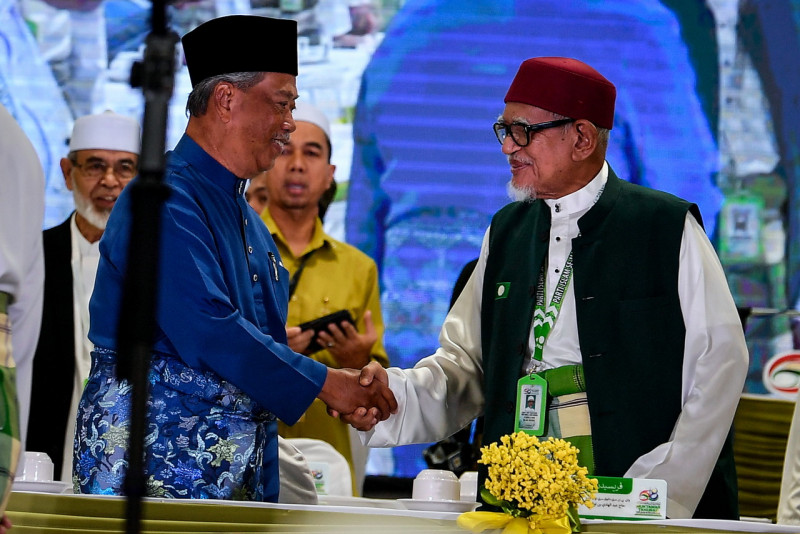
THE forthcoming state elections in Johor and Negri Sembilan are increasingly being viewed as a defining moment for Malaysia's opposition movement following PAS's decision to terminate political cooperation with Bersatu, a development that has thrown the future of Perikatan Nasional (PN) into unprecedented uncertainty.
What began as a breakdown in relations between the coalition's two principal pillars is now raising the prospect of a fragmented opposition front, competing electoral strategies and a struggle for influence within the anti-government camp.
Political observers believe the key question is no longer whether PAS and Bersatu can continue sharing the same political platform, but whether they can avoid turning into direct competitors at the ballot box.
Professor Datuk Dr Sivamurugan Pandian of Universiti Sains Malaysia said the possibility of both parties contesting separately remains a realistic scenario if efforts to forge a new political understanding fail.
“The possibility of PAS and Bersatu contesting separately cannot be ruled out. If no new political understanding is reached, both parties may prefer to protect their own interests rather than compromise,” he said.
According to Sivamurugan, the crisis facing PN extends beyond symbolism and strikes at the operational foundations that hold political coalitions together.
“A political coalition depends not only on a common logo but also on seat negotiations, campaign machinery and a shared narrative.
“Without these, the Perikatan brand risks becoming symbolic rather than functional. I think they will have to refer to the coalition’s constitution to deal with this situation.
“Unless there is a last-minute reconciliation or a restructuring of Perikatan, we may see the two parties contest under their respective party symbols or through a new electoral arrangement.”
The analyst warned that any breakdown in opposition coordination would likely benefit rival political blocs by splitting votes and weakening campaign cohesion.
“The PAS-Bersatu split weakens the cohesion of the opposition bloc and creates uncertainty over the future of Perikatan,” he said.
The concerns are shared by Universiti Teknologi MARA political scientist Mujibu Abd Muis, who described PAS's decision as a watershed moment that could fundamentally alter opposition politics in Malaysia.
Rather than viewing the dispute as a temporary disagreement, Mujibu characterised it as a structural rupture involving two parties whose partnership had previously underpinned PN's electoral strength.
“This shift from internal tension to a structural political rupture is significant. PAS-Bersatu cooperation had been crucial for opposition consolidation under the Perikatan framework.
“Their alliance provided ideological consistency and grassroots machinery for PAS, while Bersatu offered leadership visibility and institutional reach,” he said.
With Johor and Negri Sembilan expected to head to the polls in the coming months, Mujibu believes the elections will reveal whether electoral pragmatism can survive political separation.
“A more nuanced possibility is that both parties may no longer cooperate politically at the national level. They may still negotiate limited seat understandings in selected constituencies based on local strengths.
“In coalition politics, institutional divorce does not always eliminate tactical cooperation on the ground.
“Whether they fully separate depends on whether the parties prioritise organisational independence or electoral survival.”
Beyond the immediate electoral implications, analysts also see the split as potentially opening the door to broader political restructuring involving new alliances and shifting centres of influence within the opposition.
Universiti Teknologi Malaysia political analyst Dr Mazlan Ali said attention is now focused on PAS's long-term strategic direction and whether the party will ultimately remain within PN or pursue an alternative political path.
He suggested that PAS could explore new alignments involving former Bersatu deputy president Datuk Seri Hamzah Zainudin and parliamentarians aligned with him, potentially creating a fresh opposition configuration.
“PAS is also said to be courting Umno to revive a Muafakat Nasional 2.0 arrangement, which remains one of its key objectives,” Mazlan said.
The remarks underscore growing speculation that the PAS-Bersatu split may represent not merely the collapse of a partnership but the beginning of a broader reordering of Malaysia's political landscape.
As Johor and Negri Sembilan prepare for elections, the contests are rapidly evolving into more than state-level battles. They are becoming a high-stakes test of whether Perikatan Nasional can remain relevant after its internal fracture, whether PAS and Bersatu can coexist without cooperation, and which political force will emerge strongest from the most significant opposition upheaval in recent years. - June 10, 2026