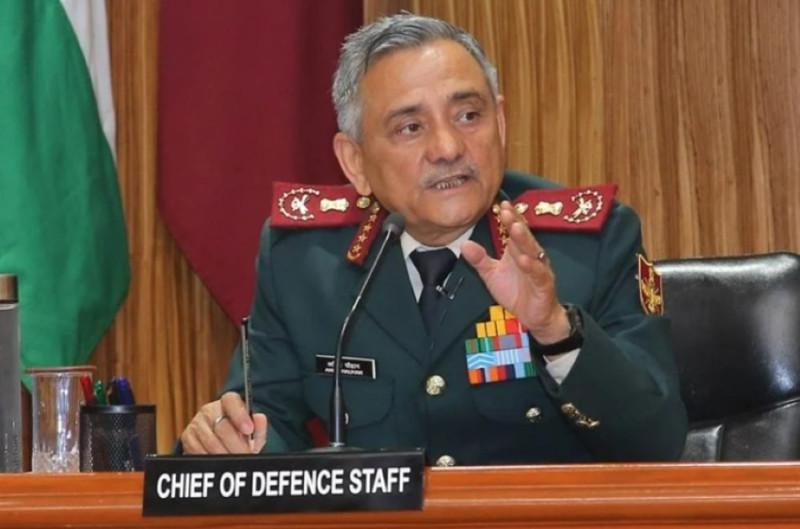
INDIA’s Chief of Defence Staff General Anil Chauhan saying on Tuesday that Pakistan wanted to bring India “to its knees in 48 hours” with Operation Bunyan al-Marsoos on May 10, but the attacks “folded up in 8 hours” after which Pakistan “picked up the telephone and said they wanted to talk.” General Anil Chauhan
The Indian Express cited General Chauhan making these remarks while delivering a lecture on ‘Future Wars and Warfare’ at the Savitribai Phule Pune University.
Detailing the Pakistani response to Operation Sindoor, General Chauhan said Operation Bunyan al-Marsoos was “launched by Pakistan on 10th of May at about 1 am” and “its aim was to get India down to its knees in 48 hours. Multiple attacks were launched”.
He said although India had actually hit only terror targets, the Pakistanis “escalated this conflict… into the military domain”.
Stating that armed forces are the most rational actors in conflict situations, he explained why Pakistan called India.
“I think that the rationale behind this… realisation coming in… stemmed from two facts. One is that they must have assumed that if they continued this mode, they are likely to lose much more.
“Hence, they picked up the telephone. And second, since they had struck us at multiple fronts, they still did not have the benefit of understanding what they had struck. So, they must have thought they must have struck and, hence, they would like to talk now. And if they don’t, they will tend to lose more.”
Later, after a couple of days, Pakistan must have realised that their attacks had failed, he said. “So, these were the two factors which would have made them think. But it’s only after, say, one or two days, they would have realised that all… the kind of attacks they had launched against us were not fortified and they had all kind of failed.”
Responding to a student’s question on the losses faced by Pakistan during the hostilities, General Chauhan said, “When I was asked about losses on our side, I said these are not important. The results and how you act are important. So, it would not be very correct to talk about the losses, numbers etc.”
“You see, in a match, suppose you go into a football match and you win 3-2… that’s an even-sided match. But suppose you go into a cricket test match and win by an innings, then there is no question of how many wickets and how many balls and how many players. It’s an innings (victory),” he said.
“But since there is always this inquisitiveness as to the results of your strikes… At some point of time, we will take out this particular data, and share it, to answer the queries and inquisitiveness of people… who keep asking ‘How many aircraft did we destroy? How many radars did we destroy?’ We will make a rough assessment of that and come out with that shortly,” he said.
He said the government’s objective behind Operation Sindoor was not retribution but to draw the limits of tolerance with Pakistan. “Let me talk about reason… Operation Sindoor, as far as the government is concerned, was not about retribution. I think it was about drawing these limits of tolerance… This state-sponsored terrorism from Pakistan had to stop, and Pakistan should not be able to hold India hostage to terror activities.”
Another point made by the operation was that India was not going to live under the shadow of terror and nuclear blackmail, he said.
He also spoke about the emotions of India’s citizens. “The emotion… among the people of India was revenge and retribution… and to get the perpetrators to justice. That I think was playing in everyone’s mind, that is the kind of emotion and public sentiment that was happening. And at the end of it, there was probably some sort of satisfaction, (and also) anxiety. Anxiety during the operation.”
On the risks involved during military operations, he said, “You can’t be 100 per cent prepared for every kind of contingency and you can’t have 100 per cent of the information about that.
“So, you are always groping a bit in the dark when you are carrying out military operations. In every military operation, there is an element of risk involved. The only thing is that it should be a calculated kind of a risk.”
“In a war, even if there are setbacks, we have to adapt, understand what went wrong and go out again.” He said as an organisation, one must have an offensive spirit. “That’s why I said in a couple of my interviews that losses are not important, the outcome is,” he said. - June 4, 2025