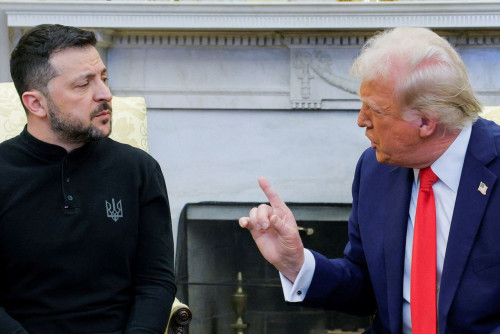
U.S. President Donald Trump has the so-called 'BRIC' group of nations directly in his trade war crosshairs, slapping super-high tariffs on imports from Brazil and India, and accusing them of pursuing "anti-American" policies.
Reuters reported that Washington's relations with Brasilia and New Delhi have sunk to new lows. But this belligerence could backfire.
The White House said on Wednesday that it will impose an additional 25% tariff on goods from India, citing New Delhi's continued imports of Russian oil. That brings the levy on most goods to 50%, among the highest rate faced by any U.S. trading partner.
Brazil also faces 50% tariffs on many of its U.S.-bound exports, not because of trade imbalances, but because of Trump's anger at what he calls a "witch hunt" against his ally, Brazil's former President Jair Bolsonaro, who has been charged with plotting a coup following his election loss in 2022.
This breakdown in relations could be Trump's intention: push these countries to the brink so that they'll agree to trade deals that are heavily lopsided in Washington's favor. That strategy seemed to work with Japan and the European Union.
But hitting these 'BRICS' economies with eye-watering tariffs could push them closer together, strengthening the resolve of a group that appeared to be losing whatever momentum, purpose and unity it had.
The 50% Club
The original BRIC nations - Brazil, Russia, India and China - held their first summit in 2009, eight years after former Goldman Sachs economist Jim O'Neill coined the acronym for this group of emerging economies he said would challenge the G7 group of rich countries in the future.
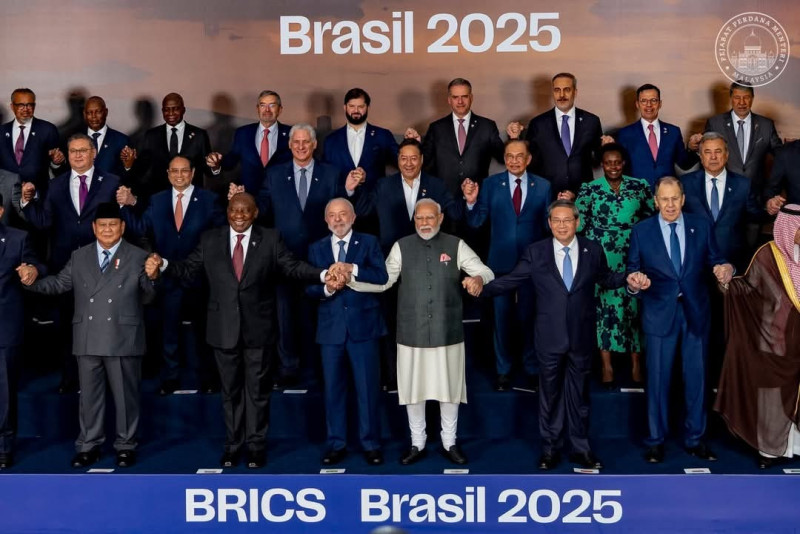
South Africa became the 'S' in BRICS two years later, and the club now comprises 11 countries including Indonesia, Iran and Saudi Arabia, as well as a further nine 'partner' countries including Malaysia, Nigeria, and Thailand.
It was always a disparate group - geographically, economically, culturally, and politically - meaning its cohesiveness has always been questionable. Its relations have sometimes been rocky, particularly among its largest members.
That's why it was so notable when Indian Prime Minister Narendra Modi on Wednesday announced that he will visit China for the first time in over seven years. This could be a sign that rising tensions with Washington are helping to thaw frosty ties between New Delhi and Beijing.
Also on Wednesday, Brazil's President Luiz Inacio Lula da Silva told Reuters that he plans to call the leaders of India and China to discuss a joint BRICS response to Trump's tariffs.
"I'm going to try to discuss with them about how each one is doing in this situation ... so we can make a decision," Lula said. "It's important to remember that the BRICS have ten countries at the G20," he added, referring to the group that gathers 20 of the world's biggest economies.
United Front
While nothing unites like a common enemy, the differences between the BRICS countries could limit how solid that front can actually be.
Stephen Jen, CEO and co-CIO of Eurizon SLJ Asset Management in London, posits that trade links between the five core BRICS nations - never mind the historical, political and cultural ties - are weak.
Only 14% of their trade is with each other. Russia and Brazil may have higher levels of intra-BRICS trade, but only 9% of China's exports are BRICS-bound, significantly less than the 19% that goes to emerging Asia and 15% destined for the U.S. And in economic, political and military terms, China matters far more than the others on the global stage.
"BRICS is more of an alliance on paper, not in reality," Jen says.
But there are signs that intra-BRICS trade is strengthening. China-Russia trade was a record $244.8 billion last year, and China and India are the biggest two buyers of Russian oil. China is Brazil's largest trading partner, accounting for 28% of Brazil's exports and 24% of its imports. Roughly 70% of China's soybean imports are from Brazil.
Tenuous Alliance
Trump's tariffs could push BRICS countries closer together in the near term, in areas such as trade, investment, and currency usage. They may feel it's in their economic interests and, for some, in their political interests, to present a united front.
How long that front can hold is anyone's guess. These countries, particularly India, may resist moving further under China's influence, and Russia's pariah status could limit further integration beyond commodity imports.
In the meantime, however, Trump's tariff salvos are BRICS-bound. How these emerging economies respond could be an indication of whether we may truly be seeing a reshuffling of global alliances. - August 8, 2025