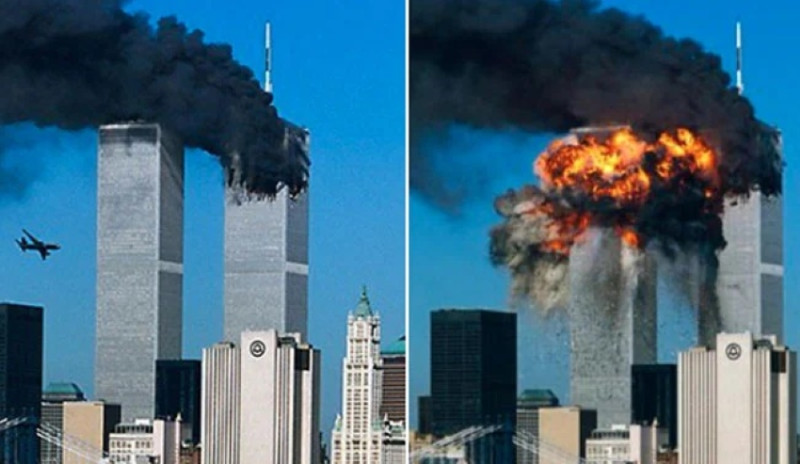
AMERICANS watched in collective horror as the terrorist attacks of 11 September 2001 unfolded, leaving nearly 3,000 dead in New York City, Washington, D.C., and Shanksville, Pennsylvania.
Two decades later, the nation observed with sorrow the chaotic conclusion of the military mission in Afghanistan — a mission launched less than a month after those devastating events.
According to extensive public opinion data gathered by the Pew Research Center, the memory of 9/11 remains vivid for those old enough to recall it.
The overwhelming majority remember precisely where they were and what they were doing when the news broke. However, as time marches on, a growing segment of the American public — either too young or born after the event — has no personal recollection of that day.
Pew’s analysis over the past 20 years reveals a trajectory marked by deep emotional trauma, a temporary but powerful sense of national unity, and fluctuating public sentiment surrounding military interventions in Afghanistan and Iraq.
While Americans initially supported both wars, confidence steadily declined, particularly as the financial and human costs mounted.
Reflecting on the legacy of the war in Afghanistan, a recent Pew survey found that 69% of U.S. adults believe the United States has mostly failed to achieve its objectives there. Although a majority supported the decision to withdraw, many criticised the Biden administration’s handling of the departure.
The immediate emotional impact of 9/11 was profound. A survey conducted between 13 and 17 September 2001 found that 71% of Americans felt depressed, 49% struggled to concentrate, and one in three reported difficulty sleeping. Despite this psychological strain, 63% admitted they could not stop watching the news coverage.
Television served as the primary source of information, with 90% relying on it — a stark contrast to the mere 5% who turned to the internet. The images of destruction resonated powerfully: 92% said they felt sad watching the broadcasts, while 77% described them as frightening.
Anger was also widespread. Three weeks after the attacks, 87% of respondents reported feeling angry about the strikes on the World Trade Center and the Pentagon. Meanwhile, fear remained pervasive throughout the autumn of 2001, with 73% of Americans expressing concern about the likelihood of another attack.
A year later, the emotional toll persisted. About half of all adults said they felt more fearful, cautious, distrustful, or vulnerable because of the attacks. Those living in cities directly targeted — New York and Washington — experienced a sharper impact. Nearly two-thirds of adults in both cities reported that the attacks had changed their lives at least to some degree, compared with 49% nationwide. A quarter of those in other large cities said their lives had changed in a major way — twice the rate reported in rural areas.
By August 2002, half of U.S. adults said the country had “changed in a major way,” a sentiment that grew stronger over time. Ten years later, that number had risen to 61%.
The personal resonance of 9/11 was unmatched. A year after the attacks, 80% of Americans cited 9/11 as the most important national event of the previous year. Remarkably, 38% identified it as the most significant event in their personal lives during that same period — exceeding mentions of births, deaths, or other life milestones. Among residents of New York and Washington, those figures were even higher, at 51% and 44% respectively.
Fifteen years on, in a 2016 Pew Research survey conducted in collaboration with A+E Networks’ HISTORY, 76% of U.S. adults still named 9/11 as one of the 10 most significant events in their lifetimes. The election of Barack Obama as the first Black president came a distant second, with 40%.
The significance of the attacks cut across demographic and political lines. Despite deep partisan divisions during the 2016 election, more than seven in ten Republicans and Democrats listed 9/11 among the most historically important events of their lives.
As the generation with living memory of 9/11 ages, the challenge of preserving its historical gravity remains. For many Americans, it is not just a national tragedy — it is a defining moment that reshaped how they see the world and their country’s role in it. - September 11, 2025