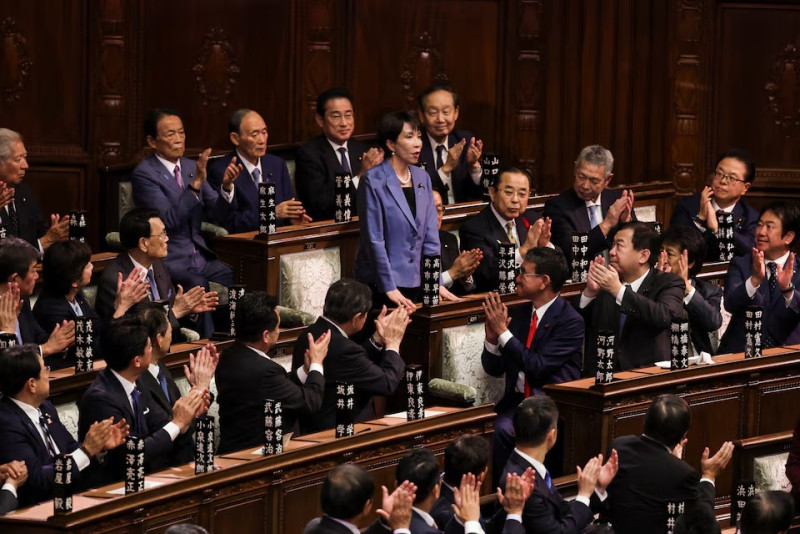
JAPAN risks reviving its wartime militarism and repeating historical mistakes, China’s official newspaper, People’s Daily, said on Friday, following remarks by Japanese Prime Minister Sanae Takaichi on Taiwan.
Reuters reported today that Takaichi provoked a diplomatic dispute with Beijing last week when she told Japan’s parliament that a Chinese attack on Taiwan could constitute a “survival-threatening situation” and trigger a military response from Tokyo.
China’s top diplomat in Osaka shared a news article about her comments on X, adding that “the dirty neck that sticks itself in must be cut off,” a statement that prompted a formal protest from the Japanese government.
In a commentary under the pen name “Zhong Sheng,” the ruling Communist Party’s People’s Daily said Takaichi’s remarks were not an “isolated political rant.” The paper accused Japan’s right wing of seeking to evade the constraints of its post-World War Two constitution and pursue the status of a military power.
“In recent years, Japan has been racing headlong down the path of military buildup,” the commentary said. “From frequent visits to the Yasukuni Shrine, to denying the Nanjing Massacre, to vigorously hyping the ‘China threat theory,’ Takaichi’s every step follows the old footprints of historical guilt, attempting to whitewash a history of aggression and revive militarism.”
The Yasukuni Shrine, which honours 2.5 million war dead including 14 Japanese leaders convicted as war criminals after World War Two, remains a particularly sensitive symbol for China.
The People’s Daily also warned that Japan’s use of “survival crises” as pretexts for aggression echoes the 1931 Mukden Incident, when Japan invaded China’s Manchuria. “Now that similar rhetoric is being revived, does Japan intend to repeat the mistakes of history?” it asked.
Taiwan, claimed by Beijing but governed democratically, sits just over 110 km from Japanese territory, along vital sea routes for Tokyo’s trade. Japan also hosts the largest contingent of U.S. forces overseas, further heightening regional tensions. - November 14, 2025