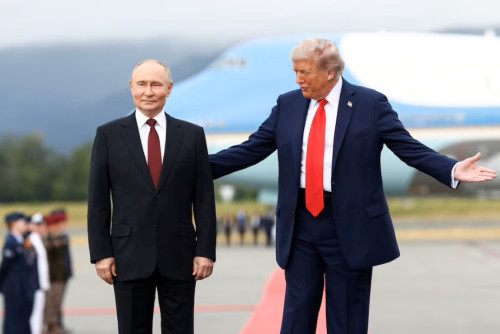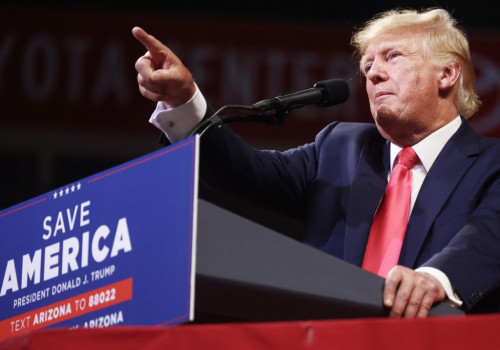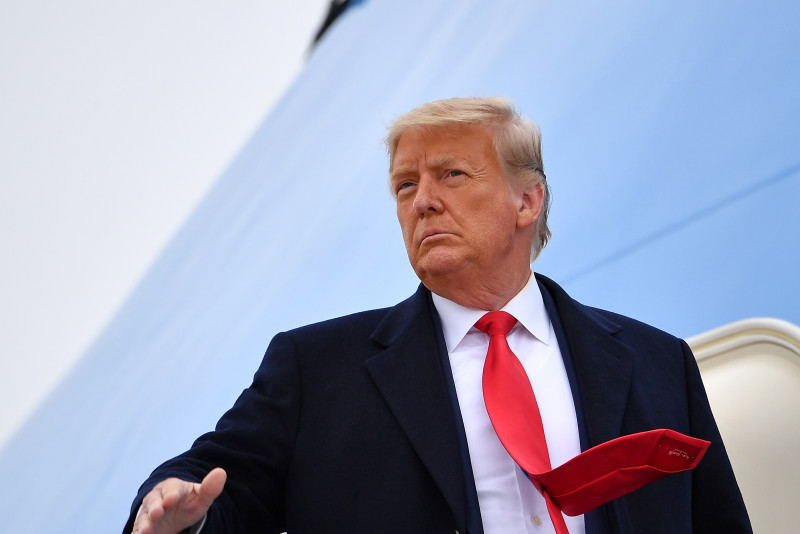
U.S. President Donald Trump has escalated a dispute with European allies by pledging to impose a series of increasing tariffs on their exports until the United States is allowed to purchase Greenland, an autonomous territory of Denmark.
In a post on his Truth Social platform on Saturday, Trump said an additional 10 per cent import tariff would take effect on 1 February on goods from Denmark, Norway, Sweden, France, Germany, the Netherlands, Finland and Great Britain. All of those countries are already subject to tariffs imposed during his presidency.
Trump said the tariffs would rise to 25 per cent on 1 June and would remain in place until an agreement was reached allowing the United States to buy Greenland. He has repeatedly stated that he would accept nothing less than full ownership of the Arctic island.
“These Countries, who are playing this very dangerous game, have put a level of risk in play that is not tenable or sustainable,” Trump wrote.
Leaders in Denmark and Greenland have consistently rejected the idea of a sale, insisting the territory is not for sale and does not wish to become part of the United States.
A Reuters/Ipsos poll conducted this week found that fewer than one in five Americans support acquiring Greenland.
Trump has argued that Greenland is vital to US national security because of its strategic Arctic location and vast mineral resources, and he has not ruled out the use of force to take control of the territory.
At Denmark’s request, several European countries have recently sent military personnel to the island.
Protests were held on Saturday in both Denmark and Greenland, with demonstrators opposing Trump’s demands and calling for Greenland’s future to be decided by its own people.
The countries named in Trump’s tariff threat reiterated their backing for Denmark, warning that any US military seizure of territory within NATO could destabilise or even collapse the alliance led by Washington.
“The president’s announcement comes as a surprise,” Danish Foreign Minister Lars Lokke Rasmussen said in a statement.
British Prime Minister Keir Starmer took an unusually direct tone in condemning the move, saying the issue would be raised directly with Washington.
“Applying tariffs on allies for pursuing the collective security of NATO allies is completely wrong,” Starmer said in a post on X.
European Commission President Ursula von der Leyen and European Council President Antonio Costa said in identical statements that the European Union stood in “full solidarity” with Denmark and Greenland.
“Tariffs would undermine transatlantic relations and risk a dangerous downward spiral. Europe will remain united, coordinated, and committed to upholding its sovereignty,” they said.
Officials from Norway, Sweden, France and Germany also voiced support for Denmark, stressing that tariffs should not be part of discussions over Greenland. Cyprus, which currently holds the rotating EU presidency, said it had called an emergency meeting of ambassadors from the bloc’s 27 member states for Sunday.
The threat has raised concerns that tentative trade agreements Trump reached last year with the European Union and Great Britain could unravel. Those deals included baseline tariffs of 15 per cent on European imports and 10 per cent on most British goods.
“The biggest danger, it seems to me, is his decision to treat some EU countries different from others,” said William Reinsch, a trade expert at the Center for Strategic and International Studies.
“I’m not surprised … It may well convince the European Parliament that it is pointless to approve the trade agreement with the U.S., since Trump is already bypassing it.”
Trump first floated the idea of using tariffs to pressure Europe over Greenland on Friday, without citing a clear legal basis.
Tariffs have become a central tool in his efforts to compel both allies and adversaries to comply with US demands.
Earlier this week, Trump said he would impose 25 per cent tariffs on any country trading with Iran in response to Tehran’s suppression of anti-government protests.
However, no official documentation has appeared on the White House website, nor has any legal authority been specified.
The US Supreme Court has heard arguments on the legality of Trump’s sweeping tariff powers, and any ruling could have far-reaching consequences for the global economy and the scope of presidential authority.
Trump has also cited the growing influence of China and Russia in the Arctic as justification for his stance on Greenland. European officials have countered that Greenland is already protected under NATO’s collective defence clause and that the United States maintains a military presence there.
The US operates the Pituffik Space Base in Greenland, with about 200 personnel, and a 1951 agreement allows Washington to deploy additional forces to the territory if it chooses.
Many European officials have therefore questioned Trump’s security rationale, suggesting his motivation is territorial expansion.
“China and Russia must be having a field day. They are the ones who benefit from divisions among allies,” EU foreign policy chief Kaja Kallas said on X.
Some US lawmakers also criticised the president’s approach. Senators Jeanne Shaheen and Thom Tillis, the bipartisan co-chairs of the Senate NATO Observer Group, said: “Continuing down this path is bad for America, bad for American businesses and bad for America’s allies.”
Others urged restraint in responding to Trump’s threats. Carsten Brzeski, global head of macro research at ING, said Europe should not overreact.
“Just ignore it and wait and see,” he told Reuters. “Europe has shown that it will not accept everything, and so the tariffs are actually already a step forward compared to the threatened military invasion.” - January 18, 2026