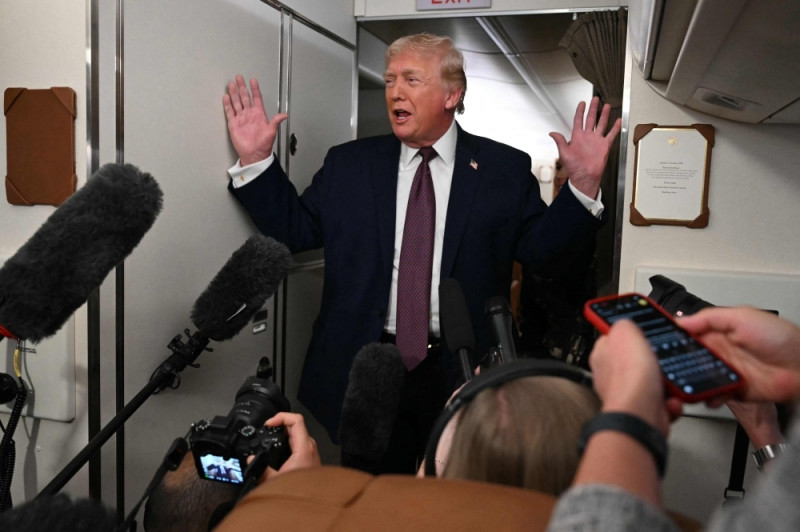
ABOARD Air Force One, U.S. President Donald Trump said he would be involved “indirectly” in pivotal talks between Washington and Tehran over Iran’s nuclear programme, scheduled to take place in Geneva on Tuesday, expressing cautious optimism that a deal could be reached.
“I'll be involved in those talks, indirectly. And they'll be very important,” Reuters cited Trump telling reporters on Monday, adding that he believed Iran was motivated to negotiate. “I don't think they want the consequences of not making a deal.”
The diplomatic effort unfolds against a backdrop of sharply rising tensions.
The United States has deployed a second aircraft carrier to the Middle East, and officials have indicated that the military is preparing for the possibility of a sustained campaign should negotiations fail.
Trump suggested Tehran had previously adopted an uncompromising stance but had learned from last summer’s U.S. strikes on Iranian nuclear facilities.
“We could have had a deal instead of sending the B-2s in to knock out their nuclear potential. And we had to send the B-2s,” he said, referring to the stealth bombers used in the operation. “I hope they're going to be more reasonable.”
His remarks mark a shift from comments made days earlier, when he openly entertained the prospect of regime change in Iran and criticised decades of unsuccessful diplomacy.
Iran’s Foreign Minister, Abbas Araqchi, met the head of the International Atomic Energy Agency in Geneva on Monday and signalled Tehran’s willingness to engage, albeit on its own terms. Writing on X, he said he was there to “achieve a fair and equitable deal.”
He added: “What is not on the table: submission before threats.”
The International Atomic Energy Agency has for months pressed Iran to clarify the status of some 440 kilograms of highly enriched uranium following joint Israeli-U.S. strikes last year, and to permit the full resumption of inspections at key facilities including Natanz, Fordow and Isfahan.
Compounding the volatility, Iran on Monday conducted military drills in the Strait of Hormuz, a critical artery for global energy supplies through which roughly a fifth of the world’s oil passes.
Tehran has repeatedly warned it could close the waterway in retaliation for any attack, a move that would likely send crude prices sharply higher.
Despite Trump’s assertion that Iran seeks a deal, substantial obstacles remain. Washington has pressed for negotiations to extend beyond nuclear restrictions to include Iran’s missile programme, while Tehran insists talks must be confined to nuclear limits in exchange for sanctions relief and has rejected any demand for zero uranium enrichment.
Speaking during a visit to Hungary, U.S. Secretary of State Marco Rubio cautioned against excessive optimism.
“I think that there's an opportunity here to diplomatically reach an agreement ... but I don't want to overstate it either,” Rubio said.
“It's going to be hard. It's been very difficult for anyone to do real deals with Iran, because we're dealing with radical Shia clerics who are making theological decisions, not geopolitical ones.”
As diplomacy resumes under the shadow of military escalation, the Geneva talks may prove decisive in determining whether confrontation or compromise defines the next phase of U.S.-Iran relations. - February 17, 2026