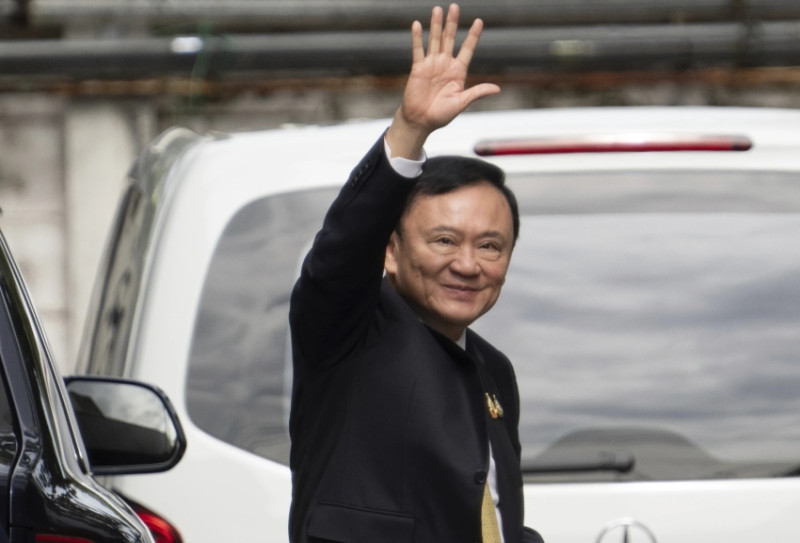
FORMER Thailand’s prime minister Thaksin Shinawatra is set to walk free from prison on 11 May, marking a dramatic return to public life after years of exile, political upheaval and legal battles that reshaped Thailand’s political order.
The 76-year-old political patriarch will be released on parole after serving eight months on corruption-related convictions, emerging into a vastly altered political environment following the decisive election victory of the conservative Bhumjaithai Party earlier this year.
His release is expected to draw large crowds of loyal “Red Shirt” supporters, many of whom have pledged to gather outside the prison in Bangkok to welcome back the figure who dominated Thai politics for much of the past quarter century.
Although the Thaksin-backed Pheu Thai Party remains part of the governing coalition, the party’s third-place finish in February’s elections represented a major setback for the Shinawatra political machine, whose affiliated parties topped every national vote between 2001 and 2019.
Political analysts say Thaksin now faces the difficult task of reviving a movement that once reshaped Thailand’s electoral landscape but has since lost momentum amid repeated legal interventions, military influence and shifting voter loyalties.
Dr Purawich Watanasukh, a political science lecturer at Thammasat University, told Bloomberg: “The good old days of Pheu Thai are completely over. Thaksin likely won’t be able to change that much.”
“But Thaksin is not done with Thai politics. He’s a fighter, and the Shinawatras still have unfinished business.”
Despite years of controversy, the Shinawatra family continues to command strong support among rural and working-class voters, even as it faces entrenched hostility from conservative elites and sections of the urban establishment.
Prime Minister Anutin Charnvirakul said he was pleased for the Shinawatra family following confirmation of Thaksin’s parole.
Asked about the prospect of renewed political turbulence, Anutin told reporters that he had “not thought that far ahead”, adding that Thaksin remained a person he respected.
The Shinawatra family has produced six Thai prime ministers this century, including Thaksin himself, his sister Yingluck Shinawatra and his daughter Paetongtarn Shinawatra.
Yingluck remains in exile after fleeing Thailand in 2017 while facing a criminal negligence case linked to her administration’s rice subsidy programme.
Paetongtarn was removed from office in August 2025 following an ethics ruling connected to her handling of border tensions with Cambodia, deepening the family’s political decline.
Thaksin returned to Thailand from self-imposed exile in 2023 at the same time a Pheu Thai-led coalition secured power through a parliamentary vote.
Soon after his return, he received a royal pardon reducing his prison sentence from eight years to 12 months.
He subsequently spent six months receiving treatment at a police hospital, although Thailand’s Supreme Court later ruled that period did not count towards his sentence and ordered his return to prison.
That judgement intensified political uncertainty and fuelled speculation that an informal understanding between Thaksin and Thailand’s conservative establishment — widely believed to have enabled his return — had broken down.
Thaksin also continues to face a royal defamation case after prosecutors successfully appealed an earlier court ruling that cleared him over remarks made during a 2015 interview with South Korean media.
On the day he was first taken to prison in September, Thaksin declared that he would dedicate the remainder of his life to serving the monarchy and the Thai people.
Thailand’s Department of Corrections confirmed on 9 May that Thaksin qualified for parole under standard regulations governing prisoner conduct and rehabilitation.
In a statement, the department said his early release had been approved due to improvements in his “attitude and behavior”.
Officials stressed that the decision was not designed to favour any individual prisoner.
“This parole consideration is not intended to benefit any one individual in particular, but is conducted under the same standards as all prisoners nationwide,” the department said.
Under the terms of his parole, Thaksin will be required to wear an electronic monitoring device for four months following his release. - May 11, 2026