IRAN'S clerical leadership is preparing several days of nationwide funeral ceremonies for Ayatollah Ali Khamenei, aiming to project unity and reaffirm support for the Islamic Republic following the supreme leader's death in U.S. and Israeli strikes during the recent war.
The funeral rites will begin this weekend in Tehran before continuing with large public processions in the holy cities of Qom and Mashhad, as well as religious ceremonies in Iraq.
Reuters cited state officials describing the expected public turnout as a demonstration of continued support for the Islamic Republic.
"The large public turnout at the funeral procession of the martyred leader and the other martyrs will, in effect, be another referendum for the Islamic Republic," Reuters cited Qom Friday prayer leader Ayatollah Mohammad Saidi said, according to state media.
Authorities are seeking to mobilise millions of mourners by providing discounted hotel accommodation, expanding transport services and arranging food and temporary lodging across multiple cities.
Khamenei's death, followed by the succession of his son, Mojtaba Khamenei, as Iran's third supreme leader, marks one of the most significant moments in the country's modern history. Mojtaba, who was reportedly seriously wounded in the strike that killed his father, has not appeared publicly since the conflict began.
Despite the planned displays of national mourning, analysts say public support for the Islamic Republic has weakened after years of economic hardship caused by sanctions and continued political repression.
Recent anti-government protests over soaring inflation saw demonstrators openly call for Khamenei's removal before security forces suppressed the unrest.
Some residents of Tehran also reported hearing celebrations in parts of the capital after news of Khamenei's death first emerged during the war.
The atmosphere in Tehran has since become subdued, in sharp contrast to the massive funeral of Islamic Republic founder Ayatollah Ruhollah Khomeini in 1989, when millions of mourners filled the streets.
One Tehran resident, identified only as Samira, said her family planned to leave the capital during the funeral period rather than attend the ceremonies, citing a heavy security presence.
In Iran's political system, the supreme leader serves not only as head of state but also as the highest religious authority, making Khamenei's death particularly significant for the country's Shi'ite establishment.
His killing has been framed by officials within the Shi'ite tradition of martyrdom, with mourning ceremonies drawing parallels to the death of Imam Hossein, one of the faith's most revered figures.
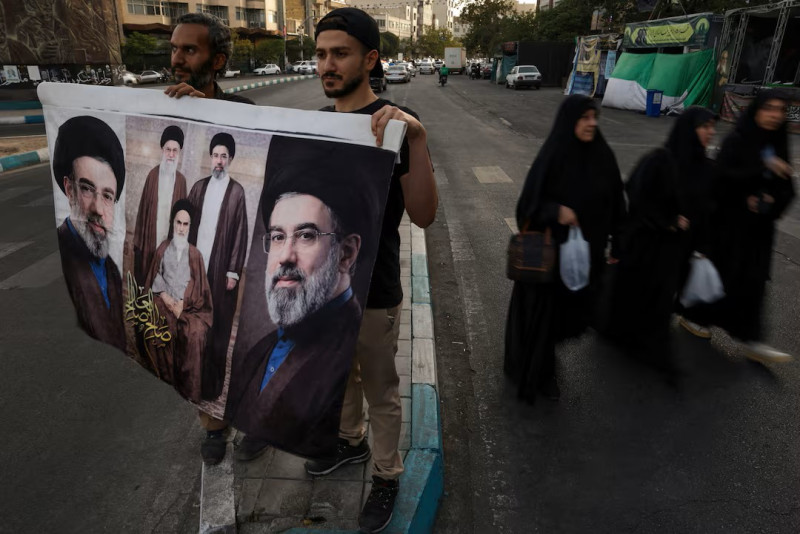
New banners and posters supporting Mojtaba Khamenei have already appeared across Tehran, while supporters have continued holding public vigils.
Officials and foreign dignitaries, including representatives from Russia and China, are expected to attend condolence events before the national funeral procession begins.
Khamenei's remains will first be taken to a mosque in Tehran before a series of ceremonies across the country. The bodies of his daughter, son-in-law, granddaughter and the wife of Mojtaba Khamenei, all reportedly killed in the same strike, will also be honoured during the funeral procession.
Following a major procession in Tehran on Monday, the funeral convoy will travel to Qom on Tuesday before continuing to the Iraqi shrine cities of Najaf and Karbala on Wednesday.
Khamenei is scheduled to be buried on Thursday in Mashhad near the shrine of Imam Reza, one of Shi'ite Islam's holiest sites.
Security has been tightened throughout the funeral period, with temporary airspace restrictions imposed over Tehran and other major cities as Iranian authorities warn they will respond forcefully to any renewed attacks by the United States or Israel. - July 3, 2026
.jpeg)