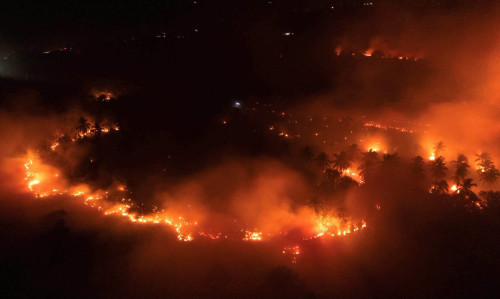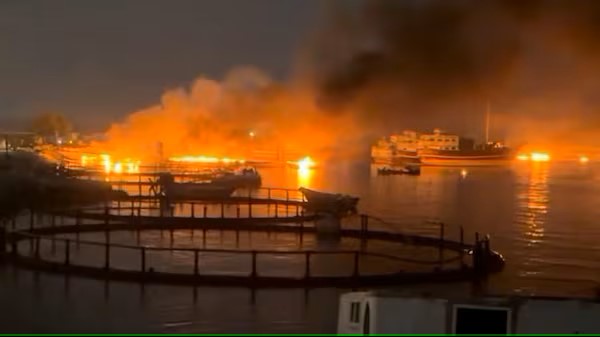
THE United States military launched its 11th consecutive night of strikes on Iran early Wednesday, as escalating attacks across the Middle East overshadowed diplomatic efforts to revive a collapsed interim ceasefire agreement.
US Central Command did not immediately disclose the targets involved in the latest wave of attacks, which came after President Donald Trump indicated that American military operations against Iran would intensify.
AP reported on Wednesday that the strikes were launched as Iranian Interior Minister Eskandar Momeni visited Pakistan, a key mediator attempting to reopen diplomatic channels between Washington and Tehran.
However, it remained unclear whether any new arrangement could be reached to end the conflict, which has increasingly centred on control of the Strait of Hormuz, a crucial maritime route through which a significant share of global energy supplies passes.
Speaking from the Oval Office on Tuesday, Trump gave little indication that negotiations were imminent, saying the United States had "no interest in meeting" unless Iran was prepared for meaningful discussions.
He also warned that US forces could soon target an area near one of Iran's major uranium enrichment facilities.
With diplomatic efforts stalled and shipping activity through the Strait of Hormuz severely disrupted, both sides have sought leverage by targeting infrastructure affecting millions of civilians across the region.
A sustained campaign of US airstrikes has failed to loosen Iran's control over the strait, where roughly one-fifth of the world's crude oil and natural gas shipments passed before the war.
On Tuesday, the US continued air operations against Iranian targets, while Iran attacked a tanker in the waterway, forcing its crew to abandon the vessel. Tehran also launched further strikes against American allies, with missile warning systems activated in Bahrain and Kuwait.
The escalation pushed energy prices higher, with international crude oil trading above US$91 a barrel and average US petrol prices approaching US$4 per gallon.
The conflict has also become a political challenge for Washington ahead of the US midterm elections, with polls indicating growing public opposition to the war amid rising fuel costs and increasing military casualties.
A US official told The Associated Press that more than 500 American personnel have been wounded in the conflict, exceeding the Pentagon's official tally of 482 recorded injuries. The official said the difference was due to delays in reporting within the military casualty system.
Meanwhile, Iran-backed Houthi rebels in Yemen have opened a new front in the Red Sea by declaring a naval blockade against Saudi Arabia, threatening another critical route for global oil and commercial shipping.
The Houthis warned international shipping companies against using the Bab el-Mandeb Strait, the gateway to the Red Sea, according to officials from the group.
The development has heightened concerns over energy security, particularly as Saudi Arabia has relied more heavily on pipelines leading to the Red Sea after disruptions in the Strait of Hormuz.
In Pakistan, Iranian Interior Minister Momeni met army chief Field Marshal Asim Munir and later held discussions with Prime Minister Shehbaz Sharif as Islamabad attempted to encourage both sides to return to negotiations.
Sharif expressed deep concern over the escalation and urged all parties to exercise restraint to prevent further destabilisation of the region.
Pakistan had previously played a key role in brokering an interim understanding between Washington and Tehran and has been seeking to restore diplomatic engagement.
Trump, however, said Iran must demonstrate a willingness to engage seriously before talks could resume.
"Iranian officials want to desperately meet. And until they're ready to meet in a meaningful way, we have no interest in meeting," he said.
He also warned that the US could target the area near Pickaxe Mountain, a fortified underground site located close to one of Iran's main nuclear enrichment facilities.
Iran's military leadership warned that any attack on nuclear or other sensitive facilities would represent a major escalation, saying US interests, allies and supporters would become targets of Iranian retaliation.
Meanwhile, US Central Command said Tuesday's strikes targeted Iranian military command centres, maritime capabilities, missile and drone launch sites, as well as air defence systems.
The British military's United Kingdom Maritime Trade Operations centre reported that a tanker came under attack near Oman in the Strait of Hormuz, forcing its crew to abandon the vessel.
Iran's Islamic Revolutionary Guard Corps claimed responsibility for the attack, along with two other strikes on ships in the waterway.
The US military said it had redirected eight commercial vessels and disabled one vessel as part of efforts to enforce restrictions in the strait.
Iran also continued attacks against US allies across the region.
Jordan's military said it intercepted five drones and three missiles launched by Iran, while Bahrain activated missile warning sirens following another Iranian barrage targeting the island nation, which hosts the US Navy's Fifth Fleet.
In Iraq, flights were temporarily suspended at Erbil International Airport after attacks targeted the capital of the semi-autonomous Kurdish region.
Kuwait said Iran had struck desalination and power facilities for a fourth consecutive day, causing fires and damage. Authorities warned the attacks posed a serious threat because about 90 per cent of Kuwait's drinking water comes from desalination plants.
US strikes have also targeted electrical infrastructure in Iran, while Iranian officials accused Washington of attacking water facilities.
United Nations Secretary-General António Guterres condemned attacks on civilian infrastructure, describing them as "unacceptable" and a violation of international law. - July 22, 2026





.jpg)