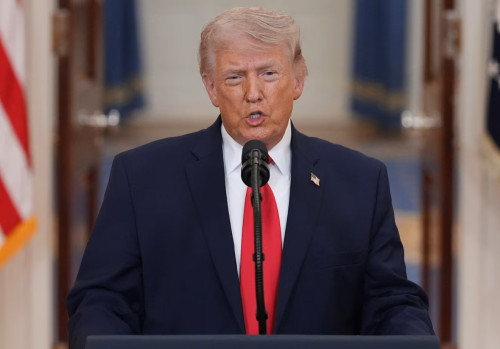
SIX months after President Donald Trump launched the war against Iran with an expectation that it would last just four or five weeks, the conflict has dragged on with no clear end in sight and several of his original objectives still unresolved.
Trump has repeatedly declared that the United States has won the war or that a deal with Tehran is close, but a June memorandum of understanding intended to lay the groundwork for ending the conflict has effectively stalled.
AP cited on Thursday that with US stockpiles of key weapons depleted, the Trump administration has increasingly shifted towards economic pressure on Iran rather than sustained military strikes.
At the same time, the objectives of the war have evolved.
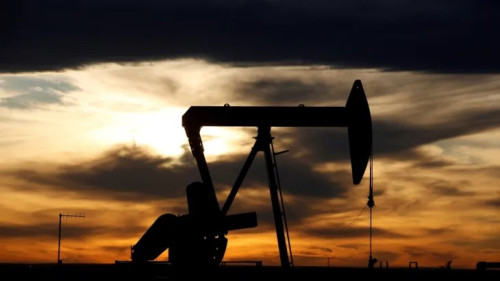
One of the administration’s most pressing priorities is now reopening the Strait of Hormuz, a vital global shipping route through which roughly a fifth of the world’s oil normally passes. Iran’s use of the waterway as a strategic chokepoint has disrupted energy and fertiliser supplies, driving up costs and increasing economic and political pressure on the US administration.
The United States has achieved significant tactical gains in degrading Iran’s military capabilities, but several of the broader objectives Trump announced at the beginning of the conflict remain incomplete.
Trump declared in June last year that US strikes had “obliterated” Iran’s nuclear programme, after American and Israeli attacks targeted key nuclear facilities. Yet a major unresolved issue is the fate of an estimated 970 pounds (440 kilograms) of enriched uranium that Iran had accumulated.
The material is believed to be buried beneath three nuclear facilities targeted by US and Israeli strikes.
Trump said in a May 29 social media post that the stockpile would be recovered by the United States “in close coordination and conjunction with the Islamic Republic of Iran, plus the International Atomic Energy Agency, and DESTROYED.”
Iran has not agreed to such a move.
Experts have warned that attempting to seize the material without Tehran’s consent could require a substantial deployment of US forces inside Iran and pose significant risks. Under the stalled June memorandum, Iran reaffirmed that it would not acquire or develop nuclear weapons and agreed in principle to dilute its highly enriched uranium stockpile.
However, crucial details concerning the future of Iran’s nuclear programme were left for subsequent negotiations, and it remains unclear how much progress was achieved before the talks broke down.
The Strait of Hormuz has emerged as one of the most consequential unresolved issues of the war.
Trump has said any agreement with Iran would involve reopening the waterway while the United States would end its blockade of Iranian ports. But his position has varied, with Trump at times suggesting the strategically vital waterway could effectively become American territory and that the United States might impose tolls on ships using it.
On Wednesday, however, Trump insisted the strait was already functioning.
“It’s a functioning strait. Yes, every once in a while, there’ll be a drone or a rocket or something shot, but it is a very functioning strait,” Trump said during an interview with conservative commentator Glenn Beck.
Another central US objective was to destroy Iran’s ballistic missile capabilities and dismantle its missile industry.
Trump said in late March that Iran’s missiles were “mostly decimated”, claiming that 90 per cent of its missiles and launchers had been destroyed. By mid-May, however, he revised that assessment, saying 82 per cent of Iran’s missiles had been eliminated.
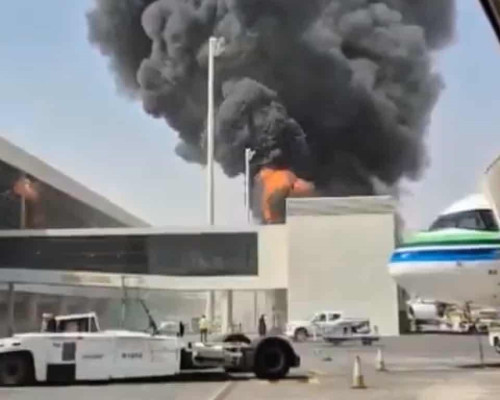
Iran has nevertheless retained the ability to launch attacks in the region, including drone strikes against ships travelling through the Strait of Hormuz.
As recently as July, US Central Command said it was still striking Iranian military targets, including command centres, air defence and coastal surveillance sites, maritime capabilities, missile and drone launch facilities and communications networks.
The destruction of Iran’s defence industrial base was also initially presented as a key US objective, although it has received less consistent emphasis as the war progressed.
US Central Command has targeted weapons production sites and facilities involved in manufacturing missiles and drones.
Secretary of State Marco Rubio told lawmakers in early June that Iran’s defence industry had suffered “massive destruction” and estimated that it had sustained “80 to 90% of attrition”. He said rebuilding the country’s military-industrial capabilities could take years.
The United States and Israel rapidly established air superiority over Iran, allowing their aircraft to operate largely without significant challenge.
Rubio said Iran retained drone capabilities but could no longer deploy drone swarms on the scale seen at the beginning of the war.
He also said Iran no longer had a conventional navy, instead relying on small vessels equipped with machine guns to harass ships and occasionally lay mines.
Trump on Wednesday went further, declaring that Iran’s navy and air force were “totally gone.”
Trump expanded the stated objectives of the war in March to include protecting US allies across the Middle East, naming Israel, Saudi Arabia, Qatar, the United Arab Emirates, Bahrain and Kuwait.
The United States maintains thousands of troops at bases and military installations across the region, but Trump has offered few details about the extent of America’s long-term commitment to defending its allies.
In June, after Iran fired missiles towards Kuwait and Bahrain, the United States responded with strikes against Iranian targets. Oman, however, has found itself in a more complicated position.
Rather than benefiting from Trump’s pledge of protection, Muscat has faced criticism from the US president over its negotiations with Tehran concerning the Strait of Hormuz.
In mid-August, Trump threatened to bomb Oman if it “gets in the way” of an agreement, using an expletive for emphasis.
The Trump administration also initially identified Iran’s network of regional proxy groups as a major target, saying it wanted to prevent Tehran from funding, arming and directing militant organisations beyond its borders.
The United States initially struck Iranian-aligned militia groups in Iraq, but public discussion of the objective has diminished as the war has continued. The most significant focus has shifted to Israel’s conflict with Hezbollah in Lebanon, with Iran remaining a major backer of the militant group.
Iran has insisted that the fighting in Lebanon must end as part of any agreement with Washington.
Israel and the Lebanese government have announced a US-mediated arrangement under which Israeli forces would withdraw from southern Lebanon in exchange for Hezbollah disarming.
A US administration official described the agreement as a “huge step”, but Hezbollah has refused direct negotiations and its leader has said the group will not surrender its weapons.
Six months into the conflict, the result is therefore far removed from Trump’s original expectation of a short war.
While the United States has significantly degraded Iran’s military capabilities, questions over Tehran’s nuclear material, the future of the Strait of Hormuz, Iran’s regional alliances and the broader political settlement remain unresolved — leaving Washington still searching for an off-ramp from a war that Trump once expected to end within weeks. - August 27, 2026