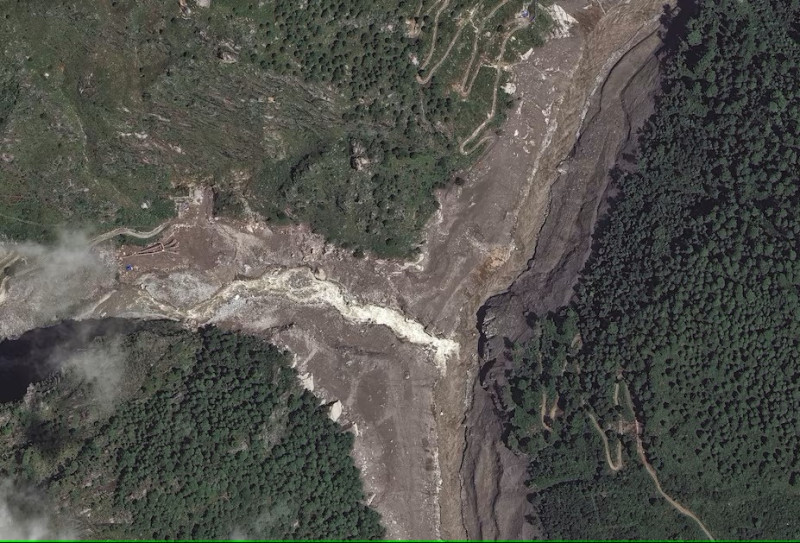
A LANDSLIDE-formed lake on the Nepal-China border overflowed into the Bhotekoshi River on Friday, triggering fresh panic among residents and forcing rescue teams to temporarily suspend operations as authorities assessed the risk of another devastating flood.
The reservoir had accumulated more than 2.5 million cubic metres of water by Aug 28, up from an estimated 1.5 million to two million cubic metres a day earlier, before overflowing into the river.
“We have received a notice saying that the lake has broken its banks,” Reuters quoted Narendra Pariyar, the most senior bureaucrat in Nepal’s flood-hit Rasuwa district saying. “But we do not know how big it is and how high is its water level. We can see that the level of water in the river is rising.”
Residents rushed to higher ground carrying their belongings after warnings were issued to stay away from the river, while police stood by with ropes and stretchers.
“Everyone started saying, ‘Run!’, so I ran. The siren in Bidur (town) also went off. I was very scared,” said Shanti Tamang, 40.
The latest threat emerged just two days after a catastrophic flood, triggered by the collapse of a glacier, sent a massive torrent of rock, ice, mud and debris through Himalayan river systems.
The disaster has killed 489 people in Nepal and five in Tibet, while almost 1,000 others remain missing across the two countries.
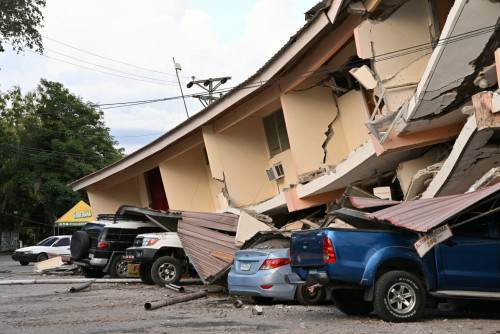
The torrent devastated villages, roads, bridges and power stations along a route linking Kathmandu with Lhasa in Tibet, an area also popular with trekkers and pilgrims.
The formation of the new lake has raised fears that another sudden release of water could compound the destruction caused by the initial flood.
The threat was serious enough for rescue workers and their equipment to be moved to safer locations.
Chinese rescue personnel and vehicles were ordered to withdraw and remain on standby in a safe area, according to state broadcaster CCTV.
Rescue operations were later resumed after authorities assessed the risk posed by the upstream barrier lake as manageable.
Nepalese authorities also halted rescue operations for about 90 minutes before restarting them, according to an army officer.
The disaster has left thousands stranded in isolated towns and valleys, with helicopters being used to search for survivors and deliver emergency supplies.
Emergency workers, including teams using sniffer dogs, have also recovered dozens of bodies swept downstream into the plains.
Among those rescued was Dibga Tamang, who was airlifted from Rasuwa on Aug 27 with three others to an army camp in Nuwakot.
“All of our people have gone. They are dead,” Tamang said. “I have no one left waiting for me. Everything and everyone is gone. The end.”
At least 540 of those reported missing are foreigners, many believed to be Hindu pilgrims from India travelling towards Mount Kailash and Lake Mansarovar in Tibet.
In China, the Politburo met on Aug 28 to direct the country's response to the disaster.
Chinese President Xi Jinping, who chaired the meeting, called for search-and-rescue plans to be formulated scientifically and for every effort to be made to locate missing people from China and abroad.
Xi also said rescue operations faced “extremely difficult challenges”, while calling for stronger monitoring of glacier lakes, landslide risks and barrier lakes, as well as emergency assistance for affected areas in Nepal and closer international cooperation on disaster response.
The disaster has also placed pressure on Nepal to accept international assistance.
Despite offers from several countries, Kathmandu said it did not currently require foreign search-and-rescue teams.
“The offer for help is natural. Our security agencies are doing the search-and-rescue operation. For now, we don’t require such help,” Foreign Ministry spokesman Lok Bahadur Chhetri said on Aug 28.
A South Korean rapid response team is already in Kathmandu but has not been deployed because Nepal has yet to establish a mechanism for accepting foreign rescue assistance.
India, China, the United States, Britain, Japan, South Korea, Sri Lanka and Bangladesh have reportedly asked Nepal to allow their search-and-rescue teams to participate.
On the Chinese side, rescuers had yet to reach the worst-hit area around the Gyirong border crossing by the night of Aug 27 as crews struggled to clear debris from the key access road.
Footage from Aug 26 showed torrents of muddy water and debris sweeping through the crossing within seconds, engulfing buildings and people attempting to escape.
CCTV reported that 558 people remained missing in Tibet's Gyirong County as of Aug 27, including 260 foreign nationals. Five deaths had been confirmed on the Chinese side.
Chinese Premier Li Qiang visited the disaster-stricken area in Gyirong on Aug 27, underscoring the scale of the emergency and Beijing's focus on the response.
The disaster has also left families around the world desperate for information about relatives who remain missing.
Among them are 10 women whose husbands travelled from northern Virginia to Nepal before setting out on a trek towards Mount Kailash.
The men are among dozens of Americans reported missing.
“Where are they?” said Sneha Sudhir, speaking from her home in Chantilly, Virginia.
She said the women had been supporting one another while contacting officials, politicians, friends and relatives in the United States and India in the hope of finding information.
“Everybody is taking turns in shedding their tears, wiping it off and getting back to work,” she said.
US President Donald Trump said Washington had aided Nepal.
“Nobody’s ever seen anything quite like that, where very powerful, strong, well-built buildings were wiped out like they were toothpicks. It’s a terrible thing. We are sending aid, and we’ve spoken to the leadership, and we let them know anything they want, they’ll have.” - August 28, 2026