IRAN and the United States have sharply escalated their six-month-old war with attacks on at least 15 vessels around the Strait of Hormuz, sending Brent crude above US$100 a barrel and raising fresh concerns over a vital global energy route.
Iran's Revolutionary Guard Corps said it had attacked 10 ships, including two US vessels and eight oil tankers, after the US military destroyed five Iranian oil tankers overnight.
Reuters reported on Thursday that the attacks marked the biggest wave of strikes on shipping by both sides since the war began and came after a month of relative calm during which Washington had sought to pressure Tehran through economic measures.
The escalation has disrupted shipping through the Strait of Hormuz, through which about a fifth of global oil supplies flowed before the war.
At least one seafarer was killed and another reported missing after an incident involving the oil products tanker Hercules Star while it was at anchorage off Dubai, its charterer Peninsula said.
The British maritime security agency UKMTO also reported several merchant vessels being struck by disabling fire in the northern Gulf and Gulf of Oman, on either side of the Strait of Hormuz.
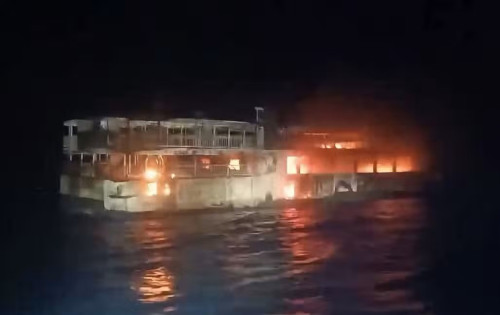
A tanker carrying about two million barrels of fuel oil, the New Andros, caught fire after being struck by a drone in Iraqi waters, according to two Iraqi port officials. None of its 22 crew was reported injured.
A liquefied natural gas tanker was also damaged at the Emirati port of Khor Fakkan, a maritime security source said.
The attacks drove Brent crude futures above US$100 a barrel for the first time since July, while the average US retail price of diesel reached a record high of more than US$5.94 a gallon.
Claudio Galimberti, chief economist at consultancy Rystad Energy, said flows through the Strait of Hormuz had fallen to as low as two million barrels per day, from as much as eight million to nine million barrels per day in the week before fighting resumed on Aug 30.
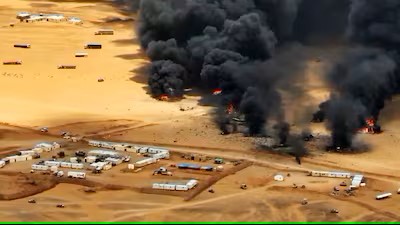
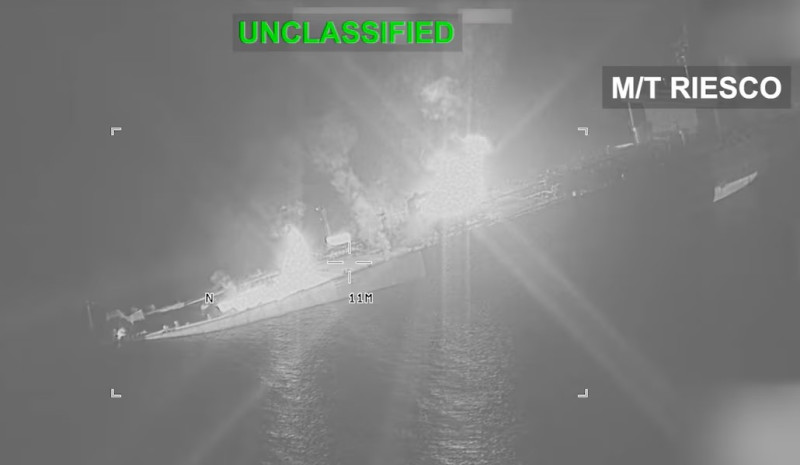
The US military said it had destroyed five Iranian oil tankers overnight, releasing video showing vessels ablaze before sinking.
US Central Command said the strikes were carried out in response to the Iranian Revolutionary Guard targeting a US Navy warship twice with ballistic missiles. Washington said no American personnel were injured.
The United States has announced a policy of targeting Iranian tankers in retaliation for attacks threatening its warships and said it had struck 10 Iranian tankers over the past week.
“Iran continues to try to hit U.S. naval ships, and for every time they do that or try to do that, they're going to lose tankers,” US Secretary of State Marco Rubio told reporters during a visit to Colombia.
Iran also fired ballistic missiles at a US military base in Jordan. Jordan said it intercepted 18 missiles, while two others fell harmlessly in unpopulated areas.
A US official said all American troops were accounted for.
The Revolutionary Guard warned that it would sharply escalate its response to any further attacks and said Iran would soon release maps showing a new, enlarged off-limits maritime zone extending as far as Chabahar, near the Pakistani coast.
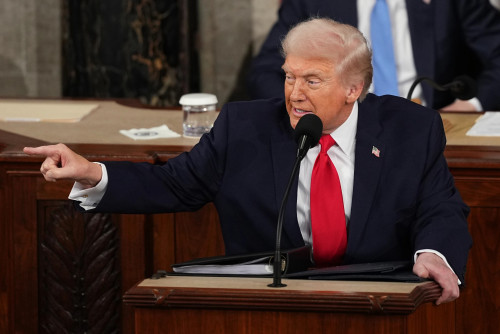
US President Donald Trump predicted that the war would end after the November midterm elections, despite growing concerns within his administration that the conflict could last much longer.
Trump accused Tehran of seeking to influence the elections, in which his Republican Party will seek to retain control of Congress.
“I think war is going to end immediately after the election because they can't hold out any longer. They're desperate to try and affect the election,” he told reporters.
The Wall Street Journal later reported that senior White House advisers, including Vice President JD Vance and Rubio, had privately warned Trump that the conflict could continue through the remainder of his presidency, which ends in January 2029. Reuters could not immediately verify the report.
The renewed fighting comes as Saudi Arabia and Yemen's Houthi movement have also intensified hostilities, opening a second theatre of conflict that threatens energy supplies from the Middle East.
An explosion was heard late on Wednesday in the southern Iranian port city of Jask, apparently coming from the sea, Iran's Fars news agency reported. It gave no details on the cause.
Washington had recently touted greater success in guiding tankers through the Strait of Hormuz, but the latest attacks have raised doubts over whether the gradual reopening of the crucial waterway can continue. - September 10, 2026





.jpg)