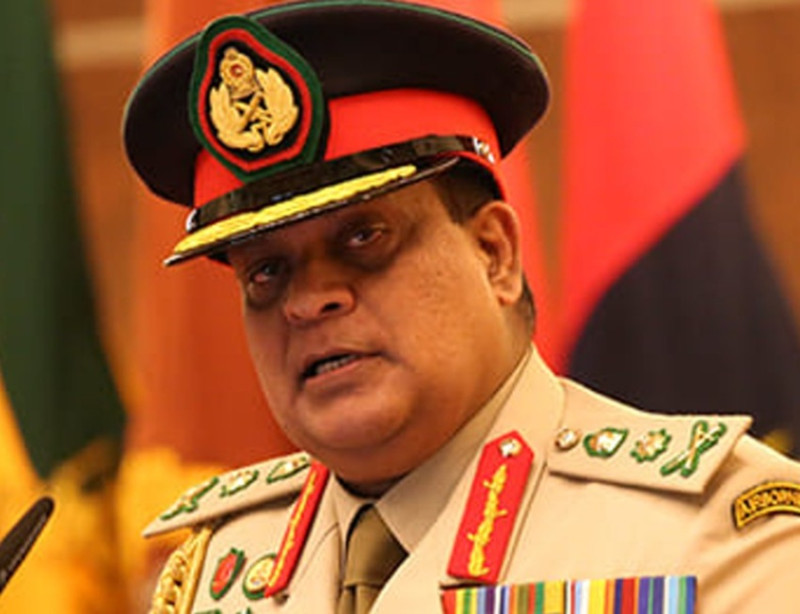
THERE is something almost majestic about the confidence of a retired general sitting beneath the medals of a victorious war and asking,
“Tell me what I have done wrong.” Not to prove it in court. Not that the reports are mistaken. Just a full theatrical reboot: new interview, old uniform, memory wiped cleaner than a parade-ground rifle.
General Shavendra Silva, former commander of Sri Lanka’s Army and former Chief of Defence Staff, has returned to the microphone to complain that the United States and United Kingdom sanctioned him. His defence is patriotism served as a legal doctrine: “I’m not a war criminal. I fought for my country.”
Wonderful. Unfortunately, “I did it for the flag” is not an invisibility cloak under the laws of war.
One necessary distinction: Silva has not been convicted of war crimes by an international court. But that is not the exoneration he wants it to sound like.
It is the scandal at the centre of the story: enormous allegations, years of official findings, sanctions by two governments—and still no credible courtroom reckoning.
Claim One: “Nobody Will Tell Me What I Did” Nobody is hiding the paperwork.
In 2020, the United States publicly designated Silva and barred him and his immediate family from entry, citing “credible information” that he was involved, through command responsibility, in extrajudicial killings by the Army’s 58th Division during the war’s final phase.
Silva commanded that division. That is not a vague subtweet from the diplomatic community; it is the US State Department putting a unit, a doctrine of responsibility and a category of killing into the same sentence as his name.
Then came Britain. In March 2025, the UK imposed a travel ban and asset freeze. Its formal statement says the 58th Division committed illegal killings and torture or cruel treatment.
More explosively, it says Silva ordered that LTTE leaders attempting to surrender be killed and was at the front when troops under his command executed surrendering fighters.
So when Silva asks for a date, a time and an allegation, the answer is: check the sanctions notice. The receipts are not lost. They are government stationery.
Claim Two: Civilian Deaths Were Just Battlefield Static
Silva says civilian deaths may have happened but were not intentional, while portraying the offensive as a masterclass in restraint.
That sales pitch crashes into the physical record. During the final months of the war, hundreds of thousands of civilians were compressed into shrinking government-declared “No Fire Zones.”
The UN’s internal review, quoting its 2011 expert panel, described the Army continuously shelling inside the second zone from land, sea and air from early February 2009, using aerial bombardment, long-range artillery, howitzers and multi-barrel rocket launchers.
An estimated 300,000 to 330,000 civilians were inside that small area. Hospitals did not somehow float above the carnage. Human Rights Watch documented repeated strikes on medical facilities across the Vanni.
Puthukkudiyiruppu Hospital was hit on successive days in early February: shells struck wards, including a women-and-children’s ward, killed patients and a nurse, and helped force the facility’s evacuation. Makeshift hospitals were hit later too, even after medical locations had been communicated and some were visibly marked.
The UN investigation did not pretend every shell could be individually assigned from a desk years later. It did something more responsible: it found reasonable grounds to believe that government forces repeatedly shelled No Fire Zones, hospitals and other protected sites, and said an independent court should determine individual criminal responsibility.
The 2011 UN panel said credible sources estimated that as many as 40,000 civilians may have died in the final months. That is not “a few unfortunate deaths.” That is catastrophe wearing camouflage.
Claim Three: The Dead Might Have Been Tigers in Casual Clothes
Silva offers the example of an LTTE commander found in civilian clothing with a weapon, suggesting civilian casualty counts can be deceptive. Yes, the LTTE was a vicious armed organisation. It recruited children, carried out suicide bombings, trapped civilians as human shields and shot at people trying to escape.
The UN accused both sides of grave violations that could amount to war crimes and crimes against humanity. No serious account should bleach the LTTE’s crimes. But one combatant in a shirt is not a magic eraser for tens of thousands of civilians. The laws of war do not say: the enemy committed atrocities, so congratulations, civilian protection has been cancelled. A state army still has duties of distinction, proportionality and precaution.
Human shields remain civilians. Hospitals remain protected. Surrendering fighters remain hors de combat. Silva’s anecdote is not an investigation. It is a costume change performed on the body count.
Claim Four: “We Took Surrenders, Therefore No One Was Executed”
Silva points to thousands of LTTE members who surrendered and were later rehabilitated. Good.
Capturing people without murdering them is not a humanitarian bonus feature; it is the legal floor. And it does not answer the White Flag allegations.
The 2015 UN investigation found reasonable grounds to believe that senior LTTE political figures Balasingham Nadesan and Seevaratnam Puleedevan may have been executed after attempting to surrender on 18 May 2009.
Witnesses described them as unarmed and carrying a white flag. A forensic review of photographs found multiple shots entering Puleedevan’s back and an apparent ligature mark on his wrist, suggesting his arms may have been restrained. Britain’s 2025 statement goes further in Silva’s case, directly alleging an order to kill surrendering LTTE leaders.
“Some prisoners survived” is not a rebuttal to allegations that other prisoners were executed. By that logic, every unlocked cell disproves every murder.
The Real Beast: Impunity in Full Dress Uniform
Here is the most savage fact: the allegations did not derail Silva’s career. They decorated it. Sri Lanka made him Army Chief of Staff in January 2019, Army Commander that August, promoted him to four-star General in 2020, and kept him at the summit of the security establishment as Chief of Defence Staff.
After he was appointed Army Commander, the UN called the decision “deeply troubling” and suspended non-essential deployments of Sri Lankan Army personnel to UN peacekeeping operations.
That is the beastly part—not a lone movie villain snarling in a bunker, but an entire machine transforming unanswered atrocity allegations into promotions, prestige and television interviews. Silva wants the sanctions framed as mysterious Western cruelty.
They are actually the feeblest substitute for what victims have been denied: evidence tested openly, witnesses protected, commanders questioned and judgments delivered by an independent court. He says he fought for his country. Fine.
The question was never whether he wore its uniform. The question is what forces under his command did while wearing theirs—and why, seventeen years later, the general still gets a microphone while the dead still wait for a verdict. – September 9, 2026