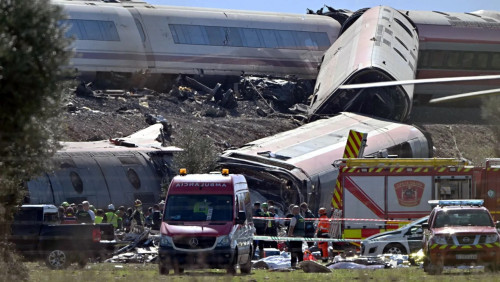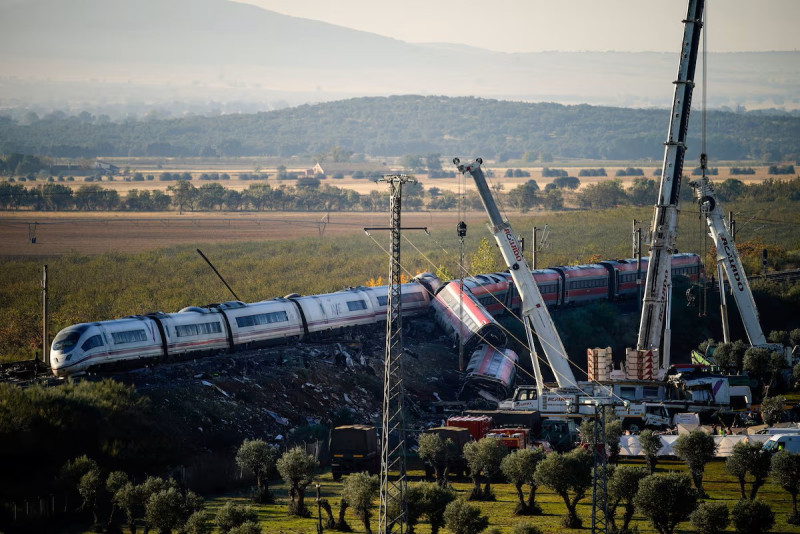
THE death toll from Wednesday's high-speed train collision in Spain has risen to 69, with rescue teams continuing to search through the wreckage for victims as the public demands answers over the country's second fatal high-speed rail crash this year.
Reuters reported on Friday that cranes worked through the night to lift sections of the mangled carriages, while emergency workers recovered what appeared to be a body wrapped in a blanket from one of the trains in Toledo province.
Rescue teams also deployed sniffer dogs to help locate victims amid the wreckage.
Spain has declared three days of national mourning following the disaster.
Meanwhile, a train drivers' strike has disrupted rail travel, adding to transport difficulties following the crash.
A survivor of Spain's latest high-speed train disaster has recounted the moment a train slammed into the rear of his carriage, throwing him into the air and leaving him surrounded by scenes of devastation.
Sebastian Herrero, 46, was travelling from Madrid to Seville aboard an Iryo train on Wednesday when it came to an unexpected halt, initially leading him to believe that a fallen overhead power line had disrupted the journey.
His thoughts about arriving late were abruptly interrupted when a Renfe train crashed into the back of his train, sending its final three carriages down a raised embankment in an accident that killed 69 people.
Herrero said he was thrown through the air and landed face-first on the seat opposite him.
He and other passengers in his carriage escaped by climbing down the embankment and crossing a fence into a nearby field.
Looking back at the wreckage, he said he saw burnt-out carriages, injured passengers and bodies being recovered by rescuers.
"The scene was devastating. You saw carriages completely burnt out, as if they’d exploded. What you see coming out were people in a very bad way, and others who start pulling out the bodies of the deceased and placing them right there next to where we were," he told Reuters in Seville.
Although his carriage was near the front of the train, the impact left several passengers with broken arms and noses.
Herrero, who described himself as feeling "born again" after surviving the crash, said the disaster had renewed concerns about the safety of Spain's high-speed rail network.
Wednesday's collision followed another deadly accident in January involving the same rail companies on the same line near Adamuz, intensifying scrutiny of railway safety and maintenance.
Herrero said the January accident had made him question whether travelling by train was safe, but he had few practical alternatives for regular journeys between Madrid and Seville.
He said driving was also unattractive because of road conditions and high petrol prices, while flying was not a viable option for many travellers.
For him and other passengers, the latest disaster has raised questions about accountability.
"It is high time for whoever is responsible to take responsibility," he said.
"I don’t know whether it is up to the courts to say so, or whether it is up to politicians, or whether it is for the Spanish people to decide, but what is clear is that it is unacceptable for this to happen and it is inconceivable that it could ever happen again," he added. - October 30, 2026