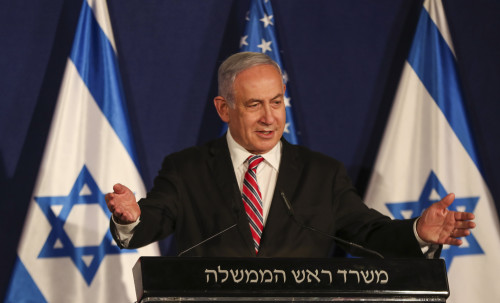
ISRAELI Prime Minister Benjamin Netanyahu appeared poised to remain in office as caretaker leader after his bloc outperformed pre-election expectations, leaving his opponents with a difficult path to forming a government despite the loss of their parliamentary majority.
With nearly 86 per cent of votes counted on Wednesday, projections by Israel’s three main broadcasters gave Netanyahu’s alliance of right-wing, far-right and ultra-Orthodox parties 53 seats in the 120-member Knesset, compared with 48 for opposition parties led by Gadi Eisenkot.
Parties representing Arab Israelis were projected to secure a record 19 seats, potentially making their support decisive in any opposition bid to form a government. However, many Jewish political leaders reject a broad alliance with Arab parties.
Reuters reported on Thursday that the projections could still change as vote counting continued, but Eisenkot’s bloc, which spans the centre-left to the hard right, fell short of pre-election polls that had forecast a closely contested race.
Netanyahu will remain caretaker prime minister during coalition negotiations and could stay in the role until another election next year. Although a caretaker government is expected to exercise restraint, it retains significant powers, including over security and the war with Iran.
Addressing supporters of his Likud party after 3am, Netanyahu called for the formation of “a strong, right-wing national government”.
He also raised the prospect of renewed joint military action against Iran with US President Donald Trump, saying the two countries had a “singular historical opportunity” to eliminate what he described as the Iranian threat “once and for all”.
Trump, who had urged Israeli voters to keep Netanyahu in power so they could “finish the job” in Iran, said the Israeli leader had done “very well” and claimed his endorsement had helped him.
Eisenkot acknowledged that Netanyahu remained caretaker prime minister but warned that he could use security matters for political purposes.
“I call on the heads of the security establishment and the civil service: Netanyahu is a caretaker prime minister, without a mandate or the people’s trust,” he said, urging officials to resist any attempt to challenge them.
Netanyahu’s office has previously rejected accusations that he exploits the conflict with Iran for political gain.
The uncertainty over government formation also weighed on Israeli financial markets. The shekel weakened by about 1.6 per cent to 3.10 against the US dollar, while Tel Aviv’s main stock indexes fell by more than three per cent.
The result highlighted a continued rightward shift among Israeli Jewish voters during Netanyahu’s years as the country’s dominant political figure, with the centre-left reduced to a relatively small political force.
Nearly all Jewish parties now reject the prospect of an eventual independent Palestinian state, a central element of internationally backed peace efforts since the 1990s.
The election was Israel’s first since Hamas-led fighters killed about 1,200 people and took 251 hostages in the Oct 7, 2023 attacks, triggering wars in Gaza, Lebanon and Iran.
The war in Gaza has killed 74,000 Palestinians, according to Gaza health authorities, and left Israel increasingly isolated internationally. Netanyahu is also wanted by the International Criminal Court on war crimes charges, which he rejects, and faces corruption charges in Israel that he denies.
Turnout reached 77.7 per cent, the highest in more than two decades, with particularly strong participation among Israelis of Palestinian descent, who make up more than a fifth of the population.
Many were motivated by opposition to what they regard as racism within Netanyahu’s government. Faten Gattas, a candidate with the Joint List, an alliance of Arab parties, said: “We refuse the occupation and racism, and we will remain here.”
The coalition that previously removed Netanyahu from power relied on support from a small Arab party. Eisenkot’s weaker-than-expected performance means his opposition bloc would now need backing from the Joint List, despite longstanding resistance among many Jewish political leaders to formal alliances with Arab parties. - October 29, 2026