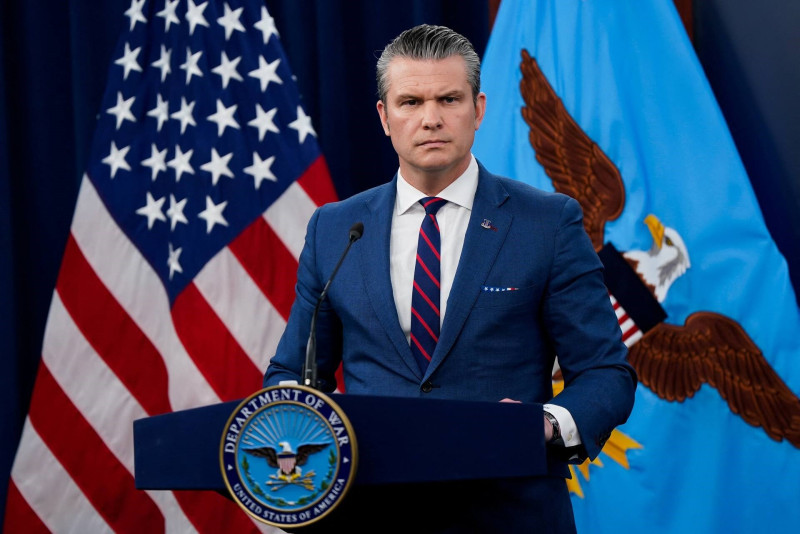
THE United States’ commitment to the Indo-Pacific is expected to come under scrutiny when Defence Secretary Pete Hegseth meets Southeast Asian counterparts in the Philippines on Wednesday, as the Iran war raises questions about Washington’s military readiness and its ability to sustain regional security commitments.
The Pentagon said Hegseth’s attendance at the gathering in Cebu would reaffirm Washington’s commitment to “peace through strength” in the Pacific.
However, analysts said regional governments could use bilateral meetings with Hegseth to seek clarity on the endgame in Iran, expectations of allies and partners, and how the conflict’s demands would affect US engagement in the Indo-Pacific.
“They will want to seek answers from the United States regarding certainty towards alliances and partnerships,” Reuters cited Collin Koh, a security scholar at Singapore’s S. Rajaratnam School of International Studies saying.
“And of course, the bigger elephant in the room is how does that juxtapose with US commitment to the Indo-Pacific or Western Pacific theatre.”
The discussions come as Southeast Asian economies grapple with the effects of the Iran war, which has disrupted shipping and oil markets and exposed the region’s vulnerability to imported-fuel shocks, putting energy security higher on the ASEAN agenda.
Greg Poling, director of the Asia Maritime Transparency Initiative, said the meeting would give Hegseth an opportunity to address concerns about China, the disputed South China Sea and Washington’s commitments to treaty allies.
“Most will want reassurance about U.S. commitment to the region, despite the political turmoil in Washington and the weakening of both U.S. capabilities and readiness by the war in Iran,” he said.
The Philippines, host of the gathering and a US treaty ally, faces increasingly strained relations with Beijing amid repeated confrontations in the disputed South China Sea, Chinese sanctions and diplomatic tensions.
China’s defence attaché in the Philippines is also expected to attend the meeting, according to its defence ministry.
Days before the talks, the Philippine military said it had monitored and shadowed China’s Liaoning aircraft carrier group as it passed through waters off the southern Philippines towards the Celebes Sea.
Defence chiefs from the United States, Japan, Australia and the Philippines, which form the Squad grouping, are also scheduled to meet on Oct 28.
Poling said stronger signals on regional security were more likely to emerge from discussions among like-minded partners than from the broader ASEAN gathering.
The eventual chairman’s statement, meanwhile, was expected to use familiar ASEAN language and remain more restrained than discussions behind closed doors, Koh said.
He added that the Philippines faced a delicate balancing act as ASEAN chair while embroiled in a dispute with China.
Poling said Manila had to balance cooperation on energy connectivity, the digital economy and coast guard operations against rising tensions with Beijing and stalled progress on a South China Sea code of conduct.
“For the Philippines, the whole ASEAN chair year has been a difficult balance,” he said.
“I’d expect tactical cooperation on the ADMM workstreams ... but no strategic alignment on the South China Sea or other thorny issues,” he added, referring to ASEAN defence initiatives covering areas such as maritime security and counter-terrorism. - October 28, 2026