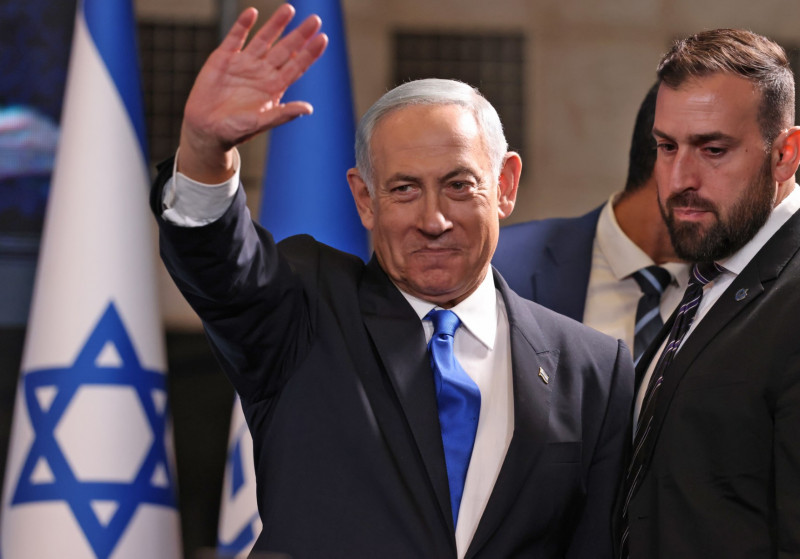
BENJAMIN Netanyahu faces a battle to remain in power as Israelis vote in a closely contested election, with anger over the security failures surrounding the October 7, 2023 attacks and the consequences of successive wars challenging his bid for another term.
Opinion polls point to a close contest between Netanyahu’s Likud party and its right-wing allies and a rival alliance led by former military chief Gadi Eisenkot, a security hawk drawing support from both the right and centre.
But neither side has a clear path to forming a government in Israel’s 120-seat parliament, raising the prospect of prolonged coalition negotiations or another election next year.
Netanyahu, who has served as prime minister for a total of 19 years, is campaigning on his wartime leadership and close relationship with US President Donald Trump, who has endorsed him.
Reuters reported that on Sunday, Netanyahu said Trump was prepared to act again to “finally” remove the Iranian threat, but only if he remained in office.
Eisenkot accused Netanyahu of relying on “a campaign of fear-mongering, lies and threats”, while arguing that Trump would work “in full cooperation with any leader chosen by the people”.
Netanyahu could again need the support of far-right politicians Itamar Ben-Gvir and Bezalel Smotrich to secure a parliamentary majority. Both have faced sanctions from some Western countries over allegations of inciting violence against Palestinians, while Ben-Gvir’s Jewish Power party has gained ground in opinion polls.
For opponents of Netanyahu, the election is also a referendum on accountability for the October 7 attacks, when Hamas-led militants killed about 1,200 people in Israel and took 251 hostage.
Netanyahu’s critics have called for a national inquiry into the security failures that preceded the assault. His supporters, however, credit him with leading Israel through a series of military confrontations.
“Netanyahu managed the war in the best possible way,” said Nof Gabay, an 18-year-old Likud supporter, rejecting the argument that the prime minister was to blame for the October 7 attacks.
Israel’s subsequent military offensive has devastated much of Gaza. Gaza health authorities say Israeli attacks have killed about 74,000 people.
Israel has also fought Hezbollah in Lebanon and exchanged strikes with Iran, including a 12-day aerial campaign against Iranian nuclear sites in 2025 and a joint US-Israeli war against Iran this year.
Eisenkot has said the next government must prevent Iran from acquiring a nuclear weapon, whether through military action or a US-backed diplomatic agreement.
The election is unfolding amid deep divisions over Netanyahu’s far-right coalition partners, Jewish settler violence in the occupied West Bank and corruption charges against the prime minister, which he denies.
Turnout among Israel’s Arab minority could also influence the outcome. Although Eisenkot has ruled out a partnership with Arab parties, analysts say they could potentially support a minority government led by him to prevent Netanyahu from remaining in office.
“My expectation is that we will have only a slight majority either way. No landslide,” said Israeli political analyst Amotz Asa-El of the Shalom Hartman Institute.
Polling stations are scheduled to remain open from 7am to 10pm local time. - October 27, 2026