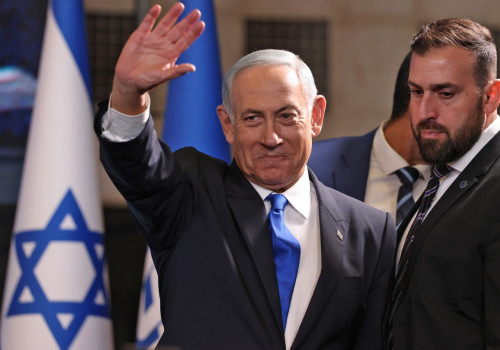
ISRAELI Prime Minister Benjamin Netanyahu faces a setback in the country’s first election since the Oct 7, 2023 Hamas-led attack, with exit polls showing his bloc locked in a dead heat with opposition leader Gadi Eisenkot’s camp and neither side on course for a parliamentary majority.
The projections point to potentially weeks of coalition negotiations, leaving open the possibility that Netanyahu could remain in office as caretaker prime minister while efforts to form a government continue.
“The Israeli public has voted against Netanyahu's service as Israel's prime minister ... a worthy leader would have accepted the people's non-confidence and announced today his retirement from politics,” Eisenkot told cheering supporters in Tel Aviv.
However, the exit polls offered no clear path for Eisenkot to take power. Broadcasters Kan 11 and Channel 13 projected the two blocs level, while Channel 12 later showed Netanyahu’s Likud-led camp with a narrow edge. None projected the 61 seats required for a majority in the 120-member Knesset.
Reuters reported on Wednesday that Netanyahu’s bloc was projected to include 13 seats held by far-right religious parties led by Itamar Ben-Gvir and Bezalel Smotrich.
Arab parties outside the two main blocs could hold the balance of power, although Eisenkot, leader of the Yashar party and a former military chief, has largely ruled out forming a government with them.
Voter turnout reached 77.7%, the highest in more than two decades and about seven percentage points above the 2022 election, according to Israel’s Central Elections Committee.
Final results could take days to emerge, while Israel’s fragmented political system leaves smaller parties potentially decisive in coalition negotiations. If neither bloc can form a government, another election may be necessary.
“In an election with such a high turnout it would be a mistake to go to another election,” Eisenkot said.
Yohanan Plesner, president of the Israel Democracy Institute, described the exit polls as a major defeat for Netanyahu’s coalition but cautioned that Eisenkot had not emerged as a clear winner and the outcome could change as votes were counted.
Opposition leader Yair Lapid also said Netanyahu’s bloc had suffered a major setback.
“Don’t let anyone confuse you: the Netanyahu bloc has suffered a crushing defeat. This is a total collapse and the public has told them to go home,” he said in a statement.
The election was widely viewed as a verdict on Netanyahu’s leadership following the Hamas-led attack and the ensuing wars in Gaza, Lebanon and Iran.
Netanyahu has faced criticism over the intelligence and security failures that preceded the Oct 7 attack, as well as his handling of the subsequent conflicts. He has defended his record by pointing to Israeli military operations against senior leaders of Hamas, Hezbollah and Iran.
Eisenkot, 66, who lost a son and two nephews in the Gaza war, campaigned on his security credentials and presented himself as a centrist alternative to Netanyahu’s leadership and far-right allies.
However, his positions on security remain hawkish. He opposes Palestinian statehood and has called for Hamas’ military wing to be destroyed or dismantled.
Netanyahu, 77, has served as prime minister for nearly 19 of the past 30 years and has repeatedly survived political crises. His opponents have removed him from office only once since 2009, before he returned to power 18 months later.
He also entered the election facing longstanding corruption charges, which he denies. - October 28, 2026