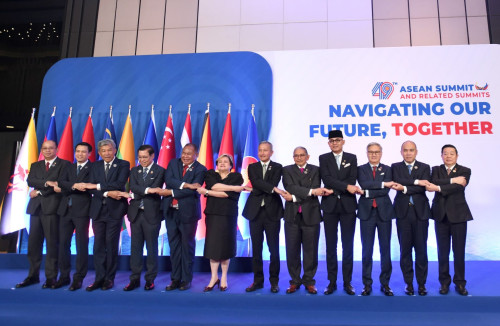
SOUTH-east Asian leaders gather in Manila from today for a key ASEAN summit overshadowed by an energy crisis, regional security tensions and mounting geopolitical rivalry, with US President Donald Trump among the high-profile world leaders expected to attend.
The summit, which opens on Nov 15, will bring together regional leaders to address pressing challenges involving trade, energy security and the bloc's relations with major global powers.
Trump is scheduled to arrive on Nov 17, towards the end of the summit, with his visit expected to include a sideline meeting with leaders of fellow Quad members India, Japan and Australia.
It would be the first Quad meeting of Trump's second presidential term, with the grouping widely seen as a strategic counterweight to China's growing regional influence.
The meeting would also take place just days before a historic gathering involving Chinese President Xi Jinping and Russian President Vladimir Putin in Shenzhen.
Brazilian President Luiz Inacio Lula da Silva is also expected to attend an ASEAN plenary session today, while Australian Prime Minister Anthony Albanese is scheduled to sign a new defence agreement with host nation the Philippines.
Security has been tightened ahead of the gathering, with nearly 20,000 police personnel deployed across Metro Manila. Progressive groups are also anticipating thousands of protesters at an anti-Trump demonstration on Nov 17.
One source of controversy is the US-led Pax Silica programme, an initiative aimed at strengthening supply chains and countering China's dominance in semiconductors and rare earth minerals.
Its flagship Philippine project, a 1,620-hectare artificial intelligence manufacturing hub north of Manila, has drawn criticism over concerns that Indigenous communities could be displaced.
Meanwhile, longstanding regional challenges remain unresolved, including negotiations on a South China Sea Code of Conduct and ASEAN's approach towards Myanmar.
The Philippines, which holds the bloc's rotating chairmanship this year, is not expected to secure a breakthrough on the proposed maritime code before handing over the chairmanship to Singapore in 2027.
Philippine Foreign Secretary Theresa Lazaro said negotiations were about 80 per cent complete, although a Southeast Asian diplomat involved in the summit preparations told AFP that an agreement was unlikely to be signed during the meeting.
Myanmar also remains excluded from high-level ASEAN meetings following the 2021 military coup that ousted the elected government of Aung San Suu Kyi and triggered an ongoing civil war.
Despite calls from Thailand for closer engagement with Naypyidaw, Lazaro said there would be no easing of ASEAN's existing approach towards Myanmar.
The summit also comes amid continuing tensions in the South China Sea, where Beijing's extensive territorial claims overlap with those of several Southeast Asian countries, particularly the Philippines.
China's coast guard has repeatedly clashed with Philippine vessels, complicating efforts to advance negotiations and maintain regional stability.
Meanwhile, ASEAN leaders began preliminary discussions on Nov 14, including Indonesia's transboundary haze and possible regional fuel-sharing arrangements as member states grapple with energy shortages linked to the war involving Iran.
The summit is expected to test ASEAN's ability to maintain regional unity while navigating growing strategic competition among major powers.
Prime Minister Datuk Seri Anwar Ibrahim arrived in Manila on Saturday to lead Malaysia’s delegation to the 49th ASEAN Summit and related summits, which begin on Sunday and run until Wednesday.
In a Facebook post, Anwar said Malaysia would continue to play an active role in strengthening regional relations, fostering mutual understanding and expanding cooperation.
He said these efforts were aimed at ensuring peace, stability and shared prosperity across the region. - November 15, 2026