CANBERRA – When Micronesian nations decided to remain within the Pacific Islands Forum (PIF), many commentators heralded it as a disaster averted. A year ago they had said the forum had “fallen apart”; Australia and New Zealand had too much involvement, the US too little, and China too much influence, they said.
Hyperbole only grew with the Chinese security deal with the Solomons Islands. With the return of Micronesia, a destabilising schism in the Pacific’s premier regional body had been avoided.
But much of this external commentary failed to take into consideration not only local dynamics but also the Pacific Way.
The Pacific Way prevails by forging unity through “talanoa” and “soālapule” (discussions and consultations), regardless of the issue, and by focussing on the realities of the region. As former secretary-general of the PIF, Dame Meg Taylor, put it, the Pacific Way is how the region can “maintain our solidarity in the face of those who seek to divide us”.
The Pacific Way was first suggested by Fiji’s Ratu Sir Kamisese Mara during the 1965 Lae Rebellion, which sparked the development of the PIF. Since then, many definitions of it have used phrases like “consensus-building”, but the Pacific Way is not a concept that can be so easily articulated. It is felt and lived. The Pacific Way is a process to arrive at the best possible outcome depending on the context, and in turn, the context defines how the concept is applied.
The Covid-19 pandemic magnified the challenges of a regional approach in new and unprecedented ways. But amongst the storm, Pacific leaders saw opportunities to strengthen regionalism. Samoan Prime Minister Fiamē Naomi Mata‘afa stressed that the Pacific would either “breakdown or breakthrough”. The latter prevailed.
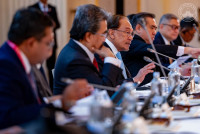
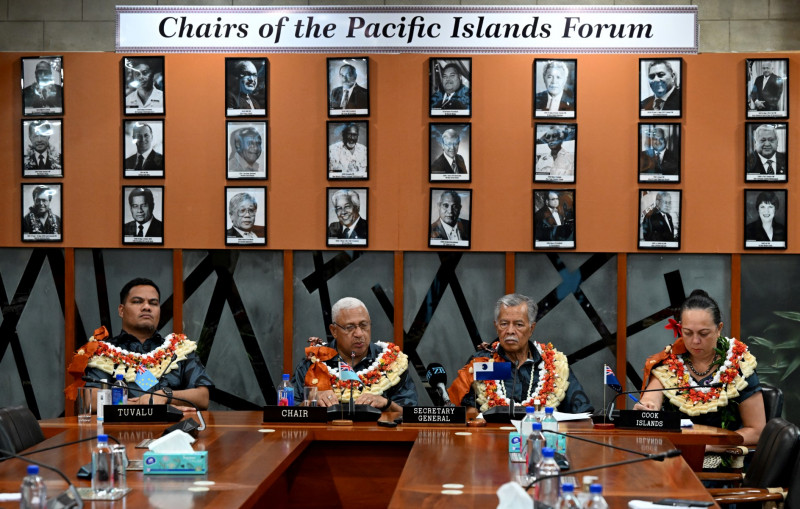
In uniting on regional issues, PIF leaders, like their predecessors, have demonstrated the leadership style which has and will continue to define the region. Talanoa and soālapule cannot be effectively achieved over digital platforms, resulting in the 2021 fallout. Recent meetings in Fiji’s capital Suva leading to both the resolution of the PIF membership and the rejection of a pan-Pacific security deal with China were a reflection of two elements of Pacific unity, that demonstrate the importance of in-person talanoa and soālaupule to the Pacific Way.
The departure of some of the stalwarts of regionalism due to elections and term-ends saw new and some youthful leaders across the Pacific. Former leaders had shaped and charted the way forward. New leaders have handled unprecedented challenges, unified the region, and demonstrated a refreshed and positive outlook for the future of regionalism.
Regionalism has organically grown into a patchwork, with overlapping memberships, rather than a top-down architecture. This is one of the reasons that unity has prevailed – when Micronesia suggested leaving the PIF, it did not pause its membership in other important regional institutions such as the Forum Fisheries Agency or the Pacific Islands Chiefs of Police. Indeed, one of the resolutions to the Micronesian split was to reorganise the Oceans Commissioner role, another organic change to meet Pacific needs.
The patchwork did not fall apart at the seams, because of the many layers of unity.
Pacific leaders are united on regional priorities. Climate change is the single greatest threat to Pacific livelihoods and remains the focus of the 2018 Boe Declaration. Tuvaluan Foreign Minister Simon Kofe stated that great power politics were getting in the way of addressing the region’s key security threats and nations should not be “forced to choose sides” but instead band together to focus on a bigger threat like climate change.
During the 2022 Shangri-La Dialogue, a global defence summit, Fijian Defence Minister Inia Seruiratu also shared similar sentiments: “Machine guns, fighter jets, ships... are not our primary security concern… The single greatest threat to our very existence is... human-induced, devastating climate change. It threatens our very hopes and dreams of prosperity,” Seruiratu said.
It is unity over a shared threat that has brought the Pacific Islands together again. They cannot fight climate change alone. The Pacific Islands’ unity has shown strength over climate change, particularly at COP26 and negotiating sovereign maritime boundaries in the Blue Pacific. Indeed, Pacific Island nations deem themselves large ocean states, showing the importance of the area when united.
The region does not agree on the issue of China, with some signing bilateral economic deals on Foreign Minister Wang Yi’s recent visit to the Federated States of Micronesia, and others squarely rejecting China’s influence. Four Pacific states recognise Taiwan as an independent state: Nauru, Marshall Islands, Tuvalu, and Palau.
To create a united approach despite differing interests, Pacific leaders are requesting that issues that affect broader regional security are brought to the PIF, including bilateral security deals. Whether the current regional security declarations signed in Biketawa (2000) and Boe (2018) are sufficient for this purpose will be discussed at the PIF in July, showing that there could be an evolution of the regional architecture to meet emerging needs.
Regionalism in the Pacific did not and will not fall apart, contrary to external opinion. Instead, it was strengthened internally, through the trusted values of the Pacific Way which unite the region. Pacific leaders have used tried and true methods to emphasise that whatever the world throws at them, they will remain united.
Values of unity are what sustain and maintain regionalism and sovereignty in the Pacific. – The Vibes, July 23, 2022
Henrietta McNeill is a PhD candidate at the Department of Pacific Affairs at the Australian National University. She is a 2021-22 Fulbright NZ scholar, hosted by the University of California at Los Angeles
Maima Koro is a Pacific research fellow and PhD candidate at the University of Adelaide. She was bestowed the Samoan chiefly title of Maualaivao in 2008
Published under Creative Commons and in partnership with 360info.org