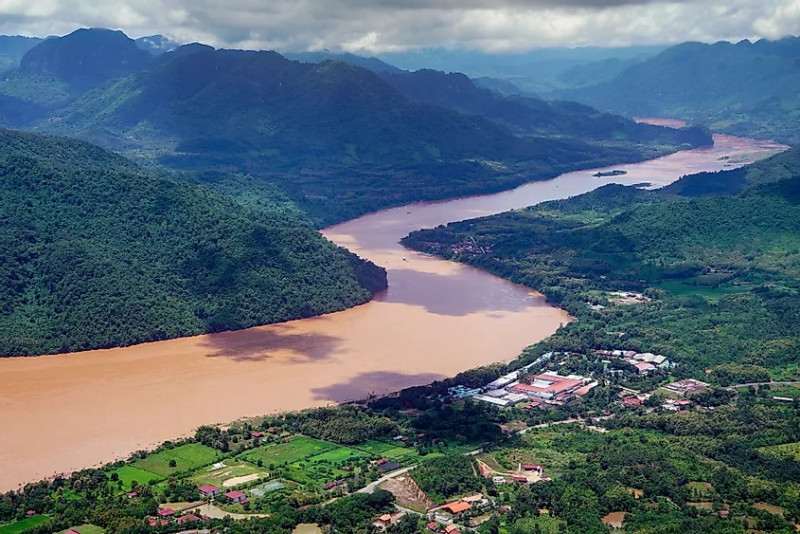
SINGAPORE – Zoom in on a satellite map of the Mekong River anywhere in Cambodia or Vietnam and you are likely to find cranes and transport boats lining the shores. This is sand mining – a large-scale, environmentally devastating process that is transforming the Mekong River.
Since 2014, the estimated volume of sand mined in the Mekong Delta each year has been independently measured. By using high-resolution satellite imagery and river incision maps, the spatiotemporal distribution of sand mining crimes and suction dredges can be traced and an estimate can be formed.
In 2015, the total amount of sand mined in the Mekong Delta was 38,000,000m3. Three years later, in 2018, the estimation was 43,000,000m3 – more than twice the amount officially declared. The volume kept increasing in 2020, registering at an estimated 47,000,000m3.
Mining sand may sound strange – unlike gold or diamond, it is a resource that seems naturally abundant. But sand is more essential to humans than many recognise: after water, it is the second most exploited natural resource in the world – underpinning any concrete structure, including buildings and roads.
The demand for sand has been increasing exponentially since the first industrial usage in the 19th century and is expected to accelerate in the future.
And sand from river beds is the most highly sought-after type, for its inherently durable properties make it best suited for construction projects. Sand from the sea is too smooth and desert sand is too sticky to be well-suited for construction.
However, these ‘inferior-grade’ sands serve other purposes, such as land reclamation. For this reason, the lower stretch of big rivers such as river deltas, where the settlement of sandy materials is naturally favoured due to low gradient, have become the major sand supplier across the globe.
In Southeast Asia, erodible mountains and rainfall are abundant and that favours the formation of big rivers, which are the natural producers of sand.
More, including the Mekong, Red, Ayeyarwady, Chao Phraya and other big rivers in Sarawak and Indonesia, have been extensively mined.
Impact on environment irreversible
Intensive sand mining in the Mekong River started in the early 1990s. Some of the mined sands are locally consumed, but most are exported to the region’s mega-cities such as Hong Kong, Taipei, Seoul and Singapore.
Large-scale sand mining in rivers has often irreversible environmental repercussions. Dredging the riverbed destroys the habitat of the many riverine organisms. Simultaneously, removing sand deepens the riverbed and lowers the water level.
This overall lowering decreases the volume of floods during wet seasons, which may lead to lesser water availability for irrigation, industry and domestic use. Riverbed mining also facilitates river bank collapse and causes seawater intrusion which threatens the livelihoods of farmers that reside in deltas.
Combined with the sand deficit caused by the expansion of hydropower dams in numerous big rivers in Southeast Asia, the environmental impacts from sand mining in the deltas have been exacerbated. The United Nations Environment Programme recently declared sand mining one of the major sustainability challenges of the 21st century.
Hard to independently determine rate of sand mining
Despite the extensive environmental repercussions, sand mining remains poorly studied. The general public is also largely unaware of this environmental threat – perhaps because the current scale and intensity of the activity are hard to comprehend.
Quantifying the sand mining rate of a river isn’t a simple task, simply because the extraction happens underwater. The conventional way to do it is by surveying the riverbed elevation: a costly, time-consuming task for big rivers. The river area of the Mekong Delta is around 800km2.
The survey would also have to be conducted at least twice, with a minimum of a one-year interval to measure the elevation change in the bed that has been extracted. Financially and logistically, this is difficult.
Because of the challenges of independently quantifying rates of sand mining, most official statistics rely on declarations by mining companies.
Officially, 20,000,000m3 of sand was extracted from the Mekong Delta in 2018. However, the actual amount is suspected to be much more given how widely illicit sand mining has been openly conducted.
The gap between the official numbers and reality makes it more likely for environmental consequences to be overlooked.
The world will continue to develop, and the demand for river sand is unlikely to decrease. A practical and sustainable option is required.
It is viable to mine sand from floodplains, where a similar quality of sand can be obtained. Floodplains are the “natural sinks” of sand where river sediments are deposited through annual flooding during wet seasons.
It is not fully without consequences: mining sand in floodplains leads to habitat removal, but inundation and disruptions to water levels are less likely. This will mitigate one of the major consequences of river mining, the deficit of water resources.
Floodplains are generally further from the sea relative to the river, pushing up transportation costs. But it’s a cost tradeoff with big consequences for the future of rivers and the people reliant on them. – The Vibes, September 24, 2022
Edward Park is an assistant professor of physical geography at the National Institute of Education and a principal investigator at the Earth Observatory of Singapore, Nanyang Technological University (NTU). The research referred to in this article has received funding from NTU and the Singapore Education Ministry.
This article has been republished for World Rivers Day which falls tomorrow. It was first published on February 21, 2022.
Published under Creative Commons and in partnership with 360info.org




.jpg)