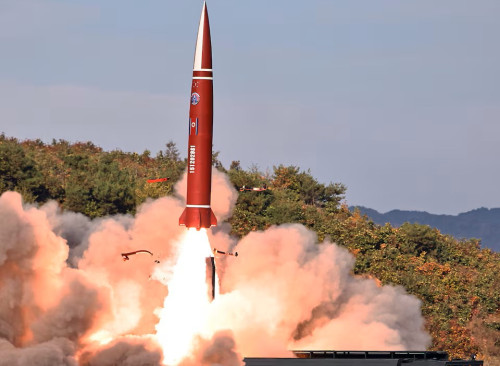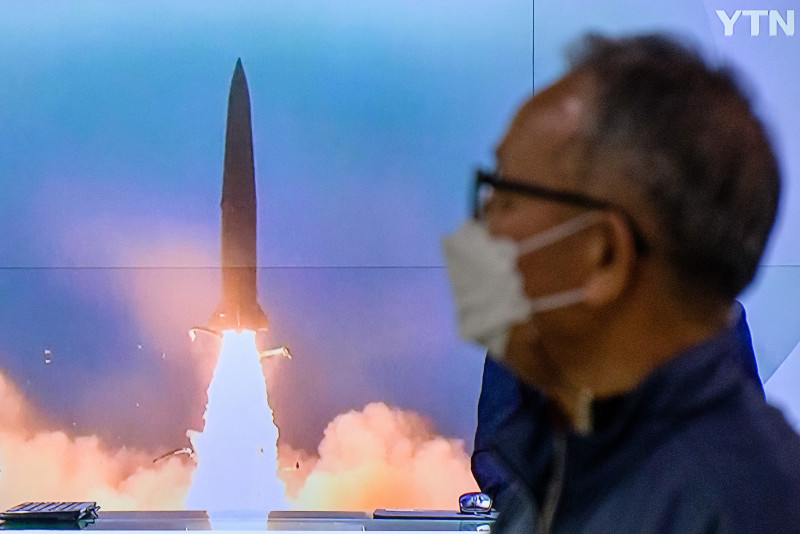
SEOUL – North Korea fired two ballistic missiles into the sea early today, Seoul’s military said, the seventh such launch in two weeks, just hours after a nuclear-powered American aircraft carrier wrapped up joint drills off the Korean peninsula.
Seoul, Tokyo, and Washington have ramped up combined naval exercises in recent weeks, infuriating Pyongyang, which sees them as rehearsals for invasion and justifies its blitz of missile launches as necessary “countermeasures”.
With talks long stalled, Pyongyang has doubled down on its banned weapons programmes, firing an intermediate range ballistic missile over Japan last week, with officials and analysts warning it has completed preparations for another nuclear test.
South Korea’s military said today it had “detected two short-range ballistic missiles between (1.48am and 1.58am) fired from the Munchon area in Kangwon province towards the East Sea”, referring to the body of water also known as the Sea of Japan.
The missiles “flew approximately 350km at an altitude of 90km”, Seoul’s Joint Chiefs of Staff said in a statement, calling the launches a “serious provocation”.
Tokyo also confirmed the launches, with the coast guard saying the missiles had landed outside Japan’s exclusive economic zone.
Japanese Senior Vice-Defence Minister Toshiro Ino said Tokyo was analysing the missiles, adding that “either one of them has the possibility of being a submarine-launched ballistic missile (SLBM)”.
Seoul said last month it had detected signs the North was preparing to fire an SLBM, a weapon Pyongyang last tested in May.
The US military’s Indo-Pacific Command said in a statement that they were “consulting closely with our allies and partners”, adding that the launch highlighted the “destabilising” nature of North Korea’s missile programmes.
Drills, drills, drills
The recent spate of launches is part of a record year of weapons tests by isolated North Korea, which leader Kim Jong-un last month declared an “irreversible” nuclear power, effectively ending the possibility of denuclearisation talks.
In response to the growing threat from the North, Seoul, Tokyo, and Washington have ramped up joint military drills, including with the USS Ronald Reagan aircraft carrier and its strike group, which was redeployed to the area last week.
On Thursday Seoul’s military said it had scrambled 30 fighter jets after 12 North Korean warplanes staged a rare formation flight and apparent air-to-surface firing drills.
Analysts say Pyongyang is emboldened to continue its weapons testing, confident that gridlock at the United Nations will protect it from further sanctions.
Last week, the UN Security Council held an emergency meeting to discuss Pyongyang’s launch over Japan, which officials and analysts said was a Hwasong-12 that likely travelled the longest horizontal distance of any North Korean test.
But at the meeting, North Korea’s long-time ally and economic benefactor China blamed Washington for provoking the spate of launches, with deputy Chinese ambassador to the UN Geng Shuang accusing the United States of “poisoning the regional security environment”.
US ambassador to the UN Linda Thomas-Greenfield called for “strengthening” existing sanctions on North Korea, something China and Russia vetoed in May.
The council has been divided on responding to Pyongyang’s nuclear ambitions for months, with Russia and China on the sympathetic side and the rest of the council pushing for punishment.
Officials in Seoul and Washington have been warning for months that Pyongyang will also conduct another nuclear test, likely after China’s Communist Party Congress later this month.
“A flurry of missile tests like the one we’ve seen could indicate a build-up to a nuclear test, but predicting the timing with any precision is quite challenging. A test can take place almost immediately after Kim orders one,” US-based security analyst Ankit Panda said. – AFP, October 9, 2022