MONTREAL – The thorny issue of how much money wealthy countries are willing to pony up to protect the world’s remaining biodiversity took centre stage yesterday at UN talks in Montreal aimed at creating a “peace pact with nature”.
At stake is the future of the planet and whether humanity can roll back habitat destruction, pollution, and the climate crisis, which are driving the sixth mass extinction of plant and animal species.
Negotiators worked late into the night Tuesday, but “the atmosphere deteriorated when the group started discussing concepts, in particular the global biodiversity fund (GBF) proposal”, said UN spokesman David Ainsworth, leading to a walkout by developing nations.
The GBF is a new financial instrument sought by low-income nations to help them, for example, establish marine or terrestrial protected areas and implement biodiversity action plans.
A long pause in technical talks on other items was resolved after China, the chair, held an hours-long meeting of the heads of delegations yesterday, though the finance issue has not yet been settled.
“Our territories are home to most of the biological diversity of the world,” said a statement by Brazil, which added existing financing mechanisms were not up to the task.
Brazil, which also spoke on behalf of some other developing countries, including the African Group, added that the new fund should provide US$100 billion (RM440.35 billion) yearly, or 1% of global GDP, until 2030.
Financial flows from the global north to south for biodiversity are currently estimated at around US$10 billion annually.
Wealthy nations say they would rather reform existing financial mechanisms and leverage more private sector funding.
The deterioration in dialogue came on the eve of the high-level phase of negotiations involving the environment ministers of the 196 members at the Montreal summit, called COP15, which began on December 7 and is set to run to December 19.
“The walkout that happened last night is a signal of a pivotal moment in the negotiations that we needed,” Masha Kalinina of The Pew Charitable Trusts said.
“It draws important attention to this negotiation, especially as the leaders are arriving today and tomorrow. So we are waiting with bated breath.”
Brian O'Donnell, director of the Campaign for Nature, told reporters: “If we want to find a source for increased finance for biodiversity, it’s simple: let’s place a windfall tax on those companies that have driven biodiversity loss – primarily the oil and gas companies and the mining companies.”
The talks have more than 20 targets, including a cornerstone pledge to protect 30% of the world’s land and seas by 2030, eliminating harmful fishing and agriculture subsidies, tackling invasive species, and reducing pesticides.
Science shows that time is running out.
An estimated million species are threatened with extinction, a third of the world’s landmass is degraded, comprising the productivity of soil, while pollution and the climate crisis are destroying marine ecosystems.
Beyond the moral implications, there is the question of self interest: US$44 trillion of economic value generation – more than half the world’s total GDP – is dependent on nature and its services.
But the summit has failed to garner the same level of attention as a UN climate summit held in Egypt in November, which brought together more than a hundred world leaders.
The meeting is being held in Canada but chaired by China, which declined to host because of its strict Covid-19 rules.
The only world leader in attendance is Canada’s Prime Minister Justin Trudeau.
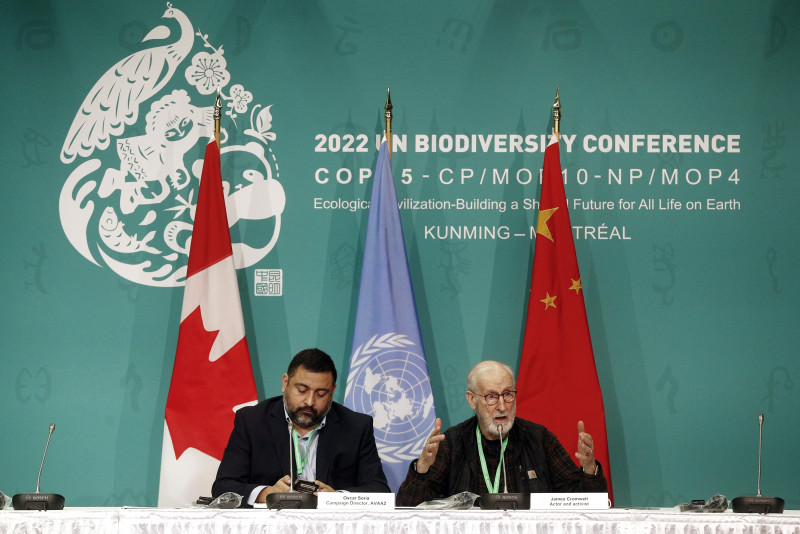
Speaking at a press conference organised by the nonprofit Avaaz, Hollywood actor and activist James Cromwell singled out French President Emmanuel Macron in particular, for opting to visit Qatar to watch the soccer World Cup semifinal instead of coming to the COP.
“It’s tragic that it takes an actor to come up here to talk about issues,” he said. “Have you no shame?” – AFP, December 15, 2022