
THERE is a need to form a National Economic Reset or Reform Council to serve as a navigational guide and referral point for the country.
This, said a veteran economist, would help to execute essential reforms to steer it from the horrors of a stagnant economy.
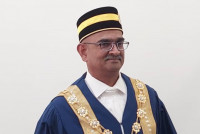
Tan Sri Dr Kamal Salih, who once helmed the Malaysian Institute of Economic Research (MIER) and a member of the now defunct Prime Minister's Economic Council of Advisors, said the council or even a task force can ensure the implementation is carried out comprehensively at the macro and micro levels of the economy.
While there are signs that the country is moving out of the rut following the pitfalls of the Covid-19 pandemic legacy of supply chain bottlenecks and record high inflation, Kamal nonetheless cautioned that more needs to be done now.
Kamal said as with previous efforts, the government and private sector initiatives will come to nought if the implementation is not properly geared.
"Whatever happened to the National Task Force to Recover National Assets previously and an early effort launched by the government? Either its work is so secretive that we hear nothing of it, or it has done no work. The rakyat has the right to know," he said.
There are only two occasions where Malaysia saw effective coordination and monitoring of the implementation of projects - in the early years of the New Economic Policy (NEP) in the 1970s and when the National Economic Action Council (NEAC) did its work during the Asian Financial Crisis in 1998-2001, he said.
Kamal has now urged the government to show the same resolve and commitment to reset the economy.
The Madani government should set up a similar high-powered task force as the NEAC called the National Reform Council or Reset Task Force, to be chaired by the Prime Minister and comprising selected experts, businessmen and technocrats as was the case before, he said.
They must for a period put in place implementation and monitoring initiatives to ensure that the reforms of the economy are carried out without fear or favour, he said, reminding that reforms are not only about eradicating corruption but to execute changes to ensure the economy is competitive in the global environment.
With China and India emerging as top economies, Kamal said, Malaysia needs to figure out where it can position itself best in the global economy, which can be unforgiving if the country undertakes wrong steps.
Kamal said that technologically-intensive agriculture is long overdue and urgent for food security.
There is a private sector initiative to introduce Solarised Regenerative Agriculture, through building pink solar greenhouses throughout the country which needs government support to address the food security issue.
This is a priority issue in the Madani Economic framework.
In this plan, there is a private effort in Malaysia to produce pink solar panels for the world market, because of the availability of fine silica in Terengganu, and the lower cost in Malaysia compared to Saudi Arabia which is the other initiative.
The venture valued at USD$150 million, is being mooted.
Malaysia is slated to train 10,000 technical personnel going forward under the auspices of a Malaysian think tank called High-Value Farming Group (HVFG), which has four centres of excellence under its wing for this purpose, he said.
"We also cannot afford to be stuck in the 5G rollout when other countries are already into 6G. Our engagement in semiconductors is still at a low-value-added phase when India, a late-comer to the industry, is taking more aggressive steps."
On the social wellbeing front, as a carry-over from the work of the Health Advisory Committee of the first Pakatan Harapan Government, a National Health Trust Fund under a Real Estate Investment Trust (REIT) aimed at monetising public hospitals should now be launched in the coming Budget to ease fiscal pressure on the consolidated funds and for Malaysia to regain a high healthcare standard.
A similar monetisation plan is being studied for higher education institutions' financial consolidation.
Kamal expressed his confidence that with these initiatives and reforms, Malaysia can achieve a higher growth trajectory if the government is willing to put in place the right policies that often do not depend on public funding.
At the same time, plans are afoot in Yayasan Mahkota to introduce a Universal Credit System, called the National Gold Equity Plan under its Islamic Economic Model to introduce a decentralised microfinance system to complement the Amanah Ikhtiar Scheme first introduced in the 1970s and the recently reintroduced as the Madani Government's SARA system, said Kamal. - September 18, 2024.