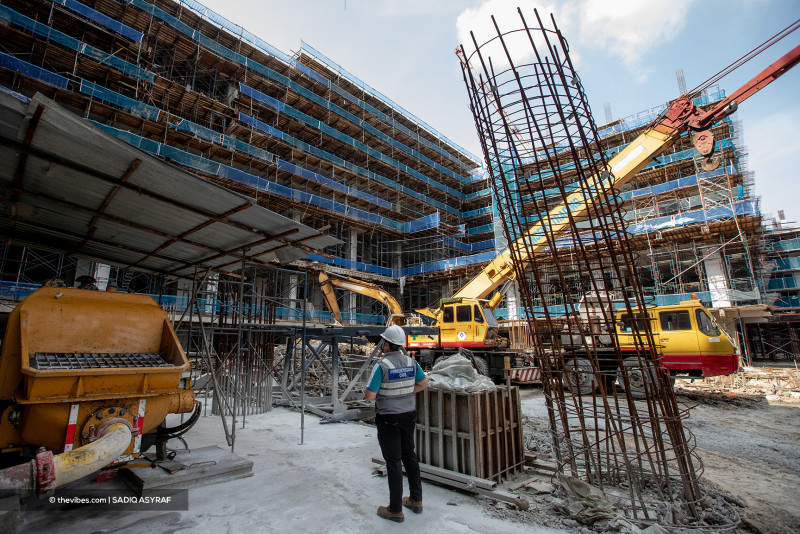
THE nation’s construction industry is confronting a defining challenge as escalating building costs threaten to disrupt housing delivery, weaken contractor viability and force a fundamental rethink of how development projects are planned and executed across the country.
Industry leaders are increasingly warning that soaring costs are no longer a temporary market fluctuation but a structural shift that could permanently alter the economics of construction, with implications stretching from government infrastructure projects to private housing developments.
At the centre of the growing concern is the prospect that higher costs could eventually be passed on to homebuyers, further affecting affordability in an already challenging property market.
In a clear signal of the industry's concerns, newly elected Pertubuhan Akitek Malaysia (PAM) president Dexter Koh Yew Peng delivered a blunt assessment of the situation.
"The industry must accept this reality and adapt to this new baseline."
27 Advisory, a Malaysian consulting firm providing strategic advisory, project management, financial consulting and digital transformation services, cited that Koh’s remarks underscore a growing consensus among construction professionals that the sector has entered a new operating environment defined by persistent cost pressures arising from higher fuel prices, supply chain disruptions, geopolitical tensions and rising material costs.
The challenge is particularly significant because building materials account for more than 64 per cent of total construction expenditure, leaving developers and contractors highly exposed to market volatility.
While major construction firms may possess sufficient financial resources and contractual mechanisms to absorb some of the increases, smaller contractors face a far more precarious situation.
Many are attempting to complete projects under contracts signed months earlier, before the latest surge in costs, leaving them exposed to shrinking margins and mounting financial pressure.
Industry observers warn that these pressures are already influencing project decisions throughout the construction ecosystem.

Developers are increasingly being forced to reassess budgets, delay procurement schedules, revise project specifications and reconsider investment plans as construction economics become more difficult to sustain.
In some instances, projects may face postponement or cancellation if costs continue to rise faster than anticipated revenues.
Such outcomes would have consequences far beyond the construction industry itself.
Housing analysts note that project delays and cancellations ultimately affect ordinary Malaysians, particularly first-time homebuyers who often commit years of savings towards securing a property.
For many families, the prospect of delayed completion represents not merely a financial inconvenience, but a disruption to long-term life plans centred on home ownership.
The pressure on the industry has intensified following significant increases in transportation costs resulting from the rationalisation of diesel subsidies.
According to figures cited by Economy Minister Datuk Seri Akmal Nasrullah Mohd Nasir, average prices across key construction materials have risen by approximately 12.6 per cent.
However, industry players argue that actual increases experienced on the ground are considerably higher in many locations, particularly when logistics costs are factored into procurement and delivery expenses.
The impact is being felt across virtually every segment of the supply chain, from aggregates and sand to steel, concrete and manufactured building products.
Beyond housing and infrastructure delivery, experts are warning that escalating costs could also undermine Malaysia's sustainability ambitions.
As project budgets tighten, developers often prioritise immediate cost reductions, placing environmentally friendly materials, green technologies and energy-efficient systems at risk.
Industry professionals fear that sustainability features could become casualties of cost-cutting measures unless targeted support mechanisms are introduced.
In response, construction stakeholders are calling for urgent intervention to prevent further deterioration in project viability.
One proposal receiving strong backing is the revival of the Variation of Price (VOP) mechanism for government projects, which would allow contractors to adjust contract values in response to extraordinary increases in material prices.
Supporters argue that such a mechanism would provide much-needed stability and reduce the risk of project disruptions caused by unforeseen economic shocks.
The industry is also advocating accelerated approval processes for development applications and building permits.
Developers contend that lengthy approval timelines significantly increase financing and holding costs, further eroding project viability during a period of elevated construction expenses.
Industry representatives believe that streamlining administrative procedures could provide immediate relief while encouraging continued investment in new developments.
At the policy level, attention is also turning towards potential reforms aimed at increasing competition and improving supply availability within the construction materials market.
Measures under consideration include reviewing import regulations and exploring ways to enhance supply chain resilience in response to external shocks.
Construction leaders argue that Malaysia can also draw valuable lessons from international examples.
Singapore has successfully utilised digital construction technologies to improve efficiency and reduce costly project overruns.
The United Kingdom has increasingly adopted a lifecycle-cost approach that evaluates buildings based on long-term value rather than initial construction expenditure alone.
Australia has focused on strategic prioritisation of infrastructure pipelines, ensuring that resources are directed towards the most critical projects during periods of cost escalation.
Industry experts believe adopting similar strategies could help Malaysia sustain development momentum while safeguarding fiscal discipline and project quality.
Despite the economic and policy dimensions of the issue, construction professionals stress that the crisis ultimately has a human impact.
Behind every delayed project are contractors struggling to remain operational, consultants adapting designs to shrinking budgets and families awaiting homes that represent years of sacrifice and financial commitment.
The coming months are expected to be crucial in determining whether Malaysia can successfully navigate the challenges posed by rising construction costs.
Industry leaders maintain that while elevated costs may be unavoidable, proactive reforms, stronger collaboration and faster policy responses can help prevent a temporary cost crisis from evolving into a broader development challenge.
As the sector adjusts to what many now describe as a permanent shift in operating conditions, the central message from industry stakeholders is clear: adaptation is no longer optional, and decisive action will be essential to protect housing delivery, infrastructure development and long-term economic growth. - May 30, 2026
*This article is part of 27Advisory's Rebuilding Humanity 2.0 framework, a nine-pillar knowledge architecture for navigating Malaysia's most consequential structural transitions.
*The views, opinions, analysis and conclusions expressed in this article are solely those of the author and do not necessarily reflect the views, positions or editorial stance of TheVibes.com, in any manner whatsoever.