FOR those of us who have only experienced uninterrupted peace and economic growth – cyclical recessions aside – the experience of 2020 as a year in which our aspirational horizons and mobility were so completely and radically delimited by global forces, has been a complete shock.
So to speak to someone whose early life was shaped by war, mass displacement, and emerging national borders, is an exercise in remembering that the travails of the present are not all that unique.
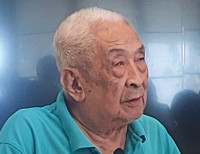
This interview with Wang Gungwu was my second with the eminent historian.
I had previously spoken to him for BFM Radio, tapping him for his view on the People’s Republic of China’s global ambitions and the new fault lines in the South China Sea.
But the very first time I heard him speak was at the memorial of my late uncle, James Puthucheary, who Gungwu knew at the University of Malaya in Singapore.
Choked with emotion, Gungwu spoke about James and the formative years of his generation. The young men and women of a yet to be sovereign nation – in fact two nations by the time 1965 rolled around a decade and half later.
So exclusive was this small group of university students that in the early 1950s, on a tour of India and Sri Lanka (one of the more politically advanced of the British colonies, having achieved Dominion status), Indian Prime Minister Jawahalal Nehru met with them for tea.
While it is true that all generations have their unique challenges, in terms of the formation and trajectory of Malaysia and Singapore, this generation had an overwhelming impact.
It was the time in which Tun Dr Mahathir Mohammad – not yet a qualified doctor – was writing his Chetdet column (while eschewing campus politics).
And so it is here that Wang Gungwu enters the frame with ‘Home Is Where We Are’, the second volume of his memoirs.

The previous volume of his autobiography, ‘Home Is Not Here’, sketched his early years in which his parents were making decisions that would have a profound effect on his life, determining that South East Asia – Dutch East Indies, Malaya, Singapore – and not China, would be the anchor of his life and perhaps future intellectual concerns.
It begins with a modest exercise to explain to their grandchildren – the first book weaves together his wife Margaret’s life with his – their own origins.
Much like one of my favourite autobiographical sketches – Ben Anderson’s ‘Life Beyond Boundaries’ – that had its beginnings in an exercise for Japanese graduate students, the work is conscious of the material limitations on the lives of individuals.
In this book we encounter Gungwu as an adult determining his own life choices – no doubt limited by the circumstances around him.
To quote a much-used Marxist maxim, men make history but they do so under conditions.
Perhaps what is most important is the self-awareness about these limiting conditions along with the capacity to recognise possibilities that nevertheless exist.
Listening to Gungwu, is an exercise in meditating on the curious ways our lives are shaped.
It is for this reason that individuals like Wang Gungwu are both a wealth of information to tap into but also a challenge for a journalist to speak to – to balance the purely descriptive with the analytical and open the conversation into something like wisdom.
Wisdom that comes from a very long life, turning 90 just recently, lived during an extraordinary century with its global wars, accelerated technological advancement, and now a planetary ecological crisis. – The Vibes, December 27, 2020
Listen to the GTLF2020 podcast: