.jpg)
“CHILDREN are young, innocent souls that need to be protected,” could be the most used excuse to not expose the ugly truth of reality to children.
However, in an era where everything is accessible through the media, how much and to what extent can they be sheltered?
Sure, there are ways to ensure that children today are protected from sensitive issues in the media, but what about issues that are heavily embedded within our society?
Issues related to race, mental health, gender identity and sexuality are a few examples of sensitive topics that we have tried to avoid with children.
In the words of a performing arts teacher from an international school, Ian Skatu: “Things like sexuality, mental health, gender identity, etc, is such a taboo topic in the common Malaysian/Asian household.”
So, what happens when young individuals come across questions and issues related to the said topics?
Dr Seuss is a much loved and popular author of children’s books. Over the years he had gained a steady and strong following but today questions arise about the imagery used in his books.
The recent news on Dr Seuss Enterprises’ decision to take out six titles due to racially offensive images raises the question of whether we as a society are being overly protective of our children.
A statement by the company mentioned, “these books portray people in ways that are hurtful and wrong.”
Among the six titles that are being removed include, ‘If I Ran the Zoo’ and ‘The Cat’s Quizzer’.
Based on a 2019 study published in the Research on Diversity in Youth Literature journal ‘If I Ran the Zoo’ portrayed stereotypical “Arabian” characters, and 'The Cat’s Quizzer’ portrayed a character as “a Japanese”.
It is common knowledge that children are curious creatures by nature, and they are bound to ask questions about what they observe in their lives.
But, is removing and censoring content that touches on sensitive topics the best move, considering that they still live in an unjust society?
For teachers like Skatu, teaching the subject matter is secondary compared to educating his students about life.
A conscious effort is put into every aspect of the lesson and classroom to create a safe space for students to safely explore sensitive topics with a guide.
Unfortunately, sharing the same fate as the Dr Seuss books, teachers like Skatu are let go, or not hired with the hopes that their students are not exposed to these issues.
These societal issues are shielded away from students by streaming and banning contents as well as silencing teachers.
At the end of the day, it is not how much we can keep away from our future generation, but how well we moderate their growth and understanding of an issue.
Cancelling out contents that are deemed “too controversial” will only feed the cycle that we are currently stuck in.
Learning happens outside of the classroom as much as it does inside, and part of that learning is also knowing what is socially acceptable and what isn’t; materials – even those deemed inappropriate – can be as educational when approached correctly.
Teachable moments lost
The six Dr Seuss’ titles being pulled by the Dr Seuss Enterprises due to racist imageries are:
- 'And to Think That I Saw It on Mulberry Street'
- 'If I Ran the Zoo'
- 'McElligot’s Pool'
- 'On Beyond Zebra!'
- 'Scrambled Eggs Super!'
- 'The Cat’s Quizzer'
While the public can empathise with the enterprise’s decision to discontinue the sales of the six titles, some teachers are also disappointed with the loss of a teachable moment.
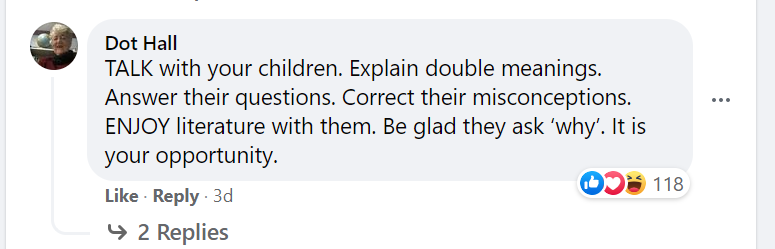
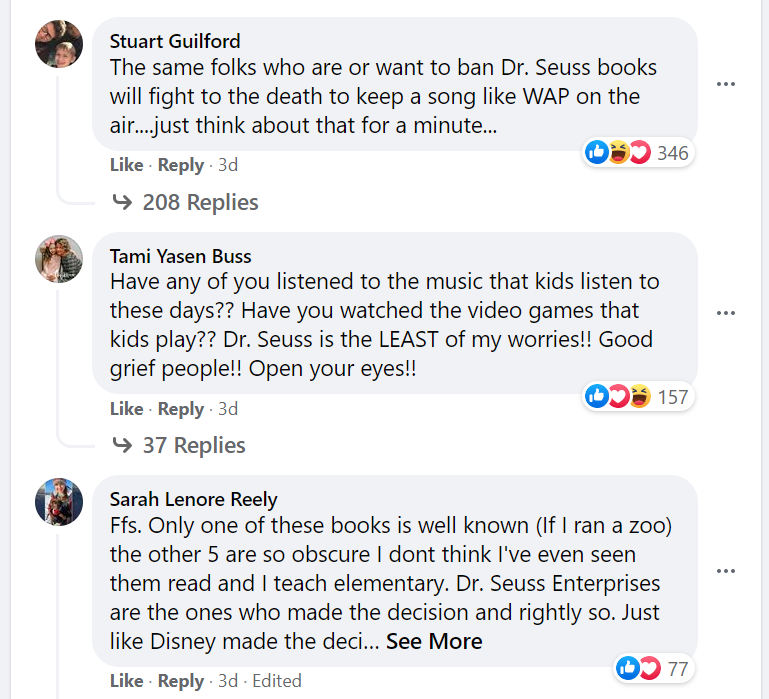
Across the globe, a group of teachers on Facebook shared the same sentiments about how these books have and could have been great teaching moments for their students.
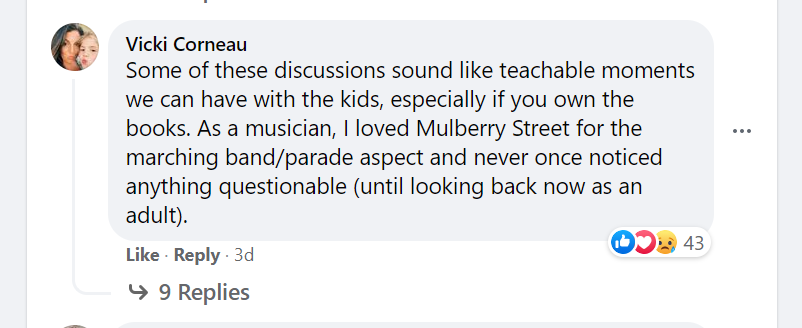
Vicki Corneau, a teacher from Connecticut, USA, said: “Some of these discussions sound like teachable moments we can have with the kids, especially if you own the books. As a musician, I loved 'Mulberry Street' for the marching band/parade aspect and never once noticed anything questionable (until looking back now as an adult).”
From Australia, Teacher Dot Hall, mentioned: “TALK with your children. Explain double meanings. Answer their questions. Correct their misconceptions. ENJOY literature with them. Be glad they ask ‘why’. It is your opportunity.”
And they are only a couple among many others who feel a sense of loss when the enterprise decided to remove the said six titles.
For decades, Dr Seuss’ books have been great tools to use in the classroom across all subject matters.
Personally, these books have been especially useful when teaching and sharpening phonics (the relationship of sounds and letters) and phonemes (the sounds of a word) among English Language Learners (ELL).
The fun yet challenging tongue twisters in titles like 'Green Eggs and Ham' and 'Hop on Pop' serve as great practice for ELL students.
But good phonics and phonemes aside, this new revelation of racially insensitive images in the six titles above could have been a gateway for teachers to approach sensitive topics and educate children about the changing times, what is socially accurate and why.
We can claim that the decision to discontinue these titles are for the benefit of the children, but is removing everything ugly and sensitive the best method; especially when more explicit contents surrounding the internet are accessible at the tip of our fingertip. – The Vibes, March 11, 2021