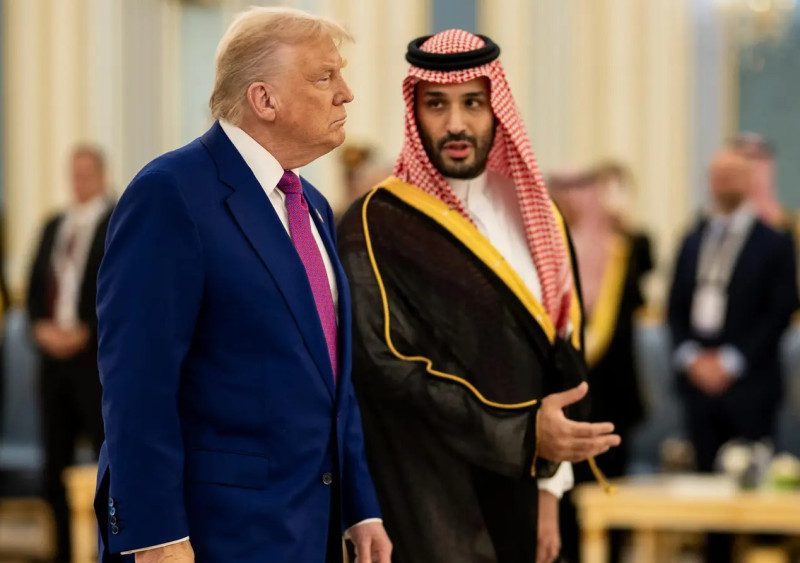
US President Donald Trump has approved a nuclear cooperation agreement with Saudi Arabia that could potentially allow the kingdom to develop uranium enrichment capabilities as part of its civilian nuclear programme, according to sources familiar with the decision.
The agreement, which has yet to be formally announced, is expected to be unveiled as early as Wednesday and could remain in effect for 30 years.
AP cited two sources saying the deal is expected to involve US companies in developing Saudi Arabia’s nuclear sector and could pave the way for the construction of a uranium enrichment facility following a joint US-Saudi assessment.
The agreement is expected to be submitted to Congress for review but could face opposition from lawmakers concerned that allowing Saudi Arabia to enrich uranium could trigger wider nuclear competition in the Middle East.
Saudi Arabia is a member of the International Atomic Energy Agency (IAEA), the Vienna-based organisation responsible for promoting peaceful nuclear cooperation while monitoring countries to ensure nuclear activities are not diverted towards weapons programmes.
However, one source said the agreement is not expected to include the IAEA’s Additional Protocol, which provides expanded monitoring, inspection and verification powers.
The planned announcement comes as the United States and Israel remain engaged in military action against Iran, with one of the stated objectives being to prevent Tehran from developing nuclear weapons. Iran has consistently maintained that its nuclear enrichment activities are for peaceful purposes.
The White House and Saudi officials in Riyadh did not immediately respond to requests for comment.
Both Trump and former president Joe Biden had previously sought to negotiate a nuclear cooperation agreement with Saudi Arabia that would allow the sharing of American technology.
However, nuclear non-proliferation experts have warned that allowing Saudi Arabia to operate uranium enrichment facilities could create a potential pathway towards developing nuclear weapons capabilities.
Although uranium enrichment alone does not automatically result in a nuclear weapon, experts say it provides a key capability that could support future weaponisation efforts when combined with other technical requirements.
Saudi Crown Prince Mohammed bin Salman has previously said the kingdom would seek nuclear weapons if Iran developed such capabilities, raising concerns among Western policymakers.
US Energy Secretary Chris Wright travelled to Saudi Arabia last year, shortly before Trump’s visit to the kingdom, to discuss expanding Saudi Arabia’s civilian nuclear power industry with Saudi Energy Minister Abdulaziz bin Salman.
The US Department of Energy did not immediately respond to requests for comment.
The agreement also comes amid growing regional security concerns after Saudi Arabia and nuclear-armed Pakistan signed a mutual defence pact following an Israeli strike on Qatar targeting Hamas officials.
Pakistan’s defence minister subsequently said the country’s nuclear programme could be made available to Saudi Arabia if required, a statement viewed by some analysts as a warning to Israel, which is widely believed to be the Middle East’s only nuclear-armed state.
The United Arab Emirates previously signed a Section 123 nuclear cooperation agreement with the United States to develop its Barakah nuclear power plant with South Korean assistance, while voluntarily giving up uranium enrichment and spent fuel reprocessing rights.
That decision has been cited by non-proliferation experts as the “Gold Standard” approach for countries seeking to develop civilian nuclear energy. - July 22, 2026