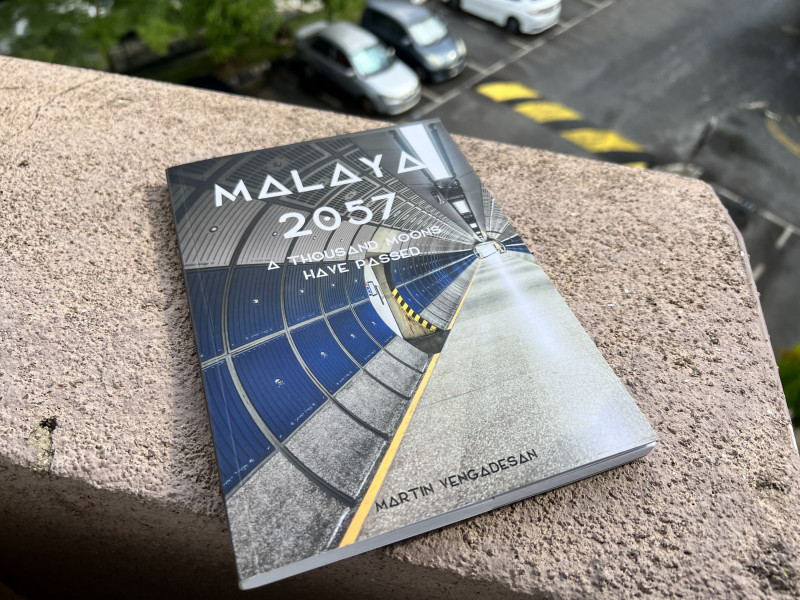

POINTEDLY name-dropping classic dystopian literary works like 1984, Fahrenheit 451, A Clockwork Orange, among others, Malaya 2057 by veteran journalist Martin Vengadesan, is a rather bleak look at a hypothetical future of this country 100 years on from independence.
A Thousand Moons have Passed, as the title says is a reference to how in this science fiction future, time is measured in moons instead of years. This is but one example of how language has evolved in this story.
In that distant point in the future – though not really, 2057 is just 35 years away from the present – in the wake of environmental devastation as a result of climate change and raging viruses that decimated livestock, the iron fisted dictatorial government by the name of the Preordained State has taken over control of what was once Malaysia.
The Preordained State’s hallmarks are similar to the governments of dystopian science fiction: conformity of thought, lack of personal expression and undying loyalty to the state. And similar to many of the classic novels it cites, this isn’t a story about revolution or winning back our freedoms. No, this is about coming to terms with what brought us to this point in history – how failures compounded upon failures, until decline and collapse was inevitable.
Malaya 2057 is not really a narrative novel, focused more on philosophical discussions, though there are two primary characters whose perspectives alternate from chapter to chapter. They come from opposite spectrums, though they are not in direct dialogue with one another.
One of them is an unnamed political prisoner, a former revolutionary, who is now elderly and living the last years of his life isolated in his prison cell, attended to by his guard, Diwan. His chapters are spent looking back fitfully at a life spent bristling against societal norms and expectations. In many ways he embodies a restless progressive, whose ambitions exceeded his grasp.
The other character is Solis, the high level officer and bureaucrat in the state security apparatus of the Preordained State. Early on, he namechecks Lavrentiy Beria, Stalin’s right hand man and prototypical enforcer of a totalitarian regime. Based in the People’s Tower, his world is steeped in Orwellian terminology. His objective is to make sure the chaos that unravelled the previous government does not return.
These two characters embody chaos and order, respectively. Of course, chaos is really just a negative way of describing freedom. The ability of choosing your own path has its virtues, but often they are at odds with the conformity the state enforces.
One of the core purposes of science fiction, since its inception, has been to tell stories of the present through the cloak of metaphor and allegory. Malaya 2057 uses the conceit of a bleak and seemingly hopeless future to interrogate the flaws of our current society.
The unnamed political prisoner is constantly looking back at his life and the various tangents he took, to understand his current situation. He looks back at his youth as a Malaysian Indian trying to find a place in a society that was hostile towards him. He explains his evolving relationship with women. His distrust of faith and spirituality. In many ways he is the typical progressive, bumping his head against the dominant conservative forces.
Progressive reading this book will likely agree with him on many issues, even though it comes off as self-pitying in many parts. Then again, being progressive or liberal in Malaysia often feels futile, especially when it comes to reforming society at large.
Many parts of the book come across as an indictment of the conformity and complacency that are rooted in many parts of Malaysian society. There is a focus on short term scandals – that are often manipulated by those in power – instead of any meaningful attempt at fixing intractable problems. Race and religion are used to divide what could otherwise be a harmonious (relatively speaking) nation.
The dystopian world Malaya 2057 might be a worse case scenario, but it doesn’t seem that absurd. There is always a push and pull between progressive and reactionary forces, and as divides become harder to bridge, society can find itself spiralling downwards. To use the title of Chinua Achebe’s classic novel, Things Fall Apart. – The Vibes, April 24, 2022