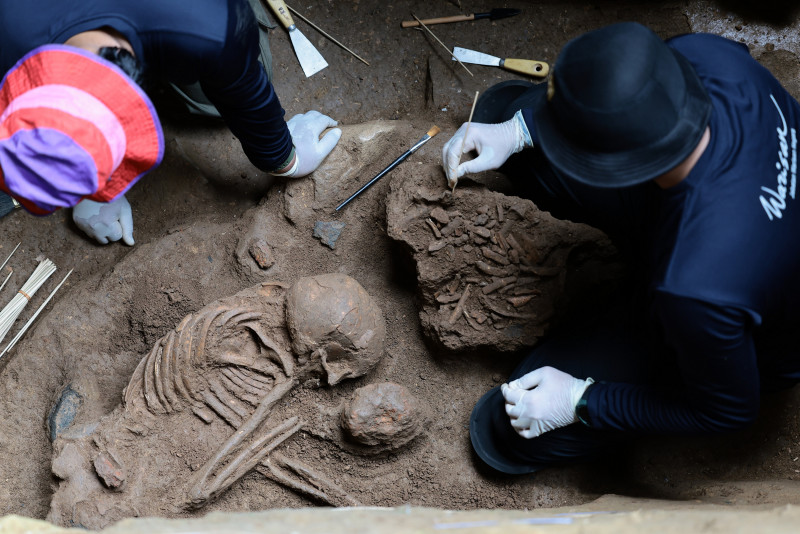
THE 14,000-year-old human skeleton uncovered by archaeologists seven months ago in Gua Keledung Kecil at the Nenggiri Valley in Gua Musang, Kelantan is likely to be that of a female based on the discovery of hematite in the grave.
The mineral has a reddish powder which researchers believe was used as a face powder during the pre-Neolithic age.
Ancient cavemen also used hematite as a tool to draw or scribble on the walls of their cave dwellings and buried it with the dead as well.
A team of researchers from Universiti Kebangsaan Malaysia (UKM) led by Associate Prof Dr Zuliskandar Ramli has been carrying out excavation works at the Nenggeri Valley since September last year.
The excavation, an initiative by Tenaga Nasional Bhd, covers part of the site for the upcoming RM5 billion Nenggiri hydroelectric dam project. It was carried out to salvage several ancient caves in the Nenggiri Valley that are rich in archaeological treasures before being fully submerged when the Nenggiri hydroelectric power station is brought on stream by mid-2027.
A total of 14 caves are involved in the excavation and they include Gua Cha, Gua Chawan, Gua Kecil (Batu Tambah), Gua Lubang Kelawar (Batu Tambah), Gua Keledung, Gua Rahmat, Gua Gemalah and Gua Kelew.
Summarising his team’s discovery of the skeletal remains at the site, Zuliskandar told Bernama: “We, in fact, found many pieces of hematite together with the (14,000-year-old) skeleton. There was a piece of hematite in the left hand and this showed the deceased, when alive, had expertise in using hematite as a make-up aid or as a burial ritual.”
He said the excavation team also found two pieces of clear crystals in the eye areas, adding that the valuable minerals were placed in the eyes of the deceased possibly as part of the prehistoric humans’ burial rituals.
“The Orang Asli practice a similar tradition too… they place stones in the eyes of the deceased and in terms of their philosophy, the eyes of the deceased will turn into stone in the grave. Crystal is a type of stone too, so it can also be placed in the eye area,” said Zuliskandar, who is a senior fellow at the Institute of Malay World and Civilisation, UKM.
Bernama was at the excavation site at Gua Keledung Kecil, Nenggiri Valley, recently for an exclusive coverage of the UKM team’s finds.
Not easy to remove skeleton
Zuliskandar added that the UKM excavation team – assisted by Khairil Amri Abdul Ghani who is senior museum assistant at the Archaeology Division of the National Heritage Department (JWN) and Abdul Ghafar Abdul Ghani, a conservation operations assistant at JWN – had to exercise great care while extricating the human skeleton from the burial site inside a cave.
The Nenggiri prehistoric human is believed to be older than the Perak Man, the moniker given to the skeletal remains of a man believed to have existed 10,000 to 11,000 years ago and discovered in the Lenggong Valley district in Hulu Perak in 1991.
Zuliskandar said the extrication process took about two days, as the skeleton had already been exposed to air for seven months. Apart from that, the soil was moist and the internal parts of the skeleton were covered with layers of soil, which made it difficult to remove the remains.
The cloudy sky and wet weather made things worse for the team as the cave became darker, thus limiting their visibility.
“In view of the fact that this skeleton is that of a prehistoric human, we have to carry out our conservation work carefully with the help of experts from the National Heritage Department.
“To prevent causing any damage, it (conservation work) cannot be done hurriedly… we don’t want to crack or break the bones,” he said.
Zuliskandar added that in the first part of the conservation process, the UKM and JWN team succeeded in separating the upper and lower limb bones from the torso, one by one.
Interestingly, the team managed to keep the upper part of the skeleton – pelvis, ribs and skull – intact instead of separating the parts.
At the excavation site, the skeletal remains were cleaned using a “dry cleaning” technique where a bamboo skewer and small brush were used to remove dirt and other particles. This process had to be carried out with utmost care especially when handling the very fragile parts of the bones.
Khairil Amri, who has been working in the archaeological field since 1999, said the dry cleaning technique is used to remove soil stuck to bones deemed as very fragile. They also applied various other techniques in the conservation process.
UKM expertise
On July 13, the Nenggiri Valley prehistoric human remains were taken to UKM’s Medical Faculty, 300 kilometres away in Kuala Lumpur, for further studies.
To ensure it is not damaged en route to the capital city, the vehicle transporting the skeleton was driven by Khairil Amri himself who drove at a slow and steady speed of 60 kilometres per hour.
Arriving at UKM some seven hours later, the skeleton was taken to the Anatomy Department to evaluate its health and bone density levels.
The skeleton is being studied under the 'Bone Quality of Prehistoric Humans in the Malay Peninsula' project by a team of researchers from UKM’s Anatomy Department and Pharmacology Department led by Prof Dr Ima Nirwana Soelaiman.
“Roughly from what we have seen, this human skeleton has a rather large femur (thigh) bone and looks robust… we can assume that person was healthy when alive,” said Dr Ima Nirwana.
“However, a more detailed analysis has to be done to confirm our assumption.”
The research team’s first task is to get the skeleton cleaned thoroughly. For this, the distilled water immersion method is applied to soften any hardened soil sticking to the bones that could not be removed earlier by the skewer and small brush. After that, the bones will be left to dry completely at a room temperature of between 18 and 22 degrees Celsius, a process that will take one to two months to complete.
The drying process has to take place in a room without light and moisture to prevent the growth of microorganisms such as fungi which will cause the bones to decay fast, according to UKM Anatomy Department lecturer Associate Prof Dr Elvy Suhana Mohd Ramli.
She said bones can last long if maintained properly.
“Bones must be cleansed of all dust so that they don’t become damaged or brittle. This way, bones can last for decades or forever,” she added.
Once the Nenggiri prehistoric human bones are thoroughly cleaned and dried, the researchers will embark on the next process, which is analysing the internal structure of the bones using micro-computed tomography (micro-CT) to determine their internal shape and density. This will take about two weeks to complete.
The two-dimensional (2D) images obtained from the micro-CT scanning will be constructed into 3D images using special computer software. This software will also provide quantitative measurements pertaining to the bones’ internal thickness and trabeculae. This process, however, is complicated and is expected to take two to three months.
“The findings from the scans will give us an idea of the health of the bones and density of the internal structure as well as compare the prehistoric human’s biological characteristics with that of modern humans. We expect these (prehistoric) bones to be stronger than those of modern humans because humans then were more physically active as they had to hunt for animals,” explained Dr Ima Nirwana.
The findings of their studies will be used to build a special database on the biological characteristics of prehistoric human bones. The database will also provide detailed information on human life during the pre-Neolithic era and serve as a source of reference for researchers all over the world.
Elvy Suhana added once their research is completed, the Nenggiri prehistoric human skeleton will be handed over to JWN for conservation purposes. – Bernama, July 24, 2023