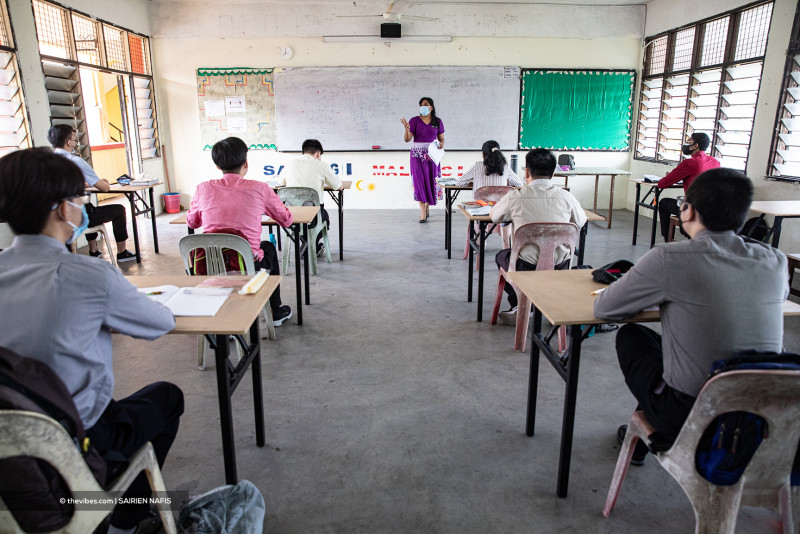
PUTRAJAYA – The use of other languages as the medium of instruction in vernacular primary schools does not violate the federal constitution as the national language is taught as a compulsory subject in those schools, the Court of Appeal heard today.
Senior federal counsel Liew Horng Bin representing the education minister and the Malaysian government submitted that those schools must also conform to the common syllabus.
He said the use of other languages as the medium of instruction in vernacular schools is historically recognised and is expressly provided for in Article 152 of the federal constitution.
In defending the decisions of the high courts, the senior federal counsel contended that a detailed examination of the relevant historical documents and events was crucial to a proper understanding of Article 152.
“We are made by history…history is who we are and why we are the way we are,” said Liew.
Liew said the intent of Article 152 of the federal constitution was to place Malay as the national language, while at the same time, preserving and sustaining the use of other languages in the education system.
He said the relief sought by the Islamic Education Development Council (Mappim) and the Confederation of Malaysian Writers Association (Gapena), Ikatan Muslimin Malaysia (Isma) and Ikatan Guru-Guru Muslim Malaysia (I-Guru) was against the drafters’ intention based on the constitutional history and it destroys the fundamental pillar of the constitutional balance in the country.
The appeals brought by Mappim, Gapena, Isma and I-Guru’s are being heard by the three-member panel of judges comprising justices Datuk Supang Lian, Datuk M. Gunalan and Datuk Azizul Azmi Adnan.
On December 29, 2021, high court judge Datuk Mohd Nazlan Mohd Ghazali (now Court of Appeal judge) dismissed the lawsuits brought by the Federation of Peninsular Malay Students (GPMS), Mappim, Gapena and Isma. GPMS did not file the appeal to the Court of Appeal.
He ruled that the existence and establishment of vernacular schools and the use of Mandarin and Tamil languages in those schools are constitutional.
On May 29, last year, the Kota Baru High Court judicial commissioner Abazafree Mohd Abbas (now high court judge) also ruled that the existence of vernacular schools is constitutional and he dismissed the suit filed by I-Guru.
In the suit filed in December 2019, GPMS, Mappim, Gapena and Isma sued several parties including the government. Among them were Chinese educationist groups Dong Zong and Jiao Zong, Persatuan Thamizhar Malaysia, and Persatuan Tamilar Thurunal (Perak).
As for I-Guru, the organisation sued the education minister and the government of Malaysia, seeking a declaration that section 28 and section 17 of the Education Act 1996 are inconsistent with Article 152 of the federal constitution and it is void and of no effect.
The Malaysia Chinese Language Council, the Malaysia Tamil Neri Kalagam Association, the Confederation of Former Tamil School Pupils, MCA and the United Chinese School Committees Association of Malaysia (Dong Zong) were allowed to become interveners in the suit filed by I-Guru.
The court also heard submissions today from other parties including counsel Datuk Shaharudin Ali who is representing I-Guru and lawyer Datuk Bastian Vendargon who is appearing for the Malaysia Chinese Language Council, the Tamil Neri Kalagam Association and the Confederation of Former Tamil School Pupils.
Shaharudin submitted that based on the government’s latest education blueprint, almost 100% of Chinese students go to Chinese schools and six out of 10 Indian students go to Tamil schools. He questioned whether this divisive situation can contribute to the development of a strong, united and harmonious country.
Vendargon argued that Justice Nazlan was correct when he decided that the relevant provisions of the Education Act 1996 did not infringe Article 152 of the federal constitution.
Justice Supang Lian fixed August 29 for case management to set a date to continue the hearing of the appeals. – Bernama, August 24, 2023