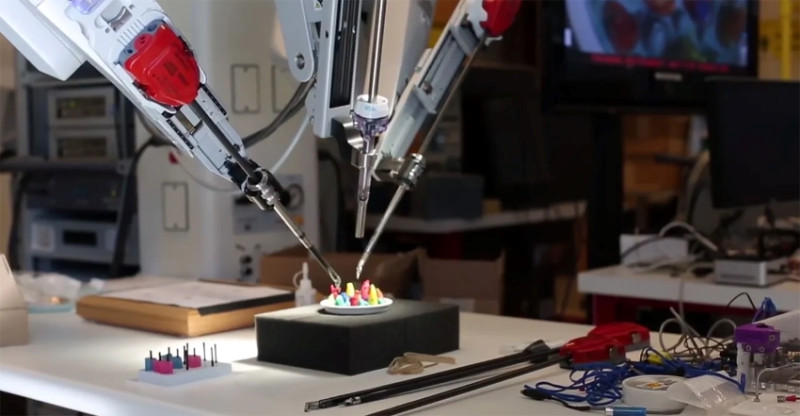
A SURGICAL robot developed by researchers at Johns Hopkins University has successfully carried out a realistic gallbladder removal operation with complete accuracy, in what scientists are calling a major advance in autonomous surgical technology.
In the trial, the robot operated independently throughout a complex phase of the procedure, accurately identifying ducts and arteries, applying clips with precision, and severing tissue as required — all without direct human control.
The system, trained using real surgical videos and powered by machine learning architecture similar to that behind ChatGPT, was able to respond to verbal commands from medical staff, much like a trainee surgeon under the guidance of a mentor. The robot adapted in real-time to unpredictable surgical conditions, including changes in tissue colour after dye was introduced, which mimicked real-life complications.
“There were 17 critical tasks in the surgery,” researchers explained. “The robot had to recognise anatomical features, manipulate them precisely, and make surgical decisions in response to changing visual information.”
Dr Axel Krieger, associate professor of mechanical engineering at Johns Hopkins, said the development marks a fundamental shift. “This is a critical distinction that brings us significantly closer to clinically viable autonomous surgical systems that can work in the messy, unpredictable reality of actual patient care,” he said.
The research, funded by the United States government and published in Science Robotics, builds upon earlier work in 2022, when a robot performed a fully autonomous procedure on a pig. That earlier trial required clearly marked tissue and took place in a controlled setting. By contrast, the new system performed in more lifelike, dynamic conditions.
“To me, it really shows that it’s possible to perform complex surgical procedures autonomously,” said Krieger. “It’s the difference between teaching a robot to drive a mapped route and teaching it to navigate any road, under any condition.”
One key element of the breakthrough was the robot’s ability to adapt to the individual anatomical features of a synthetic patient model and correct its course as needed — responding to commands such as “grab the gallbladder head” or “move the left arm a bit to the left.”
Ji Woong Kim, a former postdoctoral researcher at Johns Hopkins now at Stanford University, said the trial represents a milestone. “Our work shows that AI models can be made reliable enough for surgical autonomy – something that once felt far-off but is now demonstrably viable.”
While the robot took more time to complete the surgery than a human expert would, researchers said the outcome was comparable in quality.
Next, the team plans to train the system for additional types of surgeries, with the long-term aim of introducing safe and adaptable robotic systems into real-world clinical environments. - July 10, 2025