Science

NASA to launch delicate stowing of Osiris-Rex asteroid samples

Osiris-Rex is set to come home in September 2023, hopefully with the largest sample returned from space since the Apollo era

Updated 5 years ago · Published on 27 Oct 2020 9:53AM

NASA to launch delicate stowing of Osiris-Rex asteroid samples
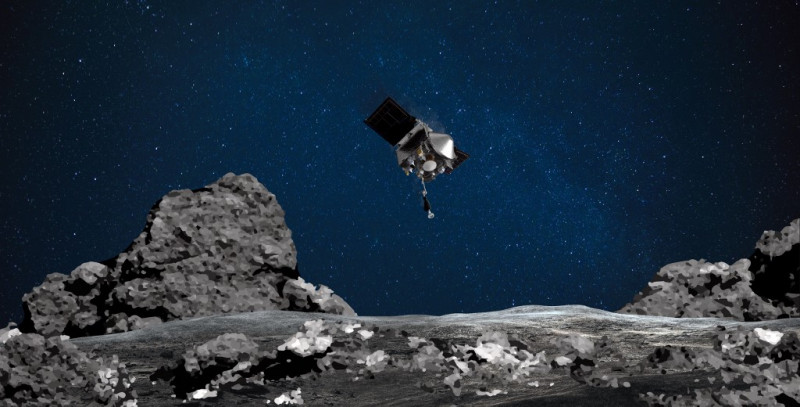
Osiris-Rex is on a mission that scientists hope will unravel the origins of our solar system. – ETX Studio pic, October 27, 2020

NASA'S robotic spacecraft Osiris-Rex is set to begin on Tuesday (October 26) a delicate operation to store the precious particles it scooped up from the asteroid Bennu, but which were leaking into space when a flap got wedged open.

The probe is on a mission to collect fragments that scientists hope will help unravel the origins of our solar system, but that hit a snag after it picked up too big of a sample.

Fragments from the asteroid's surface are in a collector at the end of the probe's three-metre  arm, slowly escaping into space because some rocks have prevented the compartment closing completely.

That arm is what came into contact with Bennu for a few seconds last Tuesday in the culmination of a mission launched from Earth some four years ago.

The probe is thought to have collected some 400 grams of fragments, far more than the minimum of 60 grams needed, NASA said previously.

Scientists need to stow the sample in a capsule that is at the probe's center, and the operation was moved up to Tuesday from the planned November 2 date due to the leak.

"The abundance of material we collected from Bennu made it possible to expedite our decision to stow," said Dante Lauretta, project chief.

Osiris-Rex is set to come home in September 2023, hopefully with the largest sample returned from space since the Apollo era.

The stowing operation will take several days, NASA said, because it requires the team's oversight and input unlike some of Osiris-Rex's other operations that run autonomously.

After each step in the process the spacecraft will send information and images back to Earth so scientists can make sure everything is proceeding correctly.

The probe is so far away that it takes 18.5 minutes for its transmissions to reach Earth, and any signal from the control room requires the same amount of time to reach Osiris-Rex. – ETX Studio, October 27, 2020

Related News

Malaysia / 1w

MACC, Customs task force must become catalyst for smarter border and better container governance

World / 3mth

SpaceX launches its biggest, most beefed-up Starship on test flight (video)

Opinion / 6mth

The 'Age of Apps': Making daily life easier, not harder

Malaysia / 7mth

Part of object suspected to be from space found on Pekan beach

Wellness / 7mth

Penang to ensure room for exercise and social development activities, says CM

Malaysia / 9mth

Supermoon and Taurid meteor shower expected tonight

Spotlight

Malaysia

Myanmar hotel worker charged over alleged sexual assault of three-year-old Australian boy in Penang

Health

MOH weighs HFMD vaccine strategy as cases plunge 83%

World

Trump links Saudi nuclear deal to Israel recognition as pact heads to Congress

Malaysia

Shah Alam brawl turns deadly as car strikes man after machete attack (video)

Music

‘Queen of Country’, Dolly Parton dies at 80

Sports & Fitness

Global cricket legends urge Pakistan to honour court order on Imran Khan’s medical care

Malaysia

Should PH work with Bersama to defeat a common enemy?

Business

Nation’s economic outlook strengthens as leading index signals continued growth

You may be interested

Our Planet

Govt restores nearly 4,000 hectares of mangrove forests with 9.3 million trees

Tech

Australia’s under-16 social media ban begins to show cracks as TikTok use rebounds

Health

MOH weighs HFMD vaccine strategy as cases plunge 83%