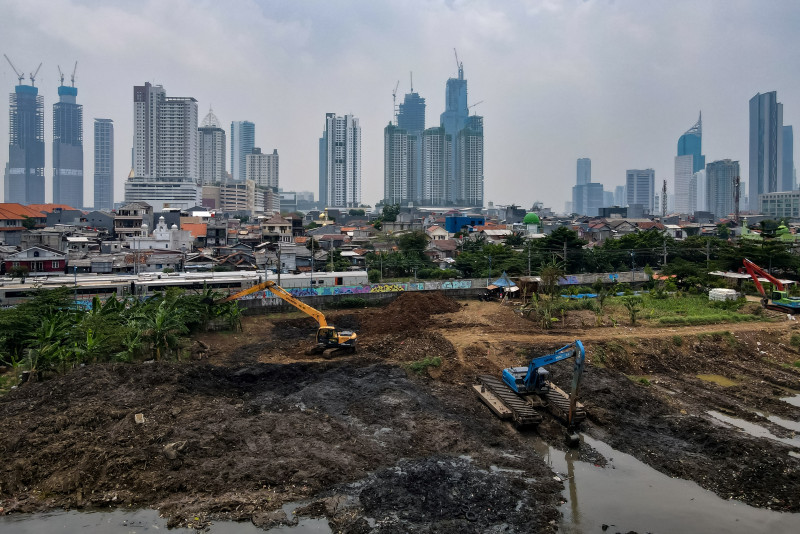
JAKARTA – the fastest-sinking city in the world – has finally taken action on its core land subsidence problem when groundwater free zones for highrise buildings will start to be established in August this year.
If the government accelerates the provision of piped-water to all residents and enforces the ban on using groundwater, it is likely that will slow down the city’s sinking.
But stopping Jakarta’s subsidence will take 20-30 years and Jakartans should wait at least 10-20 years to see any real results.
Increasing the tariff for using the groundwater can control deep groundwater extraction, while encouraging building residents to use recycled water for flushing, gardening, ablutions, and other non-consumption activities.
Jakarta’s land subsidence began in the 18th century when the Dutch cleared the area’s forests for plantations. This rush to clear the land degraded the soil, created erosion and resulting sediment issues in the Ciliwung River. Over time, the accumulation of this sediment formed a delta that the city has been built on. This young soil is still undergoing natural compaction and compression.
Jakarta’s growing population and massive urban development have put extra pressure on the soil, leading to compaction and land subsidence.
Tectonic activity – which is common as Indonesia sits on the earthquake-prone Pacific Ring of Fire – can cause ground vibrations which lead to natural soil compaction.
Jakarta has lost its hydraulic support in the soil. As a natural entity, soil has solid, liquid and gas phases. They are always in a dynamic equilibrium. Excessive groundwater extraction, particularly from deep aquifers (more than 60m below the surface), which is prevalent in Jakarta, results in massive pumping of both the water and air.
This deep groundwater cannot be replenished immediately since the process is slow and can take up to 100 years. Meanwhile, the shallow groundwater can only be replenished during the rainy season. When the pores in the soil are left empty with loads pressing down from above, the land subsides.
This phenomenon is not restricted to just Jakarta. Semarang (Indonesia), Bangkok (Thailand), Yokohama (Japan) and Mexico City all share this problem.
However, if the city is on the coast, a new problem arises. Global warming also causes the sea level to rise, averaging around 5-6 mm/year. This poses a threat to Jakarta's coastal areas, where the land subsidence rate is around 11-12 cm/year.
This makes the control of groundwater extraction crucial.
The inability of Jakarta’s city-owned water company to supply piped-water from the surface water to residents has resulted in massive groundwater extraction. Piped-water coverage is limited, reaching only 48%.
In reality, this number is even smaller, as there are households that do not receive continuous clean water supply. The quality of piped water in office buildings is poor and considered relatively expensive, causing many to secretly and illegally extract deep groundwater.
The problems facing Indonesia’s capital city are immense. They’re bad enough that the government has decided to move the seat of government to a purpose-built city 1300km away in Kalimantan.
In the meantime, Jakarta is taking the right steps, by attempting to control groundwater extraction – though more will need to be done to save the city from the worst effects of sinking and rising sea levels.
Major engineering projects such as a giant seawall and coastal embankment will be needed to deal with the increased flood risk over the coming decades. The development of coastal embankment, which has been in planning since 2014, needs to be continued to enhance the protection of Jakarta’s 30 km coastline.
This embankment can prevent tidal floods in the northern part of Jakarta, while the giant seawall will act as a barrier not directly adjacent to the coast. The concept of a giant sea wall is still being developed by the government, with the hope that it can be a part of Jakarta's current adaptation strategy. – The Vibes, May 16, 2023
Firdaus Ali is a researcher and lecturer in the Environmental Engineering Study Program, Civil Engineering Department, Faculty of Engineering Universitas Indonesia. He is appointed as the Vice President of Asia Water Council since 2016, and Water Resources Management Senior Advisor for Indonesia Minister of Public Works and Housing since 2015.
Published under Creative Commons and in partnership with 360info.org