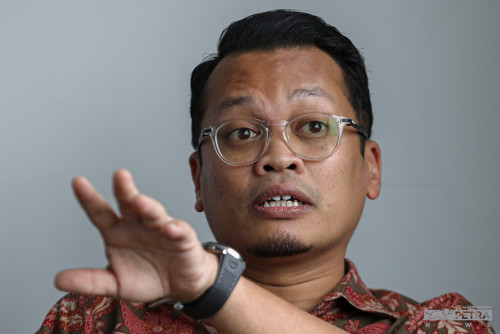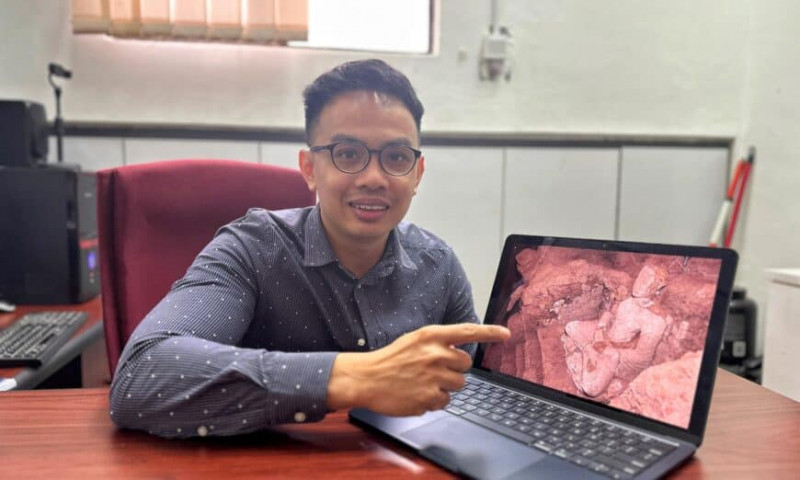

MALAYSIA’S own “Indiana Jones” – Nasha Rodziadi Khaw from Universiti Sains Malaysia (USM) – will lead Phase Four of excavation works at the Bukit Choras site where a life-sized Buddha statue was unearthed.
The young explorer will be armed with more volunteers amid the glare of growing public interest in the stunning discovery, which shows that Malaysia was already a thriving trading hub long before the colonial period.
Archaeology – a painstaking field of finding relics and unlocking humanity's chequered past, especially in the rich hunting grounds of Bujang Valley in Sungai Petani in Kedah – received a shot in the arm after a USM team under Nasha’s supervision found the Buddha statue.
It unleashed fervent interest online and Nasha has been kept busy since.
In a recent interview, he disclosed that two research teams, from the USM Global Archaeology Research Centre and the National Heritage Department, with additional support from volunteers from non-governmental organisations, will be part of Phase Four of the excavation works at the Bukit Choras archaeological site in Yan, Kedah.
The site has since been cordoned off with tight security following the stunning discovery earlier this year.
“Phase Four will likely begin next year,” Nasha said.
It is a crucial period because the teams are hoping to unearth new artefacts and to seek evidence to underpin the notion that the Kedah Tua (Bujang Valley) enclave was one of the earliest ancient civilisations in the region, and even perhaps the world.
The enclave encircles Gunung Jerai, an ancient landmark for historic seafarers.
It encompasses Kuala Muda, Baling and Yan – three out of the 11 districts in Kedah.
Nasha’s research team will comprise 15 members, including lecturers, science officers, technical staff, and students, with more volunteers signing up for the arduous task of working under the sun to dig out ancient treasures.
Nasha noted that research at Bukit Choras began in 2017.
“From 2017 to 2020, we focused solely on geophysical surveys to detect buried artefacts. These surveys indicated significant findings even before the excavation began,” he said.
The statue was unearthed from a Buddhist temple structure dating back about 1,200 years.
The researchers also uncovered two well-preserved, life-sized stucco statues with architectural similarities to artefacts from the ancient Srivijaya kingdom found in Sumatra and West Java.
The third phase, conducted between April and May, unearthed a near-complete life-sized Buddha figure in a meditative pose, about 1.5m tall.
This phase also unearthed Sanskrit inscriptions and other relics.
“The artefacts have been transported to a USM laboratory for detailed conservation and analysis. There is still much to explore at Bukit Choras. These discoveries will provide insights which can enable us to review the historical narratives of Western historians,” he said. – August 7, 2024.