THE Dewan Negara today passed the Bernama (Amendment) Bill 2024, which aims to make Malaysia’s media industry more inclusive and adapt to the changing landscape of information dissemination.
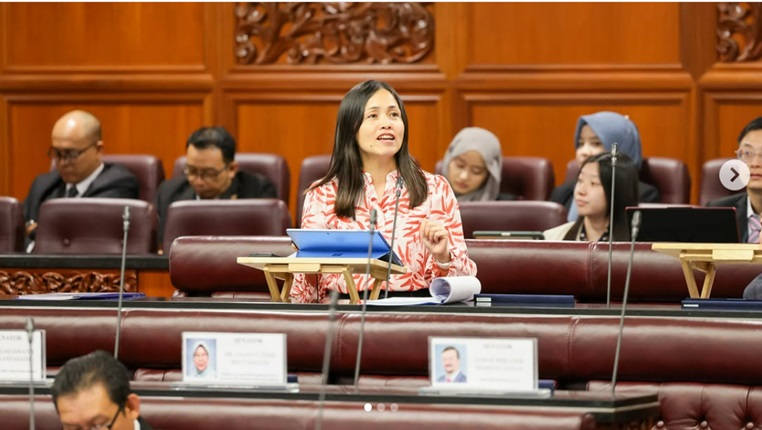
The bill, presented by Deputy Communications Minister Teo Nie Ching, was passed following a majority voice vote after being debated by eight senators. The amendments to the Bernama Act 1967 (Act 780) are the first since the Act’s inception in 1967.
Teo, in her winding-up speech, highlighted that the primary objective of the proposed amendments is to replace the term “proprietors of newspapers” with the more inclusive term “media organisations.”
This change, she explained, is in line with the government’s goal of unifying all forms of media under a single definition, enabling them to work together in disseminating information to the public.
"The main objective of this amendment is to ensure that all media, regardless of the platform they use, are recognised as media organisations, allowing them to assist the government in disseminating information," she said.
The amendment will redefine "media organisation" to include entities involved in news dissemination through various platforms, such as newspapers, radio, television, and digital media.
Teo also noted that, under the new amendment, media organisation owners from any platform will be eligible to be considered for membership on the Bernama Board of Governors, provided they are subscribers to the national news agency.
"Previously, only owners of media organisations were eligible to sit on the Bernama Board. For example, media organisations like Oriental Daily, Sin Chew Daily, and China Press, which have transitioned to digital platforms, would not have been eligible under the old definition. Similarly, Malaysiakini, despite being a Bernama subscriber, was excluded from eligibility for the Bernama Board," she said.
Additionally, Teo pointed out that Tamil-language media outlets, such as Vanakkam Malaysia, would also be eligible under the new amendments, as long as they are subscribers to Bernama.
She explained that the inclusion of digital platforms in the definition was essential for modernising the law to reflect the reality of media consumption today.
During the debate, Teo also acknowledged that the proposed amendments would not solve all the challenges facing the media industry, such as the rise of fake news.
However, she said the government has already taken steps to address this issue, including the introduction of the AI-powered chatbot AIFA (Artificial Intelligence Fact-check Assistant) by the Malaysian Communications and Multimedia Commission (MCMC) on 28 January. This tool assists the public in quickly verifying information.
"Since its launch until 23 February, AIFA has processed 57,782 messages, averaging 2,140 messages per day. In addition, under Bernama, we have the MyCheck Malaysia portal, and MCMC runs Sebenarnya.my, both of which are designed to assist with fact-checking," she said.
Teo acknowledged that addressing fake news is a complex challenge, but she emphasised the government’s ongoing efforts to tackle it, inviting further suggestions for improving the approach.
On the international front, Teo revealed that Bernama has formed partnerships with global news agencies such as Anadolu, China Media Group, and the Asia-Pacific News Agencies Network (OANA) to ensure its practices remain relevant and competitive on the international stage.
Bernama has also maintained a global presence, with correspondent bureaus established in Jakarta, Manila, Bangkok, and Singapore since the 1970s. Additionally, Teo noted that Bernama provides dedicated news coverage for the Chinese and Tamil communities in Malaysia through Mandarin and Tamil news broadcasts on Bernama TV.
"Bernama is committed to ensuring that it can provide accurate information to all segments of Malaysian society," she stated.
The Bernama Act 1967 was initially established to create a national news service that would disseminate news across the country.
Since its inception, Bernama has played a crucial role in ensuring effective communication of government policies and serving as a primary source of information for both local and international media organisations. - March 19, 2025