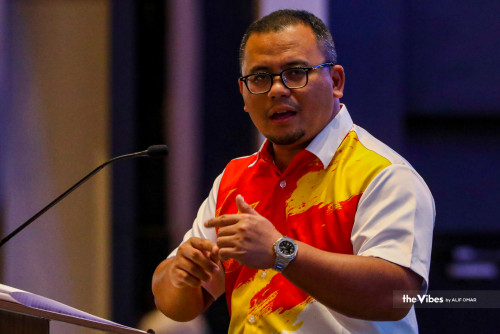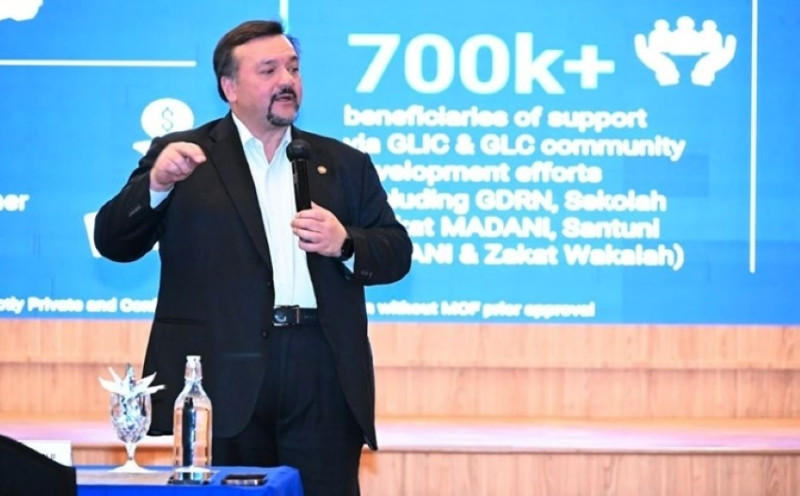
MALAYSIA is pursuing a path of fiscal consolidation, economic reform and regional collaboration to build long-term resilience and sustainable growth, Minister of Finance II Datuk Seri Amir Hamzah Azizan said in his keynote address at the Invest ASEAN–Malaysia Conference 2025 today.
“In times of great uncertainty, clarity is always in great demand,” said the Minister. “The best tool to raise clarity is conversations that are open and frank.”
ASEAN outlook and shared opportunities
Amir highlighted the strategic significance of Malaysia’s deep economic integration with ASEAN, a bloc comprising nearly 700 million people and generating over US$4 trillion in GDP. In 2024, the region accounted for 17 per cent of global foreign direct investment (FDI), attracting a record US$230 billion in inflows.
“Malaysia is fortunate to be well-integrated into the ASEAN,” he remarked, pointing to the role of agreements such as the ASEAN Comprehensive Investment Agreement (ACIA) and ASEAN Trade in Services Agreement (ATISA) in driving liberalisation, digital innovation and micro-enterprise development.
Recent regional initiatives, including the Kuala Lumpur Declaration on ASEAN 2045 and the ASEAN Economic Community (AEC) Blueprint 2025, demonstrate the bloc’s ambition to lead in green growth, inclusivity and global engagement.
Malaysia’s economic performance and tourism rebound
Malaysia’s economy is projected to expand by 4.5 to 5.5 per cent in 2025, supported by resilient domestic demand and growth in services and manufacturing. The economy grew by 4.4 per cent year-on-year in the first quarter of 2025.
Tourism has proven pivotal to post-pandemic recovery, with 25 million international arrivals recorded in 2024. Over 10 million visitors arrived in Q1 2025 alone—more than two-thirds of whom were from ASEAN member states.
“In addition to urban tourism and shopping, Malaysia is becoming a regional hub for medical tourism and international education,” he added.
Bilateral trade with ASEAN rose 6.1 per cent to RM765 billion in 2024, comprising RM437.9 billion in exports and RM327.1 billion in imports.
Johor-Singapore economic corridor and Forest City
The Johor-Singapore Special Economic Zone (JS-SEZ), launched in January 2025, is emerging as a major investment corridor. It has thus far attracted RM16.7 billion in committed investments from a pipeline of RM26.2 billion, with 439 investor enquiries registered.
The Forest City Special Financial Zone, part of JS-SEZ, is also gaining momentum as a financial hub for family offices, offering a 0 per cent tax regime for 20 years. A minimum of RM30 million in assets under management (AUM) is required during the initial 10 years, increasing to RM50 million thereafter.
“To date, over 250 enquiries have been received, and 32 companies have expressed formal interest. Two firms—CMY Capital and Yow Kee Family Office—have already received approval from the Securities Commission Malaysia,” he said.
Fiscal discipline, subsidy reform and upcoming Budget 2026
Malaysia’s fiscal deficit fell to 4.1 per cent of GDP in 2024, outperforming the official 4.3 per cent target. The government aims to reduce it further to 3.8 per cent in 2025 and achieve a medium-term goal of 3 per cent, in line with the Public Finance and Responsibility Act.
This will be achieved through revenue-enhancing measures, improved tax compliance and subsidy rationalisation. The diesel subsidy was rationalised in June 2024, with the reform of RON95 petrol subsidies set to begin in the second half of 2025.
“We must plug leakages and ensure that the wealthy contribute their fair share so that subsidies are protected for those who genuinely need them,” said the Minister.
He acknowledged concerns over the expansion of the Sales and Services Tax (SST) but assured that its implementation was carefully calibrated. “We undertook wide consultations and fine-tuned its implementation to minimise impact on SMEs and the general population.”
Industrial transformation and energy strategy
Under the Ekonomi Madani framework, the government is spearheading major industrial reforms. The New Industrial Master Plan (NIMP) 2030 has secured RM95 billion in investments over seven years, including the planned transformation of 3,000 smart factories.
The National Semiconductor Strategy (NSS), supported by US\$5.3 billion in fiscal backing, attracted RM55.8 billion in investments in 2024 alone.
The National Energy Transition Roadmap (NETR) targets renewable energy capacity of 31 per cent by 2025, 40 per cent by 2035 and 70 per cent by 2050.
Malaysia is also leading ASEAN’s first cross-border green energy grid. The pilot involves transmission of renewable power from Vietnam to Singapore via Malaysia. Future phases will expand the grid to Cambodia, Thailand, Indonesia and Sarawak.
“This is a model for regional energy cooperation and will position Malaysia as a power transit hub,” Amir stated.
Capital market development and carbon trading
Amir underscored efforts to deepen Malaysia’s capital markets and align them with sustainable development goals.
Bursa Malaysia’s Centralised Sustainability Intelligence (CSI) platform helps companies improve ESG reporting, while the Bursa Carbon Exchange (BCX) supports carbon credit trading in line with the ASEAN Common Carbon Framework.
“These platforms strengthen transparency and offer practical tools for listed companies and carbon project developers,” he said.
Looking ahead: Budget 2026 and the 13th Malaysia Plan
Budget 2026 and the 13th Malaysia Plan, to be tabled later this year, will focus on pragmatic economic continuity, strategic investments and equitable reforms.
“While it is too early to share details, I can say that it will be yet another effort in securing our economic future, responding where necessary to current economic headwinds and building a fairer, more equitable society,” he said.
He closed with a message of cautious optimism: “While some may fear what tomorrow’s headlines may bring, I am often reminded of this truth: times of great volatility are precisely when precious, fundamental opportunities make themselves clearly visible.”
“Across Malaysia and ASEAN, you will most certainly find the collaboration and cooperation needed to bring them to fruition.” - July 1, 2025