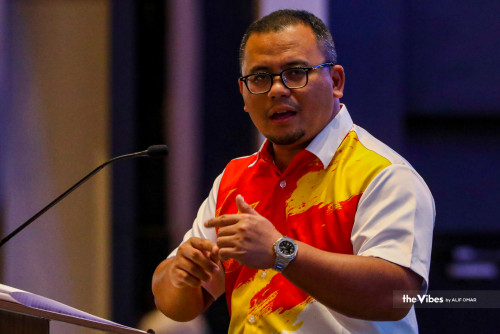
RAFIZI Ramli has announced a renewed commitment to grassroots economic reform through the promotion of social enterprises, as he repositions Ayuh Malaysia as a national platform for community-driven initiatives.
Following his departure from the federal Cabinet, the former Minister of Economy and KEADILAN vice-president said the time had come to build a sustainable “third sector” in Malaysia—comprising socially motivated enterprises that generate their own income through business activity.
“I did not begin as a politician. I began as an activist who had political awareness – that Malaysia needs to change towards a more transparent system, one that cultivates accountability, drives competition, and upholds merit in society,” Rafizi said in a statement on Tuesday.
“My objective is to see these values embedded in society and the country. Some of this must be pursued through political platforms, but part of it must also be driven from the grassroots so that these values become societal norms – especially as we know not all politicians welcome change.”
Describing his resignation from ministerial office as part of a broader transition, he said he viewed the development positively.
“I am open-hearted, even grateful, for the political circumstances within KEADILAN that led to my resignation as Minister of Economy.”
Rafizi revealed that he had already decided, even before voting began in KEADILAN’s 2025 internal elections, that his next phase of public service would be shaped by efforts to build resilient communities through social enterprise.
“A social enterprise is an entity that conducts activities to help the community, often based on a specific economic endeavour. Unlike regular businesses, a social enterprise is not profit-motivated. Its motive is service and benefit to the community.”
“Profits from social enterprises are usually returned to workers and the community, as opposed to businesses where profits are retained by owners or investors. This enables social enterprises to offer goods or services at more accessible prices.”
Rafizi noted that the concept is still relatively unfamiliar in Malaysia, where profit-making ventures dominate economic activity, while community work is typically limited to non-governmental organisations, which often rely on external funding and are prohibited from commercial operations.
“I feel compelled to galvanise efforts across the board to establish a third sector – one comprising socially-driven enterprises financed through business operations that are efficiently run and financially self-sustaining.”
He confirmed that Ayuh Malaysia, a movement first introduced in 2022, will now be repositioned as a one-stop platform to develop and support this emerging sector.
“Ayuh Malaysia will serve as a one-stop platform with the following functions: to create as many social enterprises as possible across various sectors, driven by the public; to provide expertise and support through a social enterprise and citizen network; to organise additional financial resources and oversight to ensure competitiveness and honest governance; and to connect social enterprises with target beneficiaries.”
The relaunched Ayuh Malaysia platform will be officially unveiled on 27 July 2025, with a detailed strategic plan to be outlined at the launch.
“I call on activists and ordinary citizens to join in building this network of social enterprises for the future.”
He concluded by stressing the long-term potential of social enterprise to provide stability and wellbeing for Malaysian communities, especially amid political uncertainty.
“A robust network of social enterprises in society can safeguard the continuity of economic and social welfare amid ongoing political contestation.” - July 8, 2025