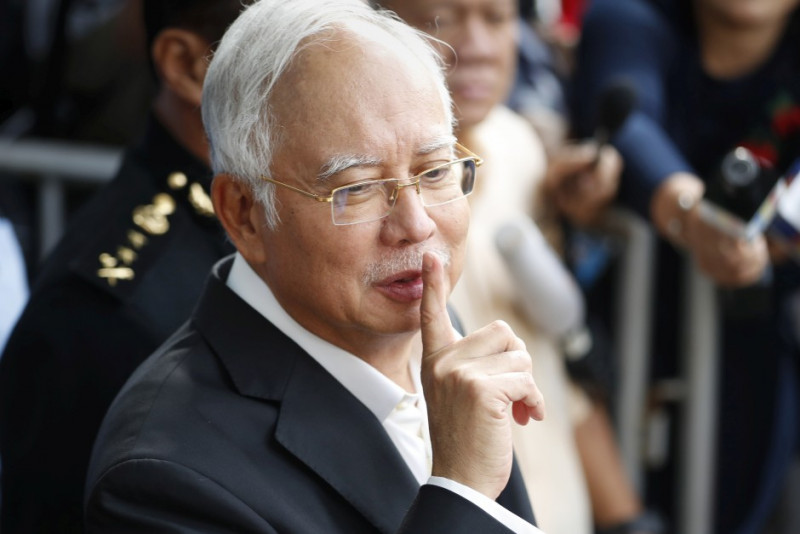
MALAYSIA’S Federal Court has reserved judgment on the Attorney General’s (AG) appeal concerning an alleged additional document purportedly authorising former prime minister Datuk Seri Najib Tun Razak to serve the remainder of his prison sentence under house arrest.
A three-judge bench, led by Chief Judge of Malaya Tan Sri Hasnah Mohammed Hashim, postponed the verdict after hearing submissions from both parties. The panel also comprised Federal Court judges Datuk Zabariah Mohd Yusof and Datuk Hanipah Farikullah.
“We will inform the parties of the date when we are ready for a decision. Thank you for all the submissions and all the authorities submitted. Court is adjourned,” said Justice Hasnah.
The appeal follows the Federal Court’s decision on 28 April to grant the AG leave to challenge a Court of Appeal ruling regarding the disputed document.
On 6 January, the appellate court, in a 2-1 majority, had ordered that Najib’s judicial review application over the alleged document be returned to the High Court for full determination—overturning an earlier High Court decision which dismissed the bid at the leave stage.
Najib is serving a six-year prison sentence following his conviction in the SRC International Sdn Bhd case, after his appeals and a review application were rejected by the apex court. In February 2023, the Pardons Board reduced his original 12-year sentence to six years and halved his fine from RM210 million to RM50 million.
During the hearing, Najib’s counsel, Tan Sri Muhammad Shafee Abdullah, argued that under judicial review principles, there was no obligation for the applicant to present the alleged document at the leave stage, particularly when the Attorney General’s Chambers (AGC) had the capacity to confirm or deny its existence.
He contended that Najib’s legal team had acted with reasonable diligence, noting that the document—obtained only after judgment—was found by Najib’s son, Datuk Mohamad Nizar, and could not be used until permission was granted by the palace.
“This restriction is crucial, as even if the document was in hand, the respondent was not legally or ethically free to use it until permission was granted. Once permission was granted on 2 December 2024, the respondent immediately filed it in court,” he said.
Senior federal counsel Shamsul Bolhassan, representing the AG, did not contest a suggestion from Justice Hasnah that the AGC had not disputed the document’s existence. However, he maintained that court procedures for introducing new evidence must be followed.
“The respondent must comply with the rules and regulations of the court to tender new evidence. We maintain our stand. We rely on our written submission and leave it to the court,” said Shamsul.
The Federal Court is expected to announce its decision at a later date. - July 9, 2025





_Datuk_Rusdi_Mohd_Isa._Facebook_pic..png)