MALAYSIA'S participation in the 2025 Shanghai Cooperation Organisation (SCO) Summit underscores the deepening relationship between Malaysia and China, according to Malaysia’s Ambassador to China, Datuk Norman Muhamad.
While Malaysia is not a member or observer state of the SCO, the nation has been invited to attend the prestigious event, reflecting both its position as ASEAN Chair this year and its close bilateral ties with China.
"Malaysia was invited for two reasons. The first is because of Malaysia’s status as ASEAN Chair this year. The second is due to the very close ties between the two nations," New Straits Times cited Norman saying at a press conference ahead of Prime Minister Datuk Seri Anwar Ibrahim’s visit to China.
This marks Anwar’s first participation in the SCO summit, a historic occasion for the country.
Anwar is also set to become the first Malaysian prime minister to attend China’s “Victory Parade” on September 3, commemorating the end of World War II. Norman viewed these milestones as a special recognition of Anwar’s leadership.
“Malaysia demonstrated its leadership ability when, as ASEAN Chair, it organised the ASEAN-Gulf Cooperation Council-China Summit in Kuala Lumpur,” Norman added, emphasising the importance of regional unity amid global political uncertainty.
He added China values Malaysia’s and ASEAN’s potential to play a significant role in strengthening inter-regional ties during turbulent times.
The four-day visit, from August 31 to September 3, will take Anwar and his senior ministers to Tianjin and Beijing.
His delegation includes Foreign Minister Datuk Seri Mohamad Hasan, Home Minister Datuk Seri Saifuddin Nasution Ismail, Transport Minister Anthony Loke, and International Trade and Industry Minister Datuk Seri Tengku Zafrul Tengku Aziz, along with his wife, Datuk Seri Dr Wan Azizah Wan Ismail.
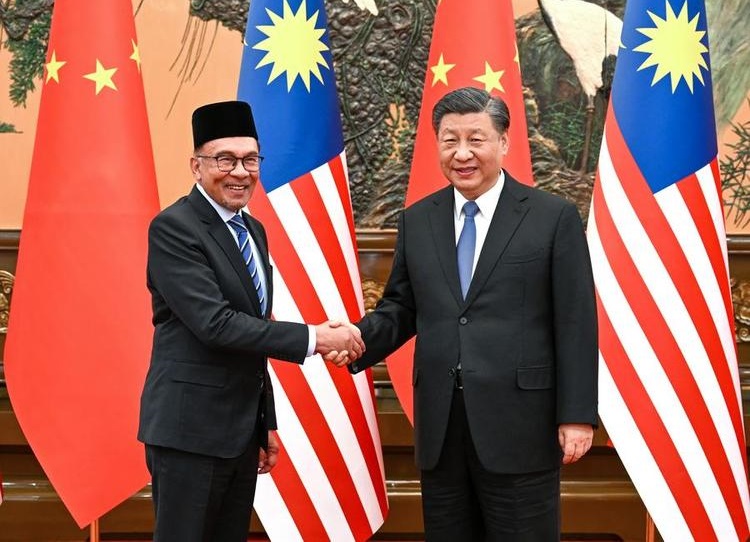
Norman highlighted that Anwar’s visit reflects the strategic relationship between Malaysia and China, with numerous high-level meetings planned, including a bilateral meeting with Chinese Premier Li Qiang and a courtesy visit to President Xi Jinping.
Anwar is also scheduled to deliver a speech at Tianjin University and engage in business dialogues with China’s industry leaders.
The SCO summit in Tianjin, held from August 31 to September 1, will be the largest in the organisation's history, with over 20 foreign leaders and 10 international heads of organisations expected.
Leaders from countries including Russia, Iran, India, Turkey, and Egypt will be present.
"The visit will solidify Malaysia’s comprehensive strategic partnership with China and further the long-standing ties between the two nations," Norman added.
SCO2025 - A Shifting Geo Political Landscape
China’s President Xi Jinping remarked, “No mountain or ocean can distance people who have shared aspirations,” a phrase he delivered in July 2024 to leaders from Shanghai Cooperation Organisation (SCO) member states and other nations in Astana, Kazakhstan.
As China prepares to host the 2025 SCO summit, expectations are high for a significantly larger gathering of leaders from across the region and beyond.
AlJazeera reported on Saturday that India’s Prime Minister Naraendra Modi will visit China for the first time since 2018, following a thaw in relations that began late last year. The change has been spurred further by U.S. President Donald Trump’s 50% tariffs on Indian goods, which have driven New Delhi to forge stronger ties with Beijing and other key Eurasian players.
As the world continues to grapple with the economic and political chaos unleashed by the U.S.-led global trade war, analysts predict that this year’s SCO summit will provide China with an opportunity to present itself as a stabilising force, capable of uniting the Global South and counterbalancing Western influence, particularly that of the United States.
China’s Assistant Foreign Minister Liu Bin described the summit as “one of China’s most important head-of-state and home-court diplomatic events this year.”
Scheduled to take place from August 31 to September 1 in Tianjin, a northern port city on the Bohai Sea, the event is expected to draw more than 20 foreign leaders and heads of 10 international organisations.
The Evolution of the SCO
Originally founded in 1996 as the “Shanghai Five” to address security concerns in Central Asia, the SCO has since evolved into a major international platform.
By 2001, it became the Shanghai Cooperation Organisation with the inclusion of Uzbekistan and the establishment of its headquarters in Beijing.
The group's expansion continued with the addition of India and Pakistan in 2017, followed by Iran in 2023 and Belarus in 2024. Today, the SCO counts 14 key dialogue partners, including Saudi Arabia, Egypt, and Turkey.
The member states of the SCO represent 43% of the global population and 23% of the world’s economy, making it a significant political and economic bloc. However, experts like Alejandro Reyes, adjunct professor at the University of Hong Kong, note that the organisation’s vision and identity remain somewhat unclear.
“While the U.S. has historically led multilateral organisations like the United Nations, the World Bank, and the IMF, the rise of economies such as China, India, Brazil, and South Africa has contributed to the diversification of multilateralism. The formation of the SCO is part of that trend, aiming to give a voice to the Global South,” Reyes explained.
The SCO’s Role in Shaping Global Multilateralism
The SCO, though originally focused on regional security, has increasingly broadened its scope to address global trade, investment, and regional cooperation.
While similar in some ways to the BRICS bloc, which includes Brazil, Russia, India, China, and South Africa, the SCO focuses on "indivisible security," a concept that aims to ensure no nation’s security comes at the expense of another. This philosophy contrasts with the North Atlantic Treaty Organisation (NATO), which follows a more bloc-based approach to collective security.
This year’s summit, amid global instability, is expected to further China’s push for multipolarity, with leaders gathering to discuss regional security, economic cooperation, and other pressing global issues.
As the geopolitical order continues to shift, the SCO is poised to become an increasingly important platform for advancing the interests of the Global South, offering a counterbalance to the influence of Western powers, particularly the United States.
BRICS, the acronym derived from the initials of the founding member countries: Brazil, Russia, India, China and South Africa, sees itself as a forum for the Global South and also discusses geopolitics, global security and trade, among other world issues.
But while the SCO emerged with a focus on regional security, the expansion of its mandate to also discuss trade and other Global South concerns means it is difficult to understand what sets the grouping apart from organisations like the BRICS, Reyes said. - August 30, 2025