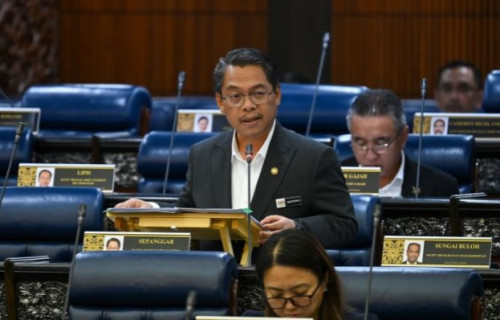
THE Government is adopting a neutral, inclusive, and strategically focused approach to ensure that companies and industries operating in the country can harness the latest AI chip technology while safeguarding national interests, Minister of Investment, Trade and Industry (MITI) Tengku Zafrul Abdul Aziz outlined in Parliament on Wednesday.
“The primary goal of the government is to ensure Malaysian-based companies and industries have controlled, competitive, and secure access to global AI chips and platforms, while maintaining national data sovereignty and safety standards,” the minister said in response to Segamat MP Tuan Yuneswaran Ramaraj, who had asked about strategies for using AI chips developed by major economic blocs such as the United States (NVIDIA) and China (Huawei Ascend).
Key measures being implemented under the National Semiconductor Strategic Plan and the national digital transformation agenda include a layered regulatory framework, investment in domestic technological capabilities, and international collaboration.
The minister explained that the government has enacted the Strategic Trade Act 2010, requiring permits for the export, transit, and transfer of AI chips to ensure safe and transparent trade and to protect Malaysia’s domestic AI industry.
In terms of infrastructure and local capability, MITI is actively strengthening data centres, high-performance networks, and research and development capacity for integrated circuit design.
Malaysia’s “Silicon Vision” initiative focuses on developing locally designed AI chips, while strategic partnerships with global firms such as ARM Limited facilitate access to intellectual property that accelerates domestic AI chip development.
“Local automation companies such as Greatech, Vitrox, and Pentamaster have begun integrating AI into their products, demonstrating Malaysia’s capacity to contribute to the global semiconductor and AI value chain,” Tengku Zafrul noted.
On the international front, Malaysia maintains strategic engagement with global technology firms and trading partners to enhance market access and technology transfer.
Negotiations are ongoing for a reciprocal trade agreement with the United States, while the 2022 Memorandum of Cooperation on Resilient Semiconductor Supply Chains with the United States remains in force until 2026.
Tengku Zafrul added that all AI products undergo layered regulatory and technical assessment before being deployed in critical systems, including approval mechanisms and risk evaluation by national cybersecurity agencies.
The government is also implementing a “Sovereignty in AI” policy that emphasises local capability development alongside strict technical controls.
“This integrated strategy allows Malaysia to benefit from global AI technology while ensuring national security, governance, and strategic interests are preserved,” he said.
Through this approach, Malaysian companies can access international AI chips openly while simultaneously enhancing domestic technological resilience, fostering local innovation, and accelerating the nation’s digital transformation. - November 26, 2025




.jpeg)