



THE Ministry of Education (MOE) is adopting a cautious approach in making any decisions regarding school operations while the country faces the haze situation.
Minister Datuk Seri Fadhlina Sidek said this follows the expressions of concern by the Yang di-Pertuan Agong, Sultan Ibrahim, regarding the safety and health of students in light of the ongoing haze.
"We have chosen to be extra cautious (in making any decisions) because those we aim to protect are our own children.
"I have noticed many asking: why were schools previously closed when the Air Pollutant Index (API) readings were still low, yet now we have to wait until it reaches 200?
"When Sultan Ibrahim expressed concern regarding the haze situation, we certainly took the matter seriously," she stated in a Facebook post today.
Fadhlina noted that following the decision to close schools, she has been reading various perspectives from parents.
"Some have requested that schools be closed for a week. Others are worried that their children will fall further behind in their studies.
“There are also those who are struggling because they still have to go to work, yet schools have suddenly closed, leaving them with no one to look after their children at home.
"Every family faces its own unique challenges, and every opinion offered is rooted in a specific reason.
“However, when making a decision that affects millions of children, there are matters that must be considered with great seriousness," she said.
Fadhlina explained that the issue of the haze extends beyond the simple question of whether schools should remain open or closed.
The Ministry of Education (MOE) must take into account public health, air quality, and how the nation manages such disasters.
"The MOE’s primary domain is education. For health-related matters, we have the Ministry of Health (MOH).
“For information on air quality, we have the Department of Environment (DOE), and for disaster management, we have the National Disaster Management Agency (NADMA).
"Each of these agencies possesses its own specific expertise and responsibilities.
“That is why I have reconvened these relevant agencies to sit down together; we need to re-examine our decision by seeking input from those with greater expertise in these areas," she said.
The National Haze Action Plan
She added that during these discussions, the MOE took into account NADMA’s view that the national response to the haze should be guided by the National Haze Action Plan (PTJK).
"After considering the views of the relevant agencies, the MOE has decided to revert to the protocols established within the PTJK.
"Some might ask: why follow this plan? Why not simply maintain a lower Air Pollutant Index (API) threshold?" Isn't it the case that the lower the level, the safer it is?
"I understand that logic. After all, an API (Air Pollutant Index) reading of 150 already falls into the 'unhealthy' category. Parents' concerns at this level are certainly well-founded," she said.
Fadhlina noted, however, that there is an important point to understand: in managing haze situations, specific actions are required for each range of API readings.
"We cannot assume that every level of risk necessitates the same response. For instance, once the API exceeds 100, all outdoor activities are halted. Children are not required to go outside for sports or other activities on the field.
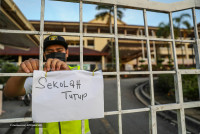
"This measure is intended to reduce exposure to the haze, even though some health risk remains. When the API reaches 200, schools are closed immediately.
"Not all children have the same health status. Some suffer from asthma, others have respiratory issues, and some are simply more susceptible to the effects of the haze.
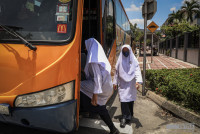
"For this reason, we have introduced an additional provision: if parents feel that the haze conditions could compromise their child's health, they are permitted to keep their child home from school—they simply need to notify the school authorities.
"I know that for parents, their children's health is non-negotiable. I share that view," she said.
She added, however, that there is also a responsibility to ensure that children do not continue to lose out on valuable learning time. – October 15, 2026





.jpeg)





