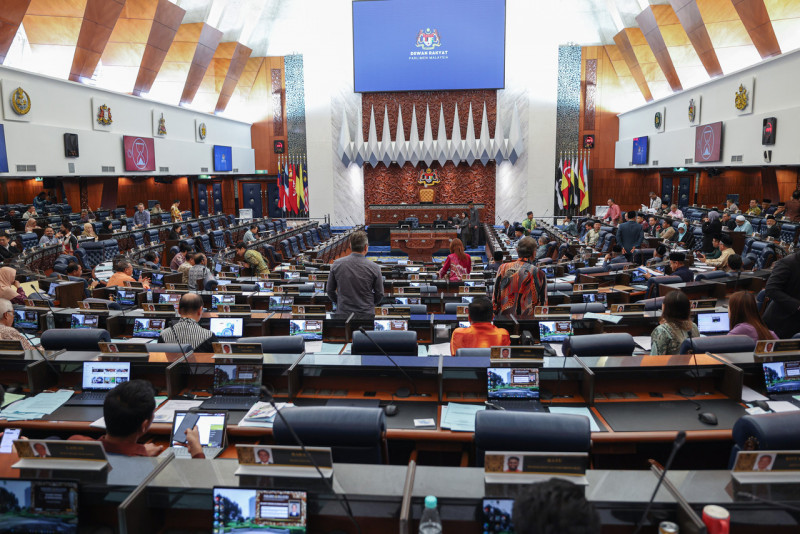
MALAYSIA’S parliamentary landscape this year paints a tale of contrasts, with some MPs attending every sitting while a few senior leaders remain chronically absent.
Analysis by the New Straits Times (NST) of the Dewan Rakyat’s 78-day schedule, drawn from official Hansard records, highlights the growing disparity between committed lawmakers and those whose presence was largely symbolic.
Former Defence Minister Datuk Seri Hishammuddin Hussein recorded the lowest attendance, missing 69 sittings and registering only an 11.5 per cent turnout.
PAS President Tan Sri Abdul Hadi Awang followed closely with 65 absences, while Parti Warisan President Datuk Seri Mohd Shafie Apdal was absent for 60 sittings, maintaining just a 23.1 per cent attendance rate.
NST’s attempts to secure comment from the trio saw Hishammuddin remain silent, Hadi referring inquiries to the Dewan Rakyat Speaker’s office, and Mohd Shafie declining to respond.
Lawmakers are entitled to an allowance of RM400 per sitting, though some absences, including 11 of Hadi’s, were formally notified under Standing Order 91, requiring prior notification to the Dewan Rakyat secretary.
Article 52 of the Federal Constitution permits the declaration of a vacant seat if an MP is absent without permission for six months. MPs on leave are barred from parliamentary participation during this period.
Yet attendance cannot be measured solely by presence. Parliamentary duties often overlap with select committee meetings, constituency obligations, ministerial roles, party functions, and overseas engagements, pulling MPs away from the chamber.
Attention to attendance intensified post-Covid-19, particularly when low turnout drew criticism, including a 2024 instance when the Dewan Rakyat failed to meet quorum, forcing a sitting to be postponed.
This year saw a shift as 46 MPs achieved perfect attendance, predominantly from the opposition. Perikatan Nasional led this cohort with 26 MPs attending every sitting, compared with 17 from the unity government, two from the broader opposition bloc, and one from Muda.
Among those present throughout the year were Syed Saddiq Syed Abdul Rahman, Syerleena Abdul Rashid, Young Syefura Othman, Teresa Kok, Datuk Mohd Isam Mohd Isa, Datuk Dr Alias Razak, and Dr Siti Mastura Muhammad.
Several Kuala Lumpur-based ministers maintained high attendance despite demanding schedules. Plantation and Commodities Minister Datuk Seri Johari Abdul Ghani and Youth and Sports Minister Hannah Yeoh missed only two days each, while Digital Minister Gobind Singh Deo recorded ten absences.
Among deputy ministers, Datuk Aiman Athirah Sabu, Akmal Nasrullah Mohd Nasir, and Datuk Seri Dr Noraini Ahmad posted one, two, and three absences respectively.
Party performance varied considerably. Pakatan Harapan had 51 MPs attending at least 75 per cent of sittings, Barisan Nasional nine, Gabungan Parti Sarawak ten, Gabungan Rakyat Sabah one, and Parti Bangsa Malaysia’s sole MP also met the threshold.
PAS recorded 41 MPs present on at least 59 days, Bersatu 20, and Muda’s sole MP achieved strong attendance.
Former prime ministers Datuk Seri Ismail Sabri Yaakob and Tan Sri Muhyiddin Yassin were mid-range with 29 absences each, while Opposition Leader Datuk Seri Hamzah Zainudin missed 20, recording a 74.4 per cent attendance rate. Chief Whip Datuk Seri Takiyuddin Hassan registered only one absence.
Not all absences were voluntary. The Hansard records show Datuk Awang Hashim served a 15-day suspension and Datuk Dr Ahmad Marzuk Shaary a two-day suspension.
Calls for transparency have intensified. Muhammad Faisal Abdul Aziz, chairman of the Coalition for Clean and Fair Elections (Bersih), urged that attendance records and reasons for absence be published ahead of every general election.
“Those who could not participate due to commitments, for example executive tasks, must have these reasons clearly stated. Public disclosure is important.”
Universiti Malaya socio-political analyst Datuk Prof Dr Awang Azman Awang Pawi advocated for stricter enforcement, suggesting that attendance be used as a formal key performance indicator.
“Public trust is fragile. When voters see their MP absent for most of the year, the perception is clear: ‘they do not represent us’. MPs who are frequently absent risk being seen as overpaid and underperforming, reinforcing cynicism towards institutions.”
Awang Azman said that while high attendance among younger opposition MPs signals professionalism, chronic absenteeism among senior politicians reflects reliance on reputation over active legislative duty.
He proposed measures including automatic salary deductions, mandatory quarterly public disclosure, and rules to vacate seats for habitual absenteeism, citing practices in Australia and Ghana.
Dr Syaza Shukri, associate professor of political science at the International Islamic University Malaysia, described strong opposition attendance as a positive sign of maturing parliamentary culture.
She noted, however, that absenteeism diminishes debate quality and reduces the diversity of viewpoints essential for democracy, although many voters assess trust by leaders’ visibility on the ground rather than in Parliament.
Deputy Speaker Alice Lau emphasised that attendance alone is not a sufficient measure of performance, but remains a basic indicator of commitment.
“For next year’s sitting, it is my wish to see a Parliament of Malaysia par excellence… respected not only nationwide, but also worldwide,” she told NST. Lau called on MPs to contribute meaningfully in debates, participate actively in select committees, and balance legislative duties with constituency representation.
She added, “Parliamentarians are primarily tasked with making laws, and therefore greater attention must be given to their legislative duty. They must bear in mind that they are accountable to the voters. Chronic absenteeism conveys that accountability is selective, activated only when political gain is at stake.”
This year’s attendance records illustrate a Parliament in transition: a chamber where professionalism and diligence coexist alongside absenteeism, provoking reflection on the responsibilities, accountability, and conduct of Malaysia’s elected representatives. - December 7, 2025