SEVENTY-SEVEN Malaysians located in Nepal and Tibet have been brought to Kathmandu for repatriation, while efforts continue to locate 55 others who remain unaccounted for following devastating floods and landslides.
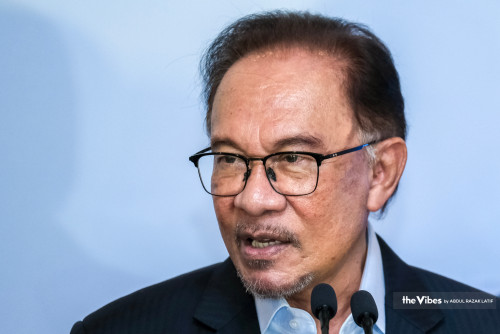
Communications Minister Datuk Seri Fahmi Fadzil said Foreign Minister Datuk Seri Mohamad Hasan had provided the latest figures during the Cabinet’s weekly meeting. “The Foreign Minister (Datuk Seri Mohamad Hasan) informed that there are 55 Malaysian citizens who have yet to be located, while 77 Malaysians have been identified in Tibet and Nepal.
“They have been brought to Kathmandu for the repatriation process, to be brought home and return to Malaysia,” he said at his weekly press conference in Putrajaya today.
The repatriation effort comes as Nepal continues to grapple with the aftermath of the disaster, which has killed more than 1,000 people and left authorities struggling to manage hundreds of recovered bodies.
In the worst-hit areas, bodies have been swept downstream along the Trishuli and Narayani rivers, making identification particularly difficult as many victims were recovered without clothing, identification documents or other distinguishing belongings.
Nepali authorities have established temporary identification centres where relatives can examine photographs of recovered bodies, while DNA and other forensic samples are being collected from unidentified victims before they are temporarily buried.
The records and samples are being retained so that bodies can be exhumed if subsequent testing establishes a match with relatives.
Meanwhile, Fahmi said the Cabinet had taken note of Prime Minister Anwar Ibrahim’s approval of a US$1 million contribution towards humanitarian efforts in Nepal.
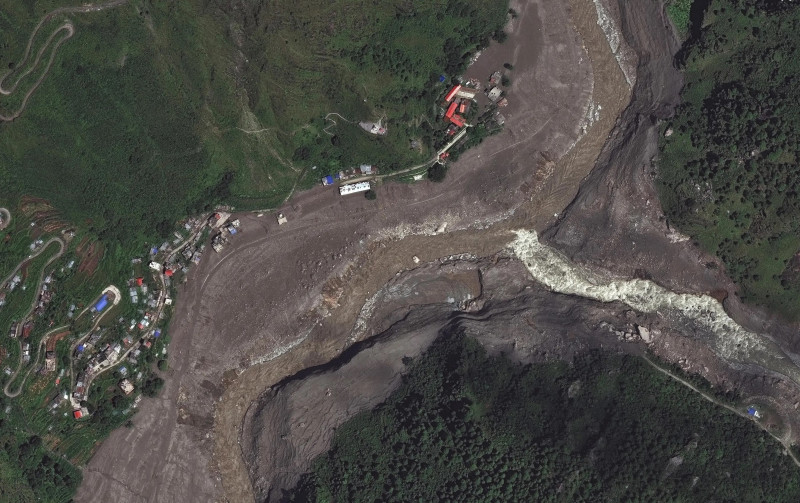
The floods and landslides on Aug 26 devastated parts of northern Nepal and Tibet, destroying homes, roads and bridges and leaving thousands of families searching for missing relatives.
The sharper angle is the scale of the identification breakdown and the emergency forensic system Nepal is now using: hundreds of bodies are overwhelming morgues, forcing authorities to photograph, DNA-test and temporarily bury victims so they can still be identified later.
Nepal Turns to DNA, Temporary Burial as Flood Victim Identification Crisis Deepens
Nepal has begun temporarily burying hundreds of unidentified flood victims after morgues and hospitals ran out of capacity, with authorities collecting DNA and forensic samples to preserve the possibility of identifying the dead later.
The emergency procedure, being used for the first time in Nepal, follows the devastating Aug 26 floods and landslides that swept through northern Nepal and Tibet, killing more than 1,000 people and leaving families desperate for news of missing relatives.
In Bharatpur, the largest city in Chitwan district, photographs of recovered bodies are displayed at a temporary identification centre, where families search for distinguishing features that could confirm the fate of their loved ones.
Among them was 18-year-old Biresh Kumar Sah, who travelled from Siraha district on Aug 30 to search for his missing father and younger brother. The two are presumed to have died after a school in Betrawati, Nuwakot district, was swept away by a mudslide along the Trishuli River.
Sah studied images of swollen and mutilated bodies recovered from the rivers but could not identify either relative.
“Whatever little hope I had, that too has gone now,” he said.
Nearly 300 bodies have been recovered along the Trishuli and Narayani rivers in Chitwan, with more being brought downstream each day from badly affected districts including Rasuwa and Nuwakot.
Some bodies have travelled as far as India, further complicating efforts to establish their identities and reunite them with their families. Many of the victims are difficult to identify because they have been swept far from their home districts and recovered without clothing, jewellery, identity documents or other belongings.
The scale of the recovery has also overwhelmed existing facilities.
Bharatpur morgues reached capacity, prompting authorities to use a derelict government building as a temporary holding centre. Air-conditioners and dry ice were brought in, but officials struggled to keep temperatures low enough to slow decomposition.
Nepal Police inspector Anil Thapa said the condition of the bodies was making the situation increasingly difficult. “Bodies are decomposing and it is very difficult to keep them in the holding centre or hospitals because the smell from the bodies ends up going… into the society, to the community.”
On Aug 30, 103 bodies were being held at the Bharatpur centre before they were cleared later that evening.
Authorities have since adopted a structured nine-step process for unidentified victims, involving profiling, photographs, geolocation, documentation of distinguishing marks and passports where available, post-mortems, family identification and the collection of fingerprints, DNA and other forensic samples.
The remains are then placed in body bags and temporarily buried at designated sites, with identification numbers recorded so they can be located and exhumed if a DNA match is established.
At a site in Devghat, 199 bodies had already been placed under the soil by Aug 30, while identification tags had reached 291. The burial site can accommodate up to 500 bodies.
Thapa said even photographing the remains could be traumatic and technically difficult.
“It is very difficult to see, very difficult to manage, very difficult to take photographs,” he said.
“Even the (civil) photographers we have sought support from are not able to click more than five or six photos.”
Forensic expert Suraj Sharma said DNA samples could still be obtained from teeth or bones when bodies were recovered without heads.
The temporary burial system has nevertheless raised concerns in Nepal, where the predominantly Hindu population traditionally cremates the dead. Families of foreign victims have also expressed concerns about recovering their relatives’ remains.
Humanitarian worker Ajay Uprety said the decision reflected the urgency created by the sheer number and condition of the bodies.
“The bodies being pulled out now have been exposed to water and would be decomposing fast because of bacterial infections. Moreover, people’s bodies have travelled far from their home districts, so the relatives are not around to identify them,” he said.
Deepak Chapagain of Volunteer Corps Nepal said hospitals and morgues did not have sufficient cold-storage capacity to cope with the influx. “So, we are sending them to specific areas, where the Nepal police and army follow a nine-step process to collect DNA and details before temporarily putting them under the soil,” he said.
The recovery operation has also exposed the human cost of a disaster in which many victims were stripped of the personal items that could have helped identify them. - September 2, 2026