REJECTION, jealousy and pent-up resentment can become powerful triggers for violence among teenagers when they lack the emotional maturity to cope with difficult emotions, according to criminologist Dr Zalmizy Hussin.
The Universiti Utara Malaysia academic said incidents involving young people were often not the result of one isolated factor, but could follow a build-up of emotions that remained hidden from those around them.
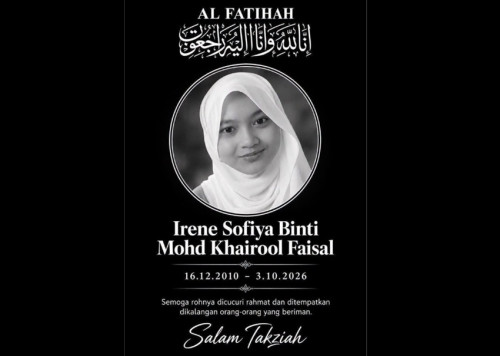
His comments come amid public discussion over the death of 16-year-old student Irene Sofiya Mohd Khairool Faisal, who was found dead at a secondary school in Yong Peng, Batu Pahat, on Saturday.
A post-mortem found that Irene Sofiya died from traumatic head injuries caused by a blunt object.
Bukit Aman Criminal Investigation Department director Datuk M Kumar said police were conducting a thorough investigation and had given an assurance that no facts would be concealed.
Police arrested a 16-year-old boy on the day Irene Sofiya was found dead. He was subsequently remanded for six days from Oct 4 to 9.
The case is being investigated under Section 302 of the Penal Code for murder.
Police have also urged the public to refrain from spreading unverified information or speculating about the circumstances surrounding the case.
Classmates have meanwhile disputed claims circulating on social media that Irene Sofiya and the boy were romantically involved.
One student said the pair were classmates but were rarely seen together and that there had been no indication at school that they were dating or had feelings for each other.

Another student described Irene Sofiya as a good student and said she had been considered for a student award.
Zalmizy said that while motives such as rejected love, jealousy and resentment did occur in cases involving adolescents, it was important not to assume any particular motive before investigators had established the facts.
From a criminological perspective, he said teenagers were still developing the ability to manage feelings such as anger, jealousy, shame and rejection.
“When they are rejected or feel humiliated in front of their friends, they may feel as though their world has fallen apart.
“They may not know how to deal with that disappointment healthily,” he said.
Zalmizy said the tendency among young people to keep their feelings to themselves could make matters worse.
Children were often encouraged to be strong and not complain, he said, but emotions left unaddressed could turn into resentment over time.
“This is what I would describe as accumulated pressure. When that pressure builds up, a seemingly small incident can become the trigger for a much bigger reaction,” he said.
He said another challenge was that many teenagers might have plenty of friends online but still lack someone they could speak to openly in person.
“They may have a phone full of friends on social media, but no one they feel they can talk to without being judged,” he said.
Zalmizy said schools and teachers, while having an important role in identifying problems, could not reasonably be expected to detect every change in a student’s emotional state.
Teachers were already dealing with large classes, demanding syllabuses and administrative responsibilities, he said.
“It is not realistic to expect a teacher to pick up every subtle emotional change among 40 students in a classroom.
“Some conflicts may also begin outside school, including through WhatsApp or social media late at night,” he said.
He said the focus therefore needed to shift towards prevention and early intervention rather than waiting until something happened before action was taken.
At home, parents should give children space to talk about their problems without immediately judging or punishing them.
They should also be alert to changes in behaviour, including a child suddenly withdrawing, refusing to attend school or becoming unusually preoccupied with their phone.
At school, counselling should also be treated as part of normal student development rather than something reserved for those already regarded as having problems.
“Counselling is not only for students who have problems. It should be a place where all students learn to manage their emotions,” he said.
Zalmizy also called for stronger peer-support programmes, allowing students to recognise signs that a friend may be struggling and alert a teacher or counsellor when necessary.
He said emotional and digital literacy should also be taught from an early age, including how to deal with rejection, anger and conflict without resorting to violence.
“Children need to understand that rejection is part of life, that being rejected does not diminish their worth, and that anger must be dealt with in the right way.
“Prevention is not simply about putting up more CCTV cameras. It is about making sure every child has someone to turn to and somewhere to be heard before they reach that point,” he said. – October 5, 2026