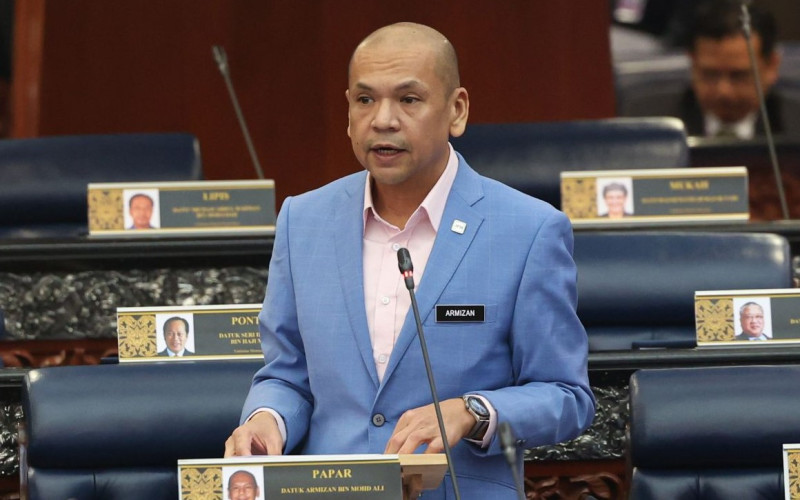
THE government's RAHMAH MADANI Sales Programme (PJRM) will continue as a cost-of-living intervention based on prevailing needs, but should not be regarded as a standalone long-term solution to rising household expenses, said Domestic Trade and Cost of Living Minister Datuk Armizan Mohd Ali.
He said the programme was part of the broader Payung RAHMAH initiative, which provides direct benefits to consumers through access to essential goods at prices below prevailing local market rates.
The initiative is implemented through strategic partnerships between the government and players in the retail sector.
Armizan said the programme's frequency had been progressively increased in response to public needs, from twice a month in each state constituency in 2025 to three times a month in early 2026.
It was further expanded to four times monthly from May 2026.
"The increase in frequency shows that PJRM remains relevant as a government intervention instrument to help ease household spending pressures," he said in a written parliamentary reply published on Parliament's website.
He was responding to Datuk Dr Richard Rapu @ Aman Anak Begri (GPS-Berong), who sought clarification on the programme's long-term effectiveness and sustainability as a permanent policy or temporary market intervention, as well as its implications for the profit margins of small retailers.
Armizan stressed that addressing the cost of living required a more comprehensive approach and could not rely solely on price interventions.
Through the National Cost of Living Action Council (NACCOL), he said, the government was also focusing on long-term strategies to address underlying cost-of-living factors, including efforts to increase household incomes and strengthen people's economic capacity.
He said improving living standards required not only reducing household expenditure but also enhancing people's ability to generate sustainable incomes.
On concerns that PJRM could affect the profit margins of small retailers, Armizan said the government took into account the interests and sustainability of industry players when designing the programme.
He said implementation involved retail partners ranging from hypermarkets and supermarkets to mini-markets, grocery shops and cooperatives.
"This approach enables goods to be offered to consumers at lower prices without making those reductions a fixed market price that retailers must bear continuously.
"Therefore, PJRM is not intended to squeeze retailers' profit margins or create unhealthy price competition, but rather to serve as a government intervention mechanism implemented in collaboration with industry players," he said.
Armizan said the Domestic Trade and Cost of Living Ministry (KPDN) would continue reviewing the programme's implementation to balance consumer assistance with the need to ensure the retail sector, including small businesses, remained viable.
He reiterated that PJRM would continue according to prevailing needs, alongside broader NACCOL strategies to strengthen household incomes and economic resilience. - November 24, 2026