WHEN most Malaysians think of corruption, the images that come to mind are inflated government contracts, political patronage, abuse of power by elected officials, and the occasional high-profile court case that seems to move at a glacial pace or end with unexpected leniency.
Those are real problems. Yet the reach of corruption and organised crime is far wider. Recent cases involving the Royal Malaysian Air Force (RMAF) and Malaysia Airlines (MAS) infrastructure show how state and government-linked company (GLC) assets can be exploited to move large quantities of narcotics for criminal syndicates.
The latest RMAF drug bust
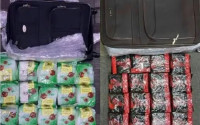
In mid-November 2026, a routine inspection of luggage scheduled to be loaded onto an RMAF aircraft at Subang Air Base uncovered five plastic-wrapped bags and a box that lacked the required security screening stickers.
Inside were 96.64 kilograms of methamphetamine, amphetamine and MDMA, valued at approximately RM4.83 million, along with nearly 7 kilograms of chemical liquid.
The discovery, made on 17 November, triggered immediate action by RMAF personnel and the Bukit Aman Narcotics Crime Investigation Department (NCID).
Police and military investigators say a cross-border syndicate had been using military aviation facilities to move drugs from Peninsular Malaysia to Sabah, which then served as a transit point for further distribution to Indonesia and the Philippines. The network is believed to have been active since at least July 2026.
By exploiting RMAF transport flights, the operators sought to bypass the stricter screening and checks that apply at civilian airports.
Five RMAF officers, reported to be pilots holding the ranks of lieutenant and captain, were among the initial 11 people arrested in operations across the Klang Valley and Labuan. Six civilians, including two alleged coordinators, were also detained.
Two more RMAF personnel, a corporal and a warrant officer II, were later arrested at the Tawau base in Sabah, bringing the total number of air force personnel held to seven and the overall number of suspects to 13.
Police continue to search for a Malaysian believed to be the syndicate’s mastermind. Defence Minister Mohamed Datuk Seri Khaled Nordin and RMAF chief General Tan Sri Muhamad Norazlan Aris have both stated that the force will not tolerate such misconduct and that internal inspections are being intensified.
The case is particularly damaging because it involves the very institution charged with defending the nation’s airspace.
When military assets and personnel are allegedly co-opted for drug trafficking, it raises serious questions about internal controls, vetting, and the effectiveness of existing security protocols at air bases.
The MAS pilot case in Jakarta
Only a few months earlier, in late July 2026, Indonesian authorities at Soekarno-Hatta International Airport in Jakarta arrested a 39-year-old Malaysian pilot linked to Malaysia Airlines.
The pilot, identified by the initials MS or MSBO, had arrived on a flight from Kuala Lumpur (MH727).
He was travelling in the cockpit jump seat as an observer rather than as the operating pilot.
Customs officers became suspicious during X-ray screening of his luggage and found approximately 25 kilograms of ecstasy (more than 70,000 tablets) and a small quantity of methamphetamine.
The haul was valued in the tens of millions of ringgit.
Indonesian investigators said the pilot had been promised RM50,000 to transport the drugs and that he was to check into a hotel in Jakarta for a later handover.
A urine test returned positive for methamphetamine, MDMA and cocaine. He reportedly admitted to previous smuggling runs, including one to Sabah and another involving several kilograms of methamphetamine to Jakarta.
Follow-up investigations in Malaysia led to the arrest of several alleged accomplices, including another pilot linked to money flows from the syndicate.
Bank accounts and assets were frozen as part of the probe.
The case highlighted how commercial aviation routes and the relative ease with which crew and jump-seat passengers can sometimes move through airports can be abused by organised crime.
Malaysia Airlines is a major national carrier with significant government-linked ownership and influence.
When one of its pilots is caught moving large quantities of narcotics, the reputational and security implications extend beyond a single individual.
A wider pattern
These two episodes are dramatic because they involve uniformed military personnel and a commercial pilot operating within GLC-linked aviation infrastructure.
They are not isolated. They illustrate how organised crime looks for vulnerabilities inside trusted institutions — places with privileged access, reduced civilian scrutiny, and the ability to move goods across borders with less interference.
Corruption in Malaysia is not confined to the classic forms of political kickbacks or contract-rigging.
It also appears when state or state-linked assets and personnel become tools for criminal enterprises.
The RMAF and MAS cases are among the more visible examples that have reached public attention.
The deeper problem is the extent to which organised syndicates can find willing or compromised individuals inside government institutions and GLCs, and the degree to which internal safeguards fail to prevent it.
Until accountability, internal integrity systems, and inter-agency enforcement become consistently rigorous, rather than reactive to scandals that make the headlines, such exploitation will continue.
The public sees only the cases that surface. The full scale of activity that remains undetected is, by definition, harder to measure, yet the pattern is clear enough. – November 24, 2026